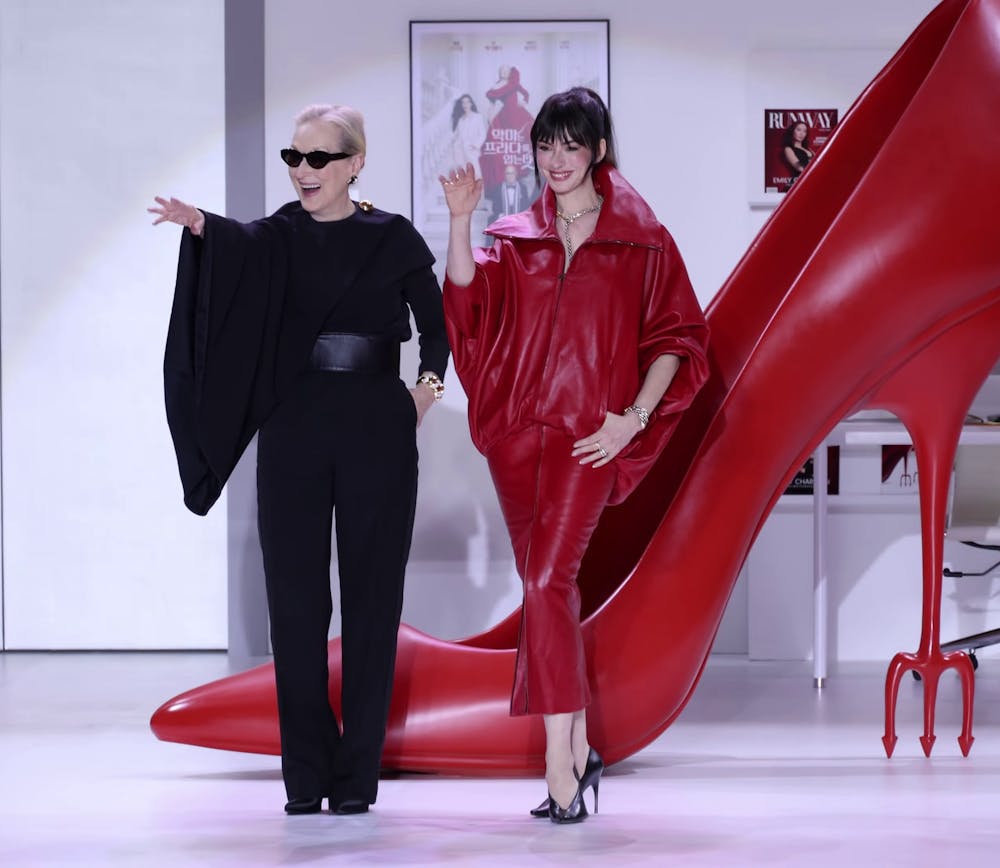
Twenty years following the original film’s release in 2006, “The Devil Wears Prada” recently returned with a highly anticipated sequel. The reappearance of Anne Hathaway, Emily Blunt and Meryl Streep — which marks Streep’s first main cast role in a sequel to date — set high expectations for the film. The film follows a journalistic shift from print to digital manifesting in the fictional magazine Runway, addressing the similar real-life media issues that arose in the decades since the first film. Simultaneously, the sequel had high expectations to meet in carrying on the original comedy drama’s legacy and surviving the unofficial cinematic sequel curse.
Shot on location in New York City, the film opens with a 2000’s-esque montage following the existing protagonist Andrea or “Andy” Sachs, played by Anne Hathaway, who works as a newspaper reporter. However, after being abruptly fired via text, she takes a job as features editor at Runway to control the damage from their latest politically incorrect article. Sachs’ new role not only sets the stage for the ensuing plot but also introduces the modern-day journalistic topics that underscore a two-hour runtime.
At first, Runway’s Editor-in-Chief Miranda Priestly, played by Meryl Streep, fails to remember Sachs’ stint as her assistant — and therefore the entirety of the 2006 film — showcasing her unscathed, harsh demeanor that resulted in some of the most quotable moments in pop culture. There are many nods to the original film woven throughout the sequel, though some are a bit on the nose, such as the “Spring Florals” Met Gala theme or the unforgettable cerulean sweater.
Expectedly, Sachs quickly struggles to balance journalistic integrity with the glamorous topics expected from fashion magazines. Runway’s challenge here ironically mirrors one the film itself faces as well, as Director David Frankel dilutes the drama’s social commentary by introducing a dull romantic subplot between Sachs and Peter, played by Patrick Brammall. Unfortunately for Sachs, she fails to break her pattern of career-disrupting boyfriends here, even 20 years after the first film’s romantic plots.
On top of the numerous callbacks, there are a variety of celebrity cameos, from designers such as Donatella Versace to popular influencers like Amelia Dimoldenberg and even New York’s very own Karl-Anthony Towns. While satisfying for viewers tapped into pop culture — or basketball — these ultimately dampen the film by feeling reminiscent of something more akin to a Super Bowl commercial rather than a future Oscar winner.
Another of the film’s overarching conflicts occurs when Runway becomes vulnerable to purchase by tech-giants who threaten to completely alter the magazine’s dynamic. The potential acquisition is merely one of the various points of friction throughout the film duration. In what seems like an attempt to sophisticate the film, Frankel winds up taking the audience through one too many convoluted narrative journeys, detracting from the central premise regarding the decline of print magazines.
Nevertheless, the sequel remains just as visually glamorous as the first, with experimental outfits and breathtaking scenery. Andy’s outfits are intentionally more mature, now becoming an elevated version of her old style that signifies her newfound confidence. Priestley and Emily Blunt’s Emily Charlton, who now works as an executive for Dior, both sport designer-only looks that are just a touch more millennial than necessary.
When Runway takes the leading crew to Milan Fashion Week, Frankel delves into nostalgic character dynamics, providing audiences with heart-warming scenes between Sachs and the irreplaceable Nigel, played by Stanley Tucci. Charlton stays sharp and witty while Priestly undergoes more character development. The 2026 film reveals Priestly’s vulnerabilities with the looming threat of old age and retirement, culminating in an emotional scene between her and Sachs. Through these interactions, the sequel basks in crowd-pleasing but hollow appeals to nostalgia — which proves as a hard task when the original cast has barely seemed to age.
The film additionally makes some relevant, albeit surface-level, comments around women’s social issues particularly regarding female roles in the workplace. After all, the conflict hinges on each character’s desire to further their respective careers. Streep delivers another strong performance as Priestly, where she confides in Sachs about her love for her journalistic career, countering the common societal narrative of retirement being expected at a certain age.
Fundamentally, the sequel may satisfy audiences by staying true to the first film in many respects, though it leaves room for improvement in carving out its own identity. Its ending harbors a cleanliness typically associated with a light-hearted comedy, wrapping up the film with all loose ends neatly tied. While there was no official exigence for a sequel following the 2006 film, “The Devil Wears Prada 2” is an entertaining picture that aims to spark conversation regarding contemporary issues within media.
Read More

Writer’s Eye brings vivid ekphrastic writing and reflective art education to the Charlottesville community
By Cecilia Sherman | 7 hours agoThis fall marks the 40th annual Writer’s Eye competition presented by the Fralin Museum of Art at the University.

On Repeat: Throwback songs for a killer fall playlist
By Madeline Unkel | 7 hours agoFrom psychedelic rock to post-punk, these four throwbacks sound as though they could have been pulled straight from a cult classic horror film, bringing that same sense of suspense to the season without relying on traditional Halloween hits.

The Hooligans break down barriers for student dancers
By Kelsey McIntyre | Yesterday“People dancing is an expression of togetherness because ... music helps bind us, and dancing is an expression of emotion and a way of communication,” Oliver said. “That's why people do it in a dance circle.”