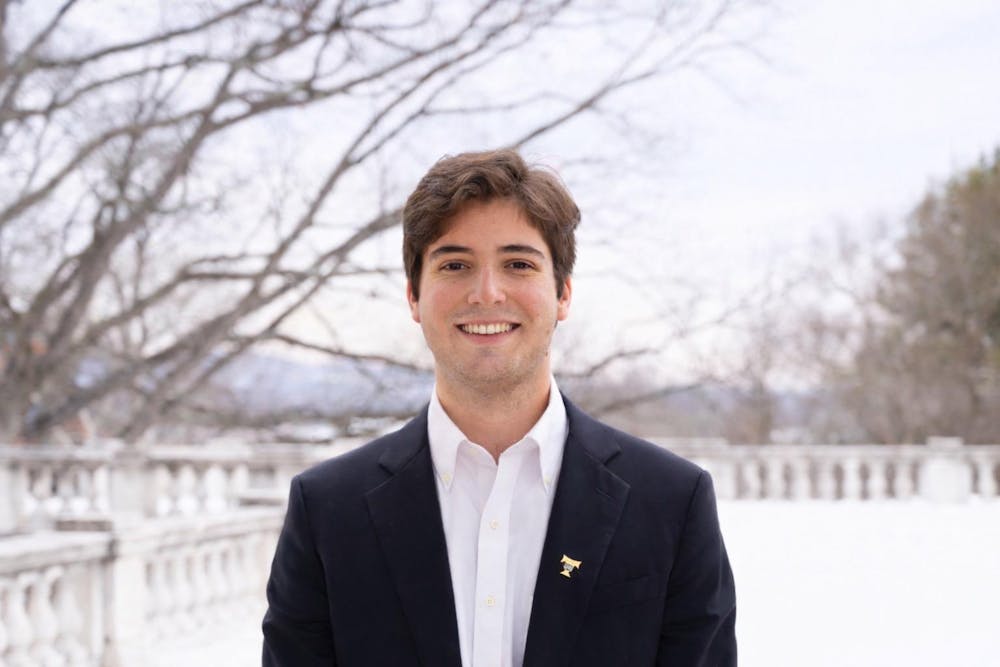
Michael Mitchell, former vice president for organizations and third-year Commerce student, won the 2026 Student Council presidential election with 51.7 percent of the vote and will serve as the University’s next Student Council president. As he begins to transition into his role as president, Mitchell said he plans to prioritize building Student Council’s long-term financial stability through an endowment, expanding access and awareness of mental health resources and increasing the Council’s visibility and engagement with the broader student body.
Mitchell defeated opponent Micah Andrews, former chief of Support and Access Services and third-year College student, by a 3.4 percent margin as part of the “Dream Ahead” ticket. Third-year College student Saehee Pérez was elected as vice president for administration and third-year Batten student Harper Tran was elected as vice president for organizations. Mitchell was sworn in as Student Council president for the 2026-27 term Tuesday.
A central priority for Mitchell is establishing an endowment to provide support for student organizations. According to Mitchell, Student Council receives far more funding requests than it can support through the Student Activities Fee allocation process. SAF is a mandatory fee paid with tuition from all University students and allocated by Student Council to be used for Contracted Independent Organizations. Currently, the Student Council budget relies on SAF revenues, fundraising and a three-year gift from former President Jim Ryan in 2023.
Mitchell also noted that several Student Council initiatives — including Support and Access Services — are currently supported by Ryan’s gift through funding, which only lasts three years. SAS is a Student Council branch founded in 2021 to provide resources for students at low or no-cost, through programs such as Airbus, Cavalier Health and Cavalier Career Closet. Establishing an endowment, he said, could help provide greater long-term financial stability for Student Council’s programs.
Clay Dickerson, former Student Council president and fourth-year College student, met with University President Scott Beardsley Jan. 23, who committed to continuing discretionary support by allocating $500,000 over the next two years — extending funding for the SAS branch through 2031. Beardsley also agreed to collaborate with Student Council on a matching-funds endowment campaign to reduce reliance on the SAF.
While increases to the SAF could provide additional funding, Mitchell said establishing an endowment would create a more stable, long-term source of funding. Mitchell noted that for the 2026 fiscal year, Student Council received 943 funding requests from CIOs totaling roughly $3 million. Mitchell said that per SAF guidelines, approximately $1.8 million of the requested $3 million was eligible to be funded, but Student Council had only $800,000 to $850,000 available to allocate toward the $1.8 million. This resulted in an allocation rate of around 44 percent — less than half of the requested funding from CIOs. He added that under his administration, Student Council will do everything it can to increase SAF and expand the amount of funds available for student organizations.
“Even if we raise [the SAF] this year in April, that’s going to be a $4 increase, which is [approximately] $110,000 … that just makes the funding gap from 2.5 million to 2.4 million,” Mitchell said. “The sooner we get this money invested, the more [money we] can grow over time.”
In addition to expanding funding for student organizations and SAS, Mitchell said his administration plans to continue internal financial reforms introduced during the 2025-26 Student Council administration. The effort — which Mitchell calls “use it or reuse it” — encouraged committees within Student Council to reassess their budgets from scratch rather than automatically requesting the same funding each year. Mitchell said monitoring how funds are used throughout the year is crucial to ensure Student Council resources are being spent effectively.
Utilization rates — the portion of allocated funds that are actually spent — have been a focus for Council leadership. According to the Student Council bylaws, unspent money cannot be reallocated to other committees until the next budget cycle, which occurs twice per year — once for the summer and once for the academic year.
Mitchell said that the current reforms — including the “use it or reuse it” budgeting approach — have already helped improve the utilization rate. According to Princess Wuraola Olubuse-Omisore, former vice president for administration and graduate public health student, the current overall utilization rate for Student Council’s annual budget is approximately 78.5 percent. This is higher from 64 percent during the 2024-25 school year and significantly higher than the 25 percent observed during the 2023-24 school year. Mitchell added that he hopes to continue these efforts to maintain strong oversight and ensure resources are fully used.
“We can’t make the argument that we need more money for Student Council and we’re not even spending the money we already have,” Mitchell said. “I think we’ve done a better job this year than in years past, but … If CIOs can have a 90 percent-plus utilization rate, we should be holding ourselves to that same standard so that’s something I fully intend to keep pursuing.”
Beyond financial policies, Mitchell acknowledged that many students are unfamiliar with the work Student Council does or the resources it provides. Increasing transparency, he said, will be another key focus of his administration. He said improving communication through social media platforms such as Instagram and YouTube will help encourage greater student engagement and address perceptions of Student Council.
“I think the consensus, and I would be curious to poll students and see what they think, is that we're a pretty mysterious, bureaucratic entity. Not a lot of people know what we do,” Mitchell said. “We are going to do a better job of that this year, specifically, how to be more transparent and break down those barriers.”
In order to increase participation and attendance at Student Council general body meetings, Mitchell said he plans on having Student Council stream their meetings on YouTube. He said CIO leaders typically only attend general body meetings to speak on their organization when the organization's branch passes a bill to recognize their CIO, but said he wants CIO leaders to be able to attend and give feedback to the representative body all the time.
Mitchell also said he hopes to gather more direct feedback from students when advocating for policy changes, particularly regarding issues such as mental health resources. He said raising awareness about mental health resources and reducing stigma around seeking support — particularly around men’s mental health — will be important for the upcoming administration.
“There is a big stigma around men’s mental health and I know there have been a lot of initiatives this year within the Inter-Fraternity Council for improving this,” Mitchell said. “This isn’t limited to men’s mental health. I think across the board, [Counseling and Psychological Services] can be improved for every single student here.”
Mitchell referenced the IFC’s efforts to raise awareness about mental health, including an event known as the Fight Against Suicide — which featured a student boxing tournament aimed at raising funds and awareness for mental health. Mitchell said initiatives like the Fight Against Suicide event demonstrate how student-led efforts can help reduce the stigma around mental health across Grounds.
Ultimately, Mitchell said that he views the presidency as a role centered on representing student voices within University governance. As president, he said he will serve as one of the primary student representatives interacting with University administrators and the Board of Visitors. He emphasized that Student Council acts as a lobbying body, bringing key issues from students and committee leaders to administrators, and cited the addition of a student-athlete representative this year as an example of how new voices have shaped Student Council advocacy.
Mitchell said his experience as VPO gives him a deeper understanding of how Student Council members can influence University decision-making and advocate for students.
Student Council passed a resolution Aug. 8 expressing no confidence in the Board following the resignation of Ryan and the subsequent search for the University’s interim president. The resolution cited concerns that the Board’s actions during the presidential search process did not sufficiently represent the student voice. Mitchell said such moments highlight the need for student leaders to balance collaboration and advocacy when engaging with University stakeholders.
“You do have to bargain with all of these stakeholders, but at the end of the day, the reason you're balancing and bargaining is to ensure the best outcome for the student body,” Mitchell said. “I think it's really important to note regardless of what stakeholders [I] interact with … I'm always representing the student body [and] student voice.”
Mitchell said he plans to work closely with Student Council representatives, the Executive Board and the broader student body to advocate for student interests to the Board. He also said that he will prioritize bringing as many student issues as possible to the Board’s attention and intends to dedicate himself fully to representing the student voice.
Mitchell’s involvement in Student Council began during his first year when he served on the Appropriations Committee within the organizations branch. The Appropriations Committee reviews funding requests from CIOs and allocates portions of the SAF.
At the end of his first year, Mitchell said he was encouraged by Ryan Bowers, then-vice president for organizations and Class of 2025 alumnus, to become director of the CIO Consultants Committee — a role he said allowed him to interact directly with student organization leaders and assist with initiatives such as the Fall Activities Fair — an annual event for hundreds of CIOs to present their missions and recruit new members.
The CIO Consultants Committee works directly with CIOs to provide guidance on Student Council processes, assist the VPO with reviewing and approving student organizations that applied for formal CIO status and connecting CIO leaders with resources needed to operate.
After serving as the director of the CIO Consultants Committee, Mitchell ran as vice president for organizations on the “A Brighter Tomorrow” ticket with Dickerson and Wuraola Olubuse-Omisore. Mitchell said serving as VPO has been one of the most valuable experiences of his time at the University and helped him develop a deeper understanding of how Student Council operates.
“I have loved supporting CIOs because I firmly believe that they are the backbone of the student experience here,” Mitchell said. “Your student experience is defined by two things — your time in the classroom and your time outside of it.”

Jaylynn Perez is a third-year College student from Chesapeake, Va., majoring in government and Public Policy and Leadership. She currently serves as a news senior writer and video staffer, after previously serving as senior associate editor for the news desk. She enjoys covering topics such as University governance and local politics.
Read More

From the Archives: Fraternity life
By Maisy Callahan and Emily Conway | YesterdayMore fraternities decide to partner with the Historic Renovation Corporation, a University-affiliated agency that provides tax credits for the restoration of historic buildings.

Center for Politics hosts Tom Perriello to discuss AI, congressional responsibilities
By Melody Yuan | 2 days agoAt the event, titled “The Deep Divide Between How the People and the Powerful Are Thinking About AI,” Perriello also referenced his Sept. 22 article “To Wary Working People, AI Preemption Is the New Nafta” in The New Republic during his discussion.

U.Va. Health’s telehealth program approaches 1 million visits
By Vrinda Vashisht | 2 days agoThe program arose from the challenge of U.Va. Health physicians traveling to communities across Virginia to treat patients who could not easily reach Charlottesville.