Correction: The previous version of this article incorrectly referred to Ryan Phelan as Inter-Fraternity Council President. Ryan Phelan is the former Inter-Fraternity Council President, as he ended his term in January 2026.
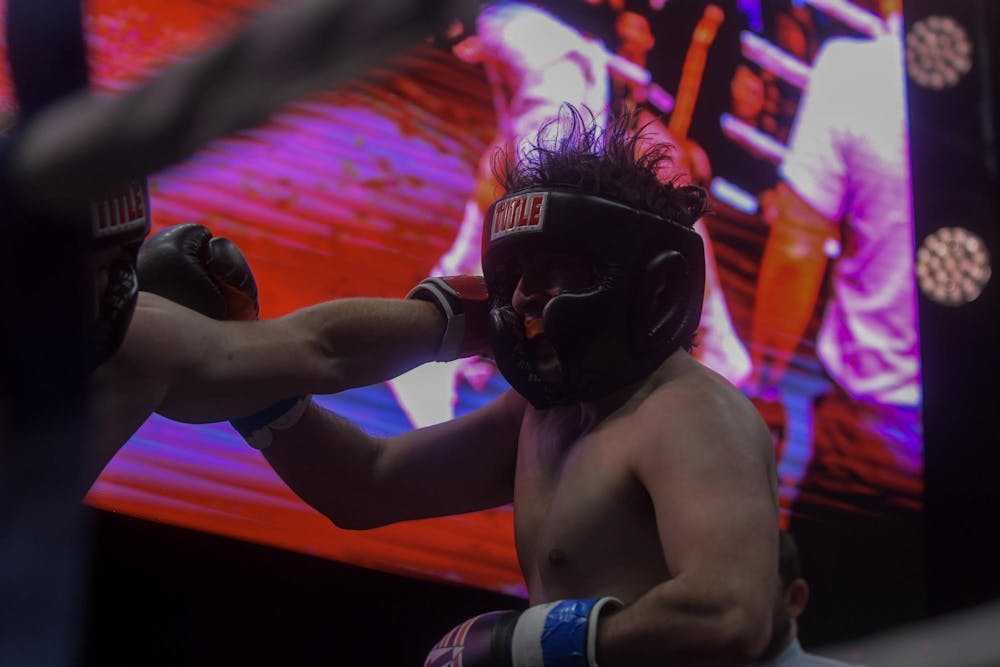
Nearly 1,500 spectators packed into Ting Pavilion Thursday night, filling the venue for the University’s first Fight Against Suicide. The crowd came for the fights, but the event carried a purpose beyond the ring.
It is not typical for a boxing match to double as a conversation about vulnerability. But the Fight Against Suicide is designed to do exactly that. By drawing in a large crowd through competition, the event creates space for conversations about mental health that are often avoided, particularly among young men.
The Fight Against Suicide is a student-led initiative that has been introduced across southern schools across the country, using organized boxing events to raise awareness and funding for mental health resources. The program was originally founded in 2021 at the University of Georgia and has since expanded to 10 other universities, including the University, where it was held for the first time Thursday.
Ryan Phelan, former Inter-Fraternity Council president and fourth-year College student, helped bring the event to the University. Phelan said the event is designed to engage students who might not otherwise seek out conversations about mental health. By bringing together multiple fraternities and drawing a large audience, he hoped the scale of the event could help create a shared experience centered around a common cause.
Phelan said the level of engagement is part of what makes the event distinct from more traditional philanthropy efforts. Bringing together multiple fraternities under a single initiative required significant early support, long before the event had fully taken shape. In total, 20 fighters across 10 different fraternities competed, including Delta Kappa Epsilon, Sigma Chi, St. Anthony’s Hall and more.
“When [we] went to the fraternities … in the early stages of doing this and pitched them on the vision … the amount of support and buy-in we got without even having any infrastructure set up was incredible,” Phelan said.
This enthusiasm to kickstart the event, he said, reflects a broader willingness among students to engage with the issue.
Behind the event was a large student team working across fundraising, operations and outreach to make the night possible. Led by Phelan, organizers built the event from the ground up — working with fraternities and promoting the event around Grounds. The team created an Instagram page to build momentum and keep students engaged leading up to the fight.
Throughout the week leading up to the fight, the organization hosted a series of events to build awareness and momentum. In addition to gym hours and fight training, The Fight Against Suicide programming included a speaker series and QPR training sessions. QPR, which stands for ‘Question, Persuade, Refer,’ is a training aimed to equip students with tools to recognize signs of distress and support their peers. A weigh-in event held at Crozet Pizza at Buddhist Biker Bar Wednesday night further built anticipation for students attending the main event.
Proceeds from the event are allocated toward expanding mental health resources at the University as well as the greater Charlottesville community. This includes efforts to improve access to counseling, support existing University programs including CAPS and provide funding for off-Grounds treatment options.
“Every single dollar we raise is staying in Charlottesville, within the community,” Phelan said.
For many of the students stepping into the ring, the event was a new challenge. Most of the fighters had no prior boxing experience, instead committing to two months of training leading up to the event. The program offered free lessons for the fighters at Wartime Fitness Warriors for training three times a week led by an ex-professional boxer.
Mason Yuh, second-year College student representing McCormick Hall, said that the training environment was largely collaborative, with participants supporting one another despite being each others’ eventual competition.
“Most of the guys that are participating in this I have never met before,” Yuh said. “So going from complete strangers to friends through training and all that, like spending like multiple hours a week together has definitely made me closer with guys across fraternities.”
For Yuh, the event’s message also carries personal weight. While he said that he has never faced mental health battles himself, he has witnessed the effects of them first-hand.
“I’ve had a lot of rough and hard conversations with a lot of my friends … and I know how serious [mental health] can get,” Yuh said. “While I will always be there for them, I think it's important to spread awareness on this issue … [of] trying to get people the help they need.”
Much of the crowd sat alongside their Greek organizations to cheer on the fighters, chanting the names of their fraternity brothers and friends as they stepped into the ring.
From the moment the fights began, the production of the event made it feel more like a professional boxing match than a student-run event. Camera operators moved around the ring, smoke machines filled the space and referees and scorekeepers managed each match. Concessions, organized seating sections and a semi-formal dress code added to the scale of the night.
Among attendees, reactions reflected a strong sense of enthusiasm about the night's impact. Second-year Architecture student Lauren Thomas said she felt the event helped bring attention to a topic that has faded from attention over time.
“I feel like first year, [the University] talked about [mental health] more … but being an older student, I don’t hear much about it anymore,” Thomas said.
Others pointed to the event’s appeal as a way to engage a specific audience — particularly young men — who are less prone to seek mental health support. For Eliza Elbaum, attendee and second-year student, the fight helped bring attention to this gap.
“Boys’ mental health is sometimes overlooked … so doing an event that’s more tailored to guys … while supporting a good cause is beautiful,” Elbaum said.
Underscoring the event was a recognition that stigma — not just access — remains a barrier to addressing mental health. While resources across universities may exist, the expectations for students, specifically males, to be “strong,” may prevent them from opening up.
This perception was echoed by other students at the event. Grant Korb, attendee and second-year Engineering student, said that gendered stigma on men expressing emotions contributes to why so few men seek out mental health care.
“I think you can’t argue against [mental health] stigmas, especially outside of high class areas… that make it seem that men have to be … [less] emotional,” Korb said.
With nearly a full house and over $188,000 raised, the event exceeded expectations and demonstrated significant student support. The turnout, paired with the energy throughout the night, reflected the engagement the organizers set out to create.
For organizers, success is not defined solely by the scale of the event, but by whether it makes conversations around mental health more visible, accessible and lasting on Grounds.
“I think if Greek men are just able to have that conversation a little bit better, then I think that's a major win for what we're trying to do,” Phelan said.
Read More

Bebe Stockwell’s sunny disposition shined at The Southern
By CC West | YesterdayFor the third show of her first headlined tour, Bebe Stockwell graced The Southern Café and Music Hall Saturday with her upbeat attitude and optimistic lyricism.

Delicious on a dime: Charlottesville’s best restaurant deals
By Lucy Larsen | 2 days agoFrom wraps and wings on the Corner to imported wine and tapas on the Downtown Mall, these are the perfect spots to treat both your taste buds and your wallet for under $25.

Play the organ
By Elizabeth Adams | 4 days agoThe college side quest does not need to be the multi-semester jaunt that my organ adventure has become, and it certainly doesn’t have to make sense.