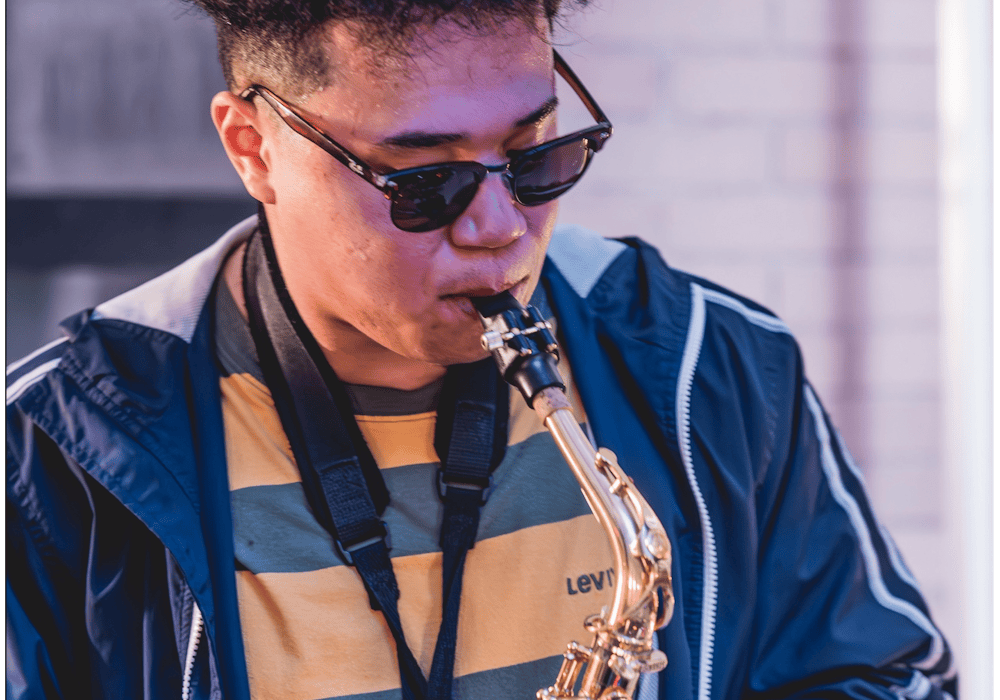
Rah Hite — releasing hip hop and jazz music under the name Rah V — is a composer, turntablist and graduate Arts & Sciences student pursuing a PhD in Composition & Computer Technology in the music department. Heavily involved in the music community at the University, he is the music department’s representative on the Graduate School of Arts & Sciences Council, and has come out with three studio albums — releasing his most recent, named “Triple Consciousness," released Feb. 15.
Starting on the piano at five years old, Hite progressed to the saxophone and jazz band in elementary school. He said being in jazz band drove him to improvise his own sounds rather than reading off notes — the initial push he needed to become the musician he is today. Hite also started DJing at age 13 remixing songs, and today he performs at undergraduate parties and local community venues. Recently, Hite both DJ’d and played the saxophone at the Ridley, a restaurant in the Draftsman Hotel.
“Part of the reason why I got into music was because I was a relatively noisy kid … [jazz band pushed me] to improvise and [find] my own voice in my instrument,” Hite said. “So that's sort of how I got into jazz. I really stuck with it because it was a way for me to get into composing music.”
Hite had always been interested in telling stories through music. When he was first learning piano, he said he would imagine fairy-tale creatures, though today, Hite works to tell tales more grounded in reality.
“I would always go to the piano and sit between the high notes and the low notes and tell a story of a giant chasing a minion or a munchkin or something, and that's my earliest example of me telling stories through music,” Hite said.
His latest project, “Triple Consciousness,” tackles more serious themes, with a key throughline being the anxiety surrounding climate change. A fusion of hip hop, jazz and dance music, the 10-track album moves through Hite’s political opinions and music styles. The recent release is the amalgamation of his efforts to promote environmental justice, political equality and share his own life through music — which he said he hopes will spark more conversations surrounding these topics.
Hite said that he wanted his third album to focus on activism and integrating his political interests into his art, moving away from simply music as a hobby in his free time.
“[Discussing environmental justice] was my goal coming in, because before this album, and before [starting my PhD], I was kind of just making music because that was something I could focus on in undergraduate,” Hite said. “I wanted to get more of my political interests involved into my craft … I wanted to make sure I was allowing intersections of my interests to collide in this space.”
As a jazz musician, Hite uses a lot of improvisation for his songs in addition to sampling and remixing. Sampling his previous work and the work of others, Hite is able to take an instrument or sound clip and turn it into something entirely new as part of his melody.
“I apply a lot of those [sampling and remix] techniques to my own playing, and ultimately, a lot of ideas are derived from doing that process,” Hite said. “I'm able to elaborate on the interventions I made on my own playing and create new melodies, harmonies … and I'm able to create something concrete from those samples.”
The name of the album, “Triple Consciousness,” is an expansion of writer W.E.B. Du Bois’s idea of double consciousness, according to Hite. The concept explains dual self-perception, in which marginalized people view themselves both in their own lens and through the lens of a prejudiced dominant people. Other intellectuals have expanded on Du Bois’s idea and turned it into triple consciousness, such as artist Paul D. Miller and jazz musician Charles Mingus, who Hite cites as references for his title.
“The third consciousness [is] being the musician who is deciphering the two different consciousnesses of being Black in America, and having to go back and forth between performing for white America and going back to your own community and perceiving what that is as a Black American,” Hite said.
In line with his environmental justice goals, Hite sampled a nearby creek for a previous class, recording it at multiple points in the stream to create a multidimensional sound. He now uses these sounds throughout his music, and they can be heard in the back of a few of the songs in the album to create a fluid quality that connects to the themes of climate justice.
In his fourth track, “Potable Water,” Hite calls out big corporations for polluting Earth’s water, saying “Why we polluting the river that we just be drinking / Just saying, don’t wanna be dead, from drinking the water.” He brings attention to their environmental transgressions, saying “DuPont and Shell / BP, Exxon as well, what’s good what’s swell? / That jail cell is collecting dust.”
Hite performed “Potable Water” at the University’s 2024 Coastal Futures Festival — an event that combined environmental humanities, music and science to promote environmental health and spark conversations about water conservation.
“Ultimately [I am] linking [climate justice] back to this idea of triple consciousness,” Hite said. “What is it like to have all these different consciousnesses and going around the world, and then having a third anxiety in the background … that is the environment that we live in, and if that's being threatened, what are the ways in which we are navigating that, coping with that?”
This album will not be his last, as Hite is fulfilling his PhD in pursuit of becoming an artist scholar and a professor in the future. Through his plans of scholarly work and inspiring the next generation of musicians, Hite hopes his music will push others toward a path of using music as a form of activism.
“I want other artists to make art that reflects their political visions, their ideas about the climate,” Hite said. “I don't hear enough music about climate change, about politics, so I wanted to combine all those things into one and show people this is a way of approaching this combination of perspectives as well as art.”
Read More

Le Marché du Soleil stitches together a community, rain or shine
By Nritho Halima | 5 hours agoThe event marked the fourth collaboration between Le Marché du Soleil, a vintage and secondhand pop-up shop and Cou Cou Rachou, a Charlottesville bakery known for its close-knit local following.

The Southern’s showcase reintroduced student bands on the right note
By Kelsey McIntyre | YesterdayThe Southern’s concert presented a moment for bands to come together and perform in front of an audience of dedicated music lovers.

Hoo’s Watching: Fall films to embrace the autumn spirit
By Bridget Baile | 3 days agoHere are three essential watches for any reader as they prepare to witness the leaves outside their windows change from green to orange.