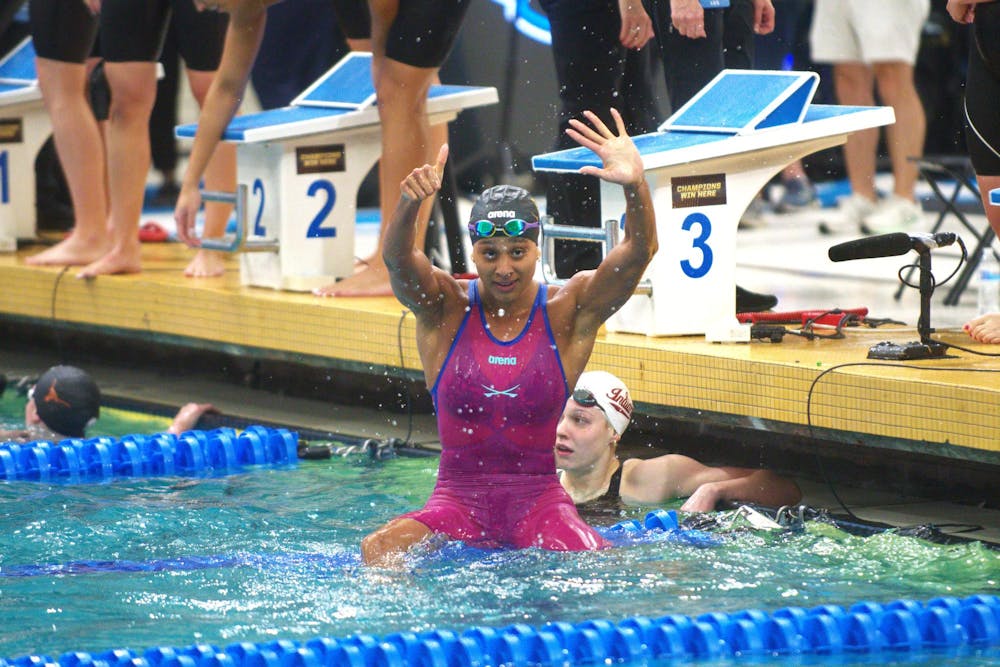
Freshman Sara Curtis stormed into the yellow touchpad as the anchor leg of the 400-yard freestyle relay — the final event of the meet — and turned to glimpse at the scoreboard. 3:05.26. A new NCAA record to tie up a victory Virginia knew all day had been coming.
The Italian Olympian mounted the lane rope, and with one hand held up one, two, three, four, five fingers. Maintaining her balance, she lifted up the other hand for one more.
Six fingers. For six championships.
The second raised hand reflected a statement Coach Todd DeSorbo made to emcee Elizabeth Beisel at the start of the week on the deck of McCauley Aquatic Center in Atlanta, Ga. — that this feels like “the first one.”
At the end of the first year of a new era, with targets on their backs, the Cavalier women produced the most dominant victory of their dynastic run — 589 points, 208.5 clear of runner-up Stanford and with a clean sweep of all five relays.
No women’s program has ever won six consecutive NCAA team titles. Virginia, which did not win its first until 2021, has never relinquished the throne, surpassing both Stanford's run from 1992 to 1996 and Texas' streak from 1984 to 1988.
In doing so, DeSorbo tied legendary Hall-of-Fame coach James “Doc” Counsilman for the longest winning streak in overall NCAA swimming and diving history — Counsilman led the Indiana men to six straight from 1968-1972. It is also the longest active winning streak in any Division I sport.
“I think all of us would probably say we outdid ourselves this year,” sophomore Anna Moesch said. “I couldn't be prouder of these girls on this team, and I think it's the best collective team I've ever been on.”
The 589-point total demolished the program’s previous best of 551.5 from 2022 — a year that featured Kate Douglass, both Walsh sisters and a roster that, until this weekend, was considered the most prolific in Virginia history. Sixteen of the Cavaliers’ 18 swimmers scored points, earning 36 All-American first-team honors and 18 second-team honors in total.
“This one's the most meaningful, because, one, it's historic, right?” DeSorbo said. “Nobody's ever done it, and not to mention they did it in a historic fashion. I know other teams have scored more overall, but it's been a long time. But for us, as good as our teams have been in the past, and as good of athletes that we had in the past, it's really impressive that we scored more points than we've ever scored.”
The run began from the opening finals session on Wednesday night. The Cavaliers won the 200-yard medley relay in a pool record of 1:31.67 despite losing three of their four legs from the team that set the NCAA record last March — and Virginia now owns the 10 fastest times in relay event history.
Curtis led off with a 22.73 backstroke split, the fifth-fastest ever. Senior captain Emma Weber swam the breaststroke leg before junior Olympian Claire Curzan dove in for butterfly, clocking 21.51 — the fourth fastest split all-time only behind Gretchen Walsh’s fastest three. Moesch anchored in 20.55 to hold off Stanford and Louisville and earn Virginia its first of five relay golds.
The 800-yard freestyle relay that same evening was even more emphatic. Senior Aimee Canny led off in a 1:41.68, freshman Madi Mintenko split 1:41.43 on the second leg, sophomore Bailey Hartman held steady in 1:43.07 on her NCAA relay debut and Moesch anchored in 1:39.03 — the fastest relay split in the history of the event. Their NCAA Championship meet-record of 6:45.21 stands as the second-fastest performance ever, behind only Virginia's own NCAA record from last year's ACC Championships.
In the 1650-yard freestyle — which, under the new championship format, is now contested on the opening day rather than the final day — sophomore Katie Grimes touched third in 15:42.65 and junior captain Cavan Gormsen added points from 13th to round out the first day at 100 points for the Cavaliers.
Thursday brought an eruption from many of the program’s emerging stars. Moesch claimed her first individual NCAA title in the 200-yard freestyle in 1:39.23, a new pool and meet record for the second-fastest performance in event history — trailing only Missy Franklin’s legendary 1:39.10 from 2015. Mintenko finished fifth in 1:41.67, combining with Moesch for 34 points from one individual event.
Curzan finished runner-up to Stanford Olympian Torri Huske in the 100-yard butterfly, 48.49 to 48.55 — Huske would go on to sweep all three of her individual events for the second-place Cardinals. Senior captain Carly Novelline and Curtis placed 12th and 13th, respectively. Grimes delivered a 4:00.56 in the 400-yard individual medley for fifth and Canny added eighth-place points. Weber scored 12 in the 100-yard breaststroke final, her fourth time receiving All-American honors in the event — and fellow senior Zoe Skirboll added B-final points.
The Cavaliers capped off the night by winning the 200-yard freestyle relay in 1:24.11 — their fifth-straight title in the event. Virginia led 249-183 over Texas by the second night of competition.
By the end of Friday night, the Cavaliers were so dominant that the title had become mathematically out of reach for any other team. DeSorbo called the prelim session on Friday “by far the most fun prelim session I've ever been a part of.” Fifteen of Virginia’s 18 swimmers scored points on the day alone.
“Everybody wanted to get in on the action,” DeSorbo said.
The day finished with Curzan clinching her first individual title of the meet in the 100-yard backstroke with a time of 48.24, a new meet and pool record that stands as the second-fastest performance in history behind only Gretchen Walsh's NCAA record of 48.10. Canny took silver in the 200-yard breaststroke behind Stanford’s Lucy Bell, with Weber adding eighth-place points.
Curtis earned silver in the 50-yard freestyle in 20.74 — the fastest time ever recorded by a freshman — a mere eight-hundredths behind Huske in one of the fastest finals in NCAA history. Moesch chipped in from eighth, and graduate Bryn Greenwaldt just missed the A-final in ninth.
Gormsen placed sixth in the 500-yard freestyle and Mintenko eighth, both contributing double-digit points, while Grimes and Hartman added further points from B-final placings. Freshman Sophia Umstead, sophomore Leah Hayes and Skirboll placed in the top 16 along with Canny and Weber to make for five scorers in the 200-yard breaststroke alone.
The 400-yard medley relay capped off the night, completing Virginia’s fourth relay victory in four attempts. At 437.5 points to 272, the sixth championship was more or less sealed, with an entire day still to swim. The Cavaliers scored 188.5 points Friday alone — double the next-best team that day. The day three lead of 165.5 already surpassed last year’s final winning margin of 127.
With such dominance in the standings, Saturday acted as a celebration. Virginia’s roster donned special edition black and gold caps, with three stars scattered throughout each leg of the “V” to subtly make six.
Curzan completed a dominant sweep of the backstroke events, clocking 1:46.10 in the 200-yard — a new meet record and just one-hundredth off her own NCAA and American record of 1:46.09. Moesch and Curtis went 2-3 in the 100-yard freestyle behind Huske’s pool-record 45.17, touching in 45.54 and 45.77 respectively. Canny and Hayes scored 13 and 12 points from the 200-yard individual medley.
Junior captain Tess Howley added a fourth-place finish in the 200-yard butterfly in 1:51.69 — a remarkable result given that Howley had swum a grueling double in the morning prelims, qualifying for the 200-yard butterfly final and, minutes later, placing 10th in the 200-yard backstroke with a personal best of 1:50.82.
“The [200-yard butterfly] this morning, Tess [Howley] and Bailey [Hartman] and Carly [Novelline] were all right next to each other in a line,” DeSorbo said. “I just think that gives them a sense of calm going into a race, and allows them to just relax a little bit, because obviously a relaxed swimmer is going to perform better. And so tonight, Anna [Moesch] and Sara [Curtis] next to each other in the [100-yard] freestyle, I think they really liked that … They do that every day in practice.”
Then came the final event, the final relay. Curzan, Mintenko, Moesch and Curtis combined for the 3:05.26 that broke the program’s own NCAA record — one set by Douglass, the Walsh sisters and Maxine Parker in 2023 — a quartet that was once considered the most formidable in women’s NCAA history. Not a single member of the previous record-holding relay was on this one.
“When I realized that we broke the NCAA record, [I] just jumped on the lane [line],” Curtis said. “It was super fun. And I'm just super glad to be part of this. It's just so special for me.”
That’s six. And if the first hand Curtis raised on the lane rope was for everything the program has accomplished, the second was for everything it still intends to become.
Read More

Early promise gives way to growing pains for Virginia at Ben Hogan Invitational
By Sofie Keppler | 3 hours agoVirginia finished 14th out of 16 historically accomplished programs, tying with Stanford at a 43-over 883.

Often weak this season, Pribula’s passing and receivers breakout led Virginia to victory
By Drew Dillman | YesterdayThough not a strong suit for the large part of the season so far, the aerial attack spearheaded the offensive domination of the Blue Hens during Virginia's 42-3 victory.

Rice secures NCAA singles bid as Cavaliers show promise in ITA All-Americans
By Margaret Piatos and Noah Cinel | 2 days agoContinuing their early-season prowess, the Cavaliers put on a strong showing in Tulsa, Okla. with multiple deep tournament runs against top competition.