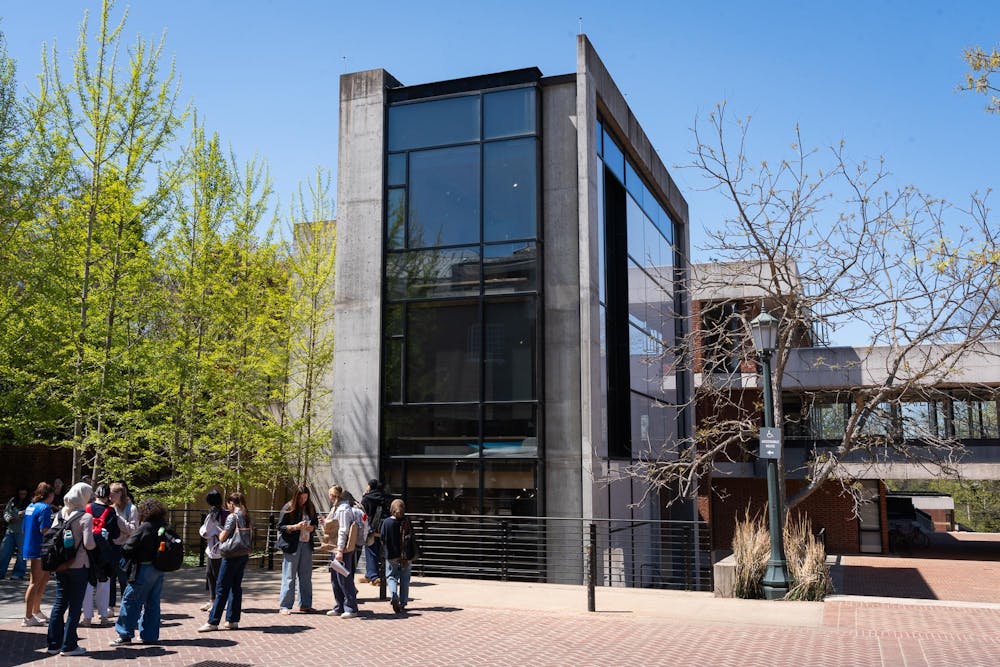
From the Woodshop, laser cutters and the studio spaces, Campbell Hall houses the complex, adventurous and dynamic work and design of the School of Architecture. The School of Architecture presents a unique opportunity for students to receive a deeper, more immersive education, as the spaces they learn in were designed by their own professors.
Campbell Hall was originally designed in 1970 by design consultant Pietro Belluschi, Sasaki Associates and Rawlings, Wilson and Associates. Additions to Campbell Hall in 2008 were important to accommodate the program’s growth — both in the student body and in its coursework.
Professors and architects W.G. Clark and Bill Sherman designed the East and South additions of Campbell Hall, respectively, which were officially completed in 2008 after construction started in 2007. Clark, designer of the East Addition of Campbell Hall, is a School of Architecture Class of 1965 alumnus and an internationally recognized designer who has taught at the University since 1988. Sherman, who designed the South Addition, is also a practicing architect in addition to working in academia for 45 years at several universities across the United States, as well as in several different positions at the University since his arrival in 1994.
Karen Van Lengen, then-dean of the School of Architecture, tasked Clark and Sherman to design the additions in 2005. Clark said after multiple trials and rejected design proposals from two different architects, Van Lengen approached Clark and Sherman to design the additions.
“It was through Karen Van Lengen's bravery that she convinced the University powers to allow her own faculty to design the additions," Clark said. "And that had never been done before."
The East Addition includes a series of project review rooms where students present their studio projects to professors or guest critics and is also used as a collaboration space. The review rooms in Campbell Hall absorb many avenues of light and reveal the room’s natural composition, presenting a refreshing take on review rooms, which Clark said are notorious for having no windows and a lack of ventilation. The glass walls provide an outlet into the building, showing to the public the work that occurs inside Campbell Hall, supporting and fostering a space where artistic conversation can take place.
“So you'll notice that the east facing wall is completely glass. Nowhere to pin up drawings. It's just for the transparency of people looking out and people looking in,” Clark said. “It was important that the materials be exposed so that students of architecture could see how things are built, not how things are covered up with sheet rock.”
Sherman said that the South Addition considers connection to seasons, cycles of nature, Grounds and student-faculty relations. These innovations are facilitated through faculty office spaces, outlets to the outdoors and a stairwell that combines both practical and creative design elements. Sherman’s stairwell is an iconic space for students to take photos of their models, as the sliver of window that breaks up the concrete walls acts as a sundial and creates unique lighting that is ideal for highlighting details within the models.
Light — being an important feature of both additions — has taught Architecture students how to analyze and interpret a space and how to manipulate it within design.
“There … are so many aspects of this building that were designed to teach students about how buildings go together, how buildings work,” Sherman said. “To teach students about the passage of the sun by having the sundial in the stairwell, where they can actually pause and see the Earth turn.”
Third-year Architecture student Amina Fall reflected on what lessons the additions have taught her about light in design.
“I think both the additions are extremely uniform and orderly, but how they play with light and integrate it into the space makes them shine,” Fall said. “They have that in common, which I think is really interesting, though they were designed by different people.”
According to Sherman, the faculty offices connect students and faculty in a new way, with the offices located near student workspaces instead of on separate floors. Groups of three to four office rooms are connected by a shared outdoor patio — providing a channel of fresh air and sunlight for faculty.
The dynamic explored between students and faculty in this addition pays homage to the Academical Village and the Pavilions. The faculty offices balance nature and academia as one side faces the garden and the other faces into the studio spaces — similar to how the Pavilions face into both the Gardens and the Academical Village. The office porches form small clusters that encourage collaboration between faculty which is reminiscent of the upper outdoor pathways connecting the Pavilions on the Lawn.
“This idea about using the building as a way of connecting back to the Grounds … to make that all part of the daily life of the building is very different than a building which primarily closes you off from all of those relationships that so many of our buildings do, internally focused,” Sherman said. “So the building was designed as a place to connect you to the world beyond.”
Beyond the confines of the classroom, the additions are an emblematic feature of the School of Architecture where students have a place to generate dialogue about their designs among professors and peers alike. Fall said that she found a unique appeal to the building’s structure, finding utility in its Spartan design.
“I'm someone who tends to go for … less ornate designs and really focus on how the space feels, without having to kind of inject a bunch of walls and random things,” Fall said. “I think that both the additions are very practical and represent [a] really functionalist design approach.”
After almost 20 years, the additions continue to be integrated into student education through lessons on light, materiality and spatial orientation. The Architecture buildings complement these lessons by integrating them into both the Architecture curriculum and within the structure of the buildings themselves. Architecture students are granted a unique, additional layer of immersive education in which they learn from the designers of the spaces around them.
Read More
The revival of needlepoint — crafting calm in a digital age
By Julia Prevost | 36 minutes agoIn a fast-paced and increasingly digital world, some University students are choosing to unplug and slow down one stitch at a time.

A&E Book Club: Three middle-child narratives for the middle-of-spring month
By Carly Smith | YesterdayThis list features three popular stories that can relate to April’s spot in its spring family — tales with prominent middle-child characters who, much like the month of April, tend to be less of a focal point in their respective families.

‘The Drama,’ the drama it lacks and the drama it is causing
By Caroline Lee | 3 days agoNothing about the promotional rollout for “The Drama” is out of the ordinary.