
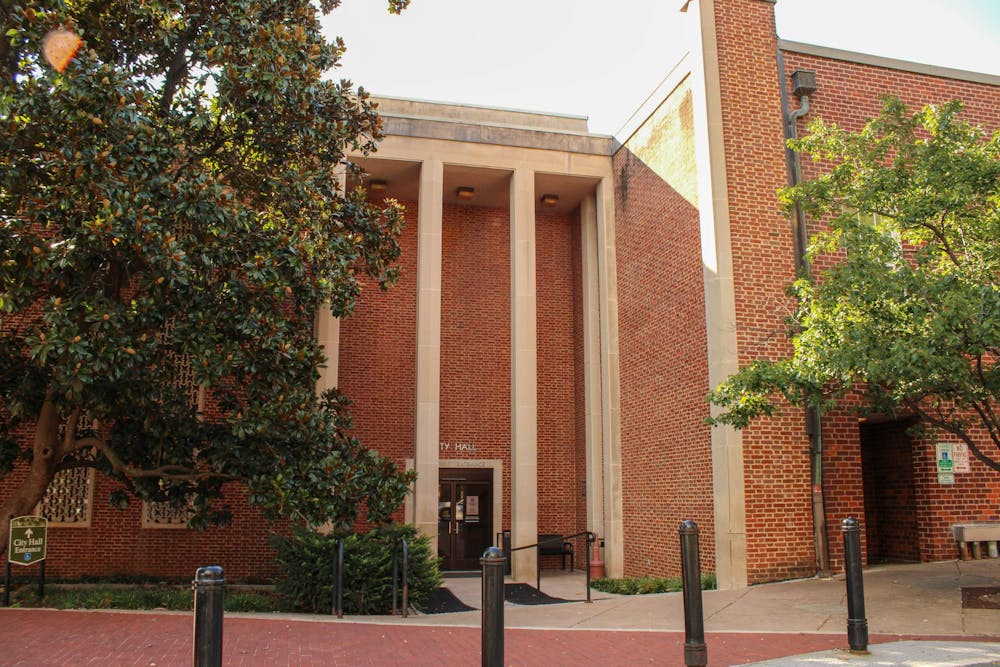
The Charlottesville City Council convened Monday for its first regular meeting since a March 30 affordable housing rally took place outside City Hall. At the meeting, residents and University students packed the chamber, calling on the Council to amend the zoning code to further incentivize affordable housing and limit private luxury apartments marketed to students to certain sections of the City.
The rally March 30 was organized by the Charlottesville Low-Income Housing Coalition — a coalition of residents and “community based organizations” working to stop displacement in Charlottesville and support affordable housing. Rallygoers advocated a zoning text amendment — an amendment to the City’s zoning code that alters regulations — which would limit these student housing projects to areas closer to Grounds where there are already large collections of students, such as Jefferson Park Avenue. Also at the protest were members of the Charlottesville Public Housing Association of Residents and the Legal Aid Justice Center — which partners with Virginia clients to advocate “racial, social and economic justice.”
The CLIHC is part of a growing number of advocates and residents that argue the development of luxury student housing projects gentrifies their communities — attracting wealthy residents who drive up the cost of living and force low-income families to move away. Residents are also concerned that two private apartment projects marketed towards students — an 11-story tall proposal by LV Collective near Westhaven and a seven-story proposal in Fifeville known as “The Mark” will both contribute to this displacement and block residents’ sunlight.
CLIHC also sent a letter to the Council, co-signed by 63 community groups, that advocated expanded relief programs for those affected by displacement and more stringent affordable housing requirements for developers.
Many of the same residents who attended the March 30 rally were present at the Council meeting Monday and spoke during the “Community Matters” segment of the meeting — in which 16 members of the public can address the Council for three minutes each. They asked the Council to implement housing policy recommendations by the CLIHC. These recommendations include further limiting building height in the Core Neighborhood Corridor Overlay — a protective zone which includes Cherry and Preston Avenue and mandates developers obtain a special permit to build projects higher than seven stories.
The CLIHC recommends amending the overlay to allow for three stories of building height by-right — not requiring the Council’s approval — with an extra two stories allowed if a project reserves at least 20 percent of units for affordable housing.
One of these residents present at the Council meeting, Terry Tyree, member of the National Association for the Advancement of Colored People and president of the Charlottesville Community Resilience Center, noted that over the course of several months, residents have expressed concerns to Council members about displacement. Tyree called for the CLIHC’s recommendation for a more stringent Core Neighborhood Corridor Overlay to be implemented. She questioned why the Council has allegedly failed to act on the community's concerns with new protective policies.
“Without protections like [the CLIHC’s recommendations], development does not include us — it replaces us,” Tyree said. “[We] have shown up, we’ve stood in these rooms, we’ve rallied, we’ve cried, we’ve written letters … and still we are asking — ‘why are our voices not enough?’”
As Tyree and other concerned residents spoke, several audience members stood silently in solidarity and some held signs, one of which read “We Repeat What We Don’t Repair.”
Tyree said that, through her work as a DoorDash driver, the contrast between subcommunities of mostly students and her own community has weighed “very heavy” on her. She described sections of Charlottesville near the University with private student housing as having “pools, security cameras and elevators,” where residents are comfortable leaving their belongings out in public.
“Then I returned to our communities,” Tyree said. “Where families are fighting just to get basic [community] beautification and we are in fear. That contrast is not physical, it’s systemic … Be brave … Do what’s right.”
Gillet Rosenblith, Board of Commissioners member for the Charlottesville Redevelopment and Housing Authority and assistant professor of arts and sciences, expressed the belief that the City is at a “moment of opportunity” to ensure low-income, historically disadvantaged communities get a “seat at the table.” She reiterated that both The Mark and the LV Collective proposal will displace city residents and gentrify their respective communities.
“I want to be clear,” Rosenblith said. “It’s not that building luxury apartments means that we … aren’t also building affordable housing, it’s that the specific location of these proposed apartment buildings would have a direct and negative impact on communities that we are trying to serve after generations of marginalization.”
Third-year College student Jaeda Fontaine-Rasaiah said during the “Community Matters" segment of the meeting that she believes University students stand in support of the concerned residents and do not want to be responsible for gentrification in the City.
“The University community … already [feels] so complacent in the amount of … economic gaps there are,” Fontaine-Rasaiah said. “We want housing but … housing that’s not going to destroy the Charlottesville community … Students are with the community on this. We are against the luxury housing.”
According to a statement read by Council member Natalie Oschrin, the Council discussed “aspects of changes to the City’s zoning code” with legal counsel during closed session.
During open session, the Council voted to lend $3,850,000 to a project constructing 71 affordable rental homes at 501 Cherry Avenue.
Oschrin also announced that the City’s “monthly walk” will take place on North Grounds Sunday. The “monthly walks,” which take place the second Sunday of every month, are a series of 12 walks led by Bicycle and Pedestrian Coordinator Tommy Safranek in different parts of Charlottesville for residents to get to better acquainted with the City’s subcommunities.
The Council will readjourn April 20 for its next biweekly meeting.

Luca Bailey is a third-year Politics student from Free Union, Va. As a staffer on the news and video desks, he has covered topics ranging from the General Assembly and state elections to local politics and University governance. He is also The Cavalier Daily’s beat writer for the Charlottesville City Council.
Read More

Student Council considers creating an ad hoc committee to review UBE proceedings
By Lucia Gambacini | 12 hours agoConsideration of the bill was postponed until the next general body meeting.

Health System Board Finance Working Group passes remote participation policy
By Lily Kostro | 12 hours agoThe policy states that a member of HSB may participate remotely in meetings not open to the public, provided the member notifies the rector that they are unable to attend in-person due to an emergency, personal matters or a disability.

Less than three months out — what’s on the ballot this November in Virginia?
By Abigail Larkin | 12 hours agoHere is a closer look at what is on the ballot this November in Virginia’s elections for the U.S. Senate, U.S. House of Representatives and amendments to the Virginia Constitution.


