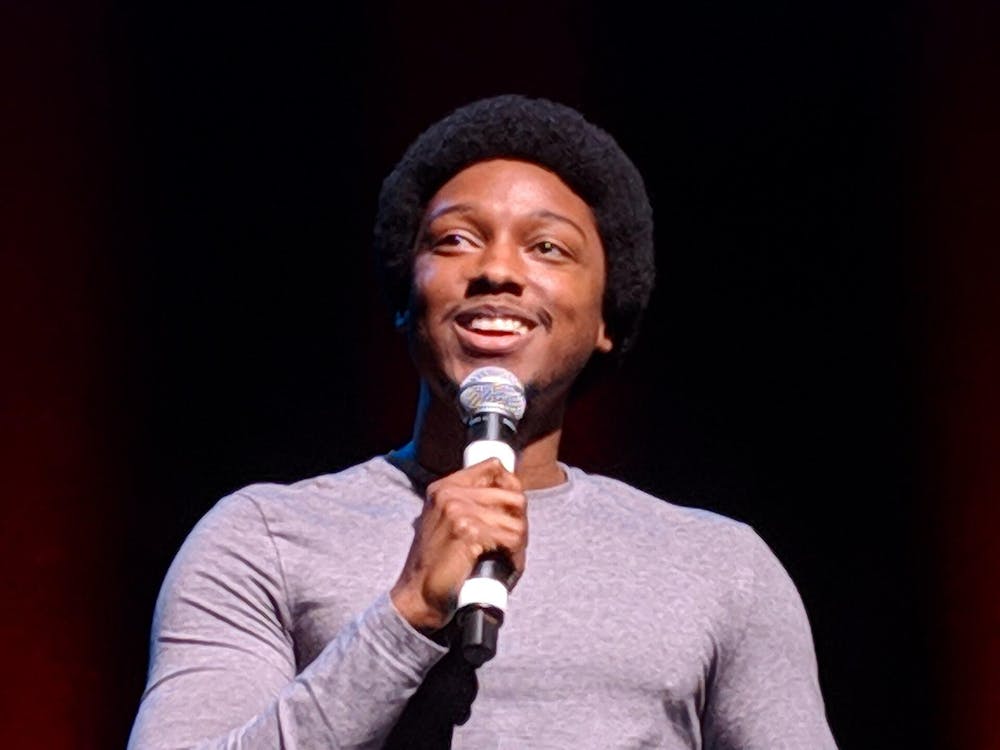
From writing for late-night staples like “The Tonight Show Starring Jimmy Fallon” to his current role as a rotating host for “The Daily Show,” Josh Johnson has established himself as a prominent voice in observational comedy. After opening for Trevor Noah on tour, Johnson brought his narrative-driven stand-up to Old Cabell Hall Tuesday for the University Programs Council’s SpringFest Comedy Show. The free performance provided the University community with a full evening of laughter and comedic social commentary.
Before Johnson took the stage, two other comedians performed shorter stand-up sets to warm up the crowd, the first coming from Clay Dickerson, outgoing Student Council president and fourth-year College student. Outside of his work in Student Council, Dickerson said that he has a passion for storytelling, both on paper and on stage in the form of stand-up comedy.
Dickerson opened the show by joking that he was the opener to the opener, indicating a sense of grounded humility combined with wit. He proceeded with a playful narrative of his voting experience a few hours earlier — regarding the referendum on congressional redistricting — making his comedy directly applicable to the lives of students in attendance. After a few more entertaining anecdotes, including one about car inspections and another about his admiration of President Obama, Dickerson offered a welcoming introduction for the second opening act, Rahmein Mostafavi.
Known for his writing ability and acting chops, Mostafavi entered the stand-up world after performing in the Kennedy Center’s “Shear Madness,” a murder-mystery play. Shortly after walking on stage, Mostafavi quickly engaged the audience asking for a show of hands from freshmen and seniors in attendance, and who was from the farthest away. He proceeded with some observational humor that playfully critiqued Gen Z — touching on everything from anti-anxiety medication to social habits — with a conversational tone that invited the audience to laugh at themselves. He continued to interact with the crowd — playfully picking on attendees and prompting reactions — before encouraging the audience to give an applauding welcome to the main headliner, Josh Johnson.
Johnson followed with a different energy, delivering a longer, more narrative-driven set than his predecessors. He began by observing the historic style of architecture of Old Cabell Hall, jokingly commenting on how more archaic buildings tend to carry darker or more unsettling histories. He then transitioned into a range of loosely connected observations — from judging people based on how they eat fruit to a broader commentary on politics, technology and social behavior. His humor often built gradually, rewarding attentive listeners by frequently circling back to earlier bits. Third-year College student Nikita Majumdar attended the show and said she appreciated Johnson’s thoughtful comedic style.
“I really liked the main act,” Majumdar said. “I could tell that everything he was joking about, all of his stories, he put a lot of thought into it.”
Throughout his set, Johnson also explored modern-day anxieties, such as artificial intelligence and the job market, virtual reality hardware and rising screen dependence — framing technology as both addictive and inescapable. First-year College student Maisie Hollaran remarked that the pacing between each of Johnson’s bits was steady and conversational, relying on tone and buildup rather than shock value to deliver the material.
“I feel like his bits, in comparison to [the] openers, he had a softer delivery and a lot more commentary on the world in a way that wasn't always trying to be edgy,” Hollaran said. “He wasn't trying to use shock humor the whole time.”
Johnson’s understated delivery continued as he shifted into a mix of cultural and historical references, touching on political absurdities and modern media with a measured, analytical tone. One thread included jokes about artistic dedication and how much effort goes into depicting “ugly” subjects in classical painting. This culminated in a longer reflection on religious artwork, including Leonardo da Vinci’s “The Last Supper,” leading into a bit about visiting a museum in Brussels and noticing Jesus’ frequent appearance in 15th-century paintings. He concluded with a joke about his girlfriend thinking Jesus had been alive in the 15th century to pose for the paintings, revealing a misunderstanding of when Jesus actually lived. This joke — his final of the night — was a fan-favorite among audience members.
The success of the evening reflected broad appreciation for UPC’s accessible programming. For students looking to take a break from the academic grind, these events offer a rare opportunity for high-caliber entertainment without the barrier of a ticket price. Fourth-year College student Sanjith Pradakara expressed her appreciation for the opportunity to attend the stand-up show.
“I really like UPC comedy shows,” Pradakara said. “It's fun to be able to do things like this for free, while you still can.”
As Johnson thanked the crowd and made his exit, the atmosphere in Old Cabell Hall remained light. By seamlessly threading together scattered topics — from fruit-eating habits to the metaverse — Johnson managed to keep the audience anchored in his narrative from start to finish.
Read More

An essential guide to the Charlottesville music scene
By CC West | YesterdayWhether someone is a composer, a dedicated listener or looking to grow their music knowledge, here are some ways to find new harmonies throughout a student's years on Grounds.

Bebe Stockwell’s sunny disposition shined at The Southern
By CC West | YesterdayFor the third show of her first headlined tour, Bebe Stockwell graced The Southern Café and Music Hall Saturday with her upbeat attitude and optimistic lyricism.

‘Final Friday’ at the Fralin brings an opportunity for hands-on engagement with the arts
By Amelia Lucien | YesterdayThe majority of Final Friday events also include free food and student-led tours of the museum via the Fralin Student Docent program.