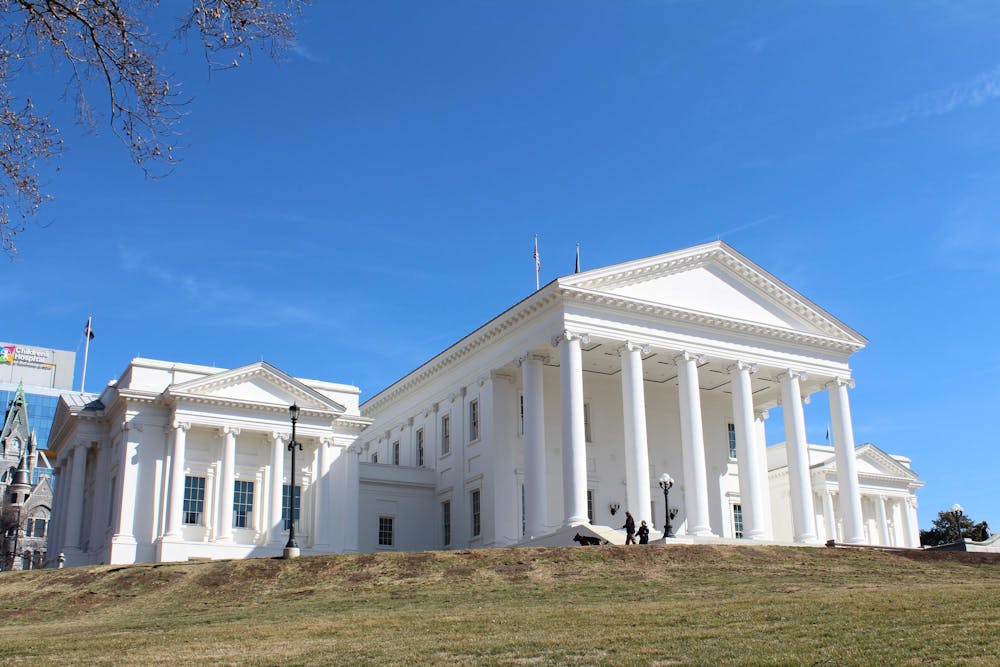
Gov. Abigail Spanberger’s (D) deadline for action on legislation passed by the General Assembly was 11:59 p.m. April 13, and among the bills she signed or amended included over two dozen pieces of legislation on gun violence prevention. Senate Bill 727, amended by Spanberger April 11, amends and reenacts §18.2-287.4 in the Virginia Code, prohibiting the carrying of guns “operable as an assault firearm” in public places.
Spanberger recommended amendments to SB 727 in the Nature of a Substitute — a rewritten version of the bill — which was received back by the Senate April 11. The bill was signed by the speaker of the House and president of the Senate March 12, and the bill was formally communicated to Spanberger March 14.
Sen. Michael J. Jones (D-15) introduced SB 727 and serves as chief patron. Sen. Scott A. Surovell (D–34) is a co-chief patron and former Sen. Adam P. Ebbin (D-39) is an incorporated chief co-patron.
Jones said in an interview with The Cavalier Daily that Spanberger’s amendments “more or less, in their substitute, just cleaned up a lot of the language.”
In the amendment, Spanberger clarifies what qualifies as an “assault firearm” to elucidate which kinds are covered versus exempt from the restriction. In doing so, she aligned this definition across multiple pieces of gun legislation. The amendment also removes the exemption for concealed handgun permit holders, meaning that those with permits will still be subject to the legislation. Further, the amendment adds an exemption for members of cadet corps at public higher education institutions during approved training or ceremonial events.
Pertaining to the future of the bill, Jones said that the substitute for the bill will have to be accepted when the General Assembly reconvenes Wednesday to become law.
SB 727 incorporated the previously proposed Senate Bill 312 in January. However, it expands — among other changes — the reach of the original bill from eight cities and five counties in Virginia to the entirety of the Commonwealth. The cities and counties mentioned in SB 312 include the incorporated cities of Alexandria, Chesapeake, Fairfax, Falls Church, Newport News, Norfolk, Richmond and Virginia Beach, as well as the counties of Arlington, Fairfax, Henrico, Loudoun and Prince William.
Jones said that his purpose for patroning SB 727 was to standardize the effects of the law on gun owners across the Commonwealth. Jones said the bill aimed to standardize gun legislation and not focus disproportionately on urban centers with significant Black and brown populations.
“[SB 727] just sought to deal with the geographical inconsistencies, which were really based on where Black and brown folk live,” Jones said. “You would need a concealed carry permit in Richmond [for a gun holding more than 20 rounds of ammunition], but you wouldn’t need one in Chesterfield.”
Per census data, Chesterfield County is 55 percent white, 23 percent Black, 13 percent Hispanic and 0 percent other, while Richmond is 42 percent white, 38 percent Black, 11 percent Hispanic and 9 percent other.
Bobby Doyle, project director of the U.Va. Gun Violence Solutions Project, said that there are three main potential upsides to SB 727. For one, the bill standardizes where restrictions occur across the Commonwealth to allow more clarity on individual rights. Additionally, the bill does not restrict most handguns that people use for self-defense, and it makes accessing guns more difficult.
“Standardizing across the state is an upside, just so people know what their rights are more easily, because it’s hard to expect everyone to know exactly which cities they will or will not be able to do certain things,” Doyle said.
The GVSP is an organization maintained by the Office of the Provost dedicated to reducing gun violence, and it focuses its reduction efforts on smaller localities and a collaborative approach with Charlottesville community partners.
“The U.Va. Gun Violence Solutions Project is a University-wide effort to develop, implement and assess actionable solutions to reduce gun violence,” the GVSP website reads. “The project is taking a holistic approach, beginning with developing and applying solutions at a local level in the Charlottesville region, while also exploring law and policy and the history and cultural factors that shape gun violence.”
Doyle pointed to the feature of the bill that excludes many guns that gun owners are already using as personal protection firearms and said that making access to guns more difficult can prevent violence.
“A great deal of community firearm violence [and] shootings we see out in the streets are because [someone makes] a rash decision that they often end up regretting a few minutes later,” Doyle said. “Restricting this sort of open carry could theoretically reduce opportunities for that dangerous combination to occur.”
He also explained some of the potential downsides of SB 727, including the fact that it would criminalize people who are unwilling to give up their guns because they feel unsafe in their communities.
“Many people will continue to carry guns, whether or not it is legally sanctioned by the state — and not just people who are strong Second Amendment supporters, but many people who find that carrying guns are important for their own safety,” Doyle said.
SB 727 and other gun bills recently proposed by the Virginia legislature — including SB 749 and HB 1525, which both received amendments in the Nature of Substitutes — have faced criticism by some Republican politicians. The votes to pass SB 727 — 21-Y and 19-N in the Senate, and 55-Y 41-N in the House — were split mostly along party lines, with the majority of Democrats voting for and the majority of Republicans voting against. There is currently a Democratic majority in both the House and the Senate — a 21-19 majority in the Senate and a 64-36 majority in the House.
Significant pushback from Republican opponents of these bills — SB 727 in particular — centers around expanding the definition of which guns would be considered illegal. Opponents of the bill argue that the expanded definition could restrict firearm ownership for law-abiding citizens, raising Second Amendment concerns.
In a floor speech March 14 posted on Facebook by the Virginia House Republicans, Del. Thomas A. Garrett Jr. (R-56) opposed SB 727.
“[By passing SB 727], we [will have] literally created a criminal class out of millions … of Virginians,” Garrett said during his floor speech.
John Commerford, executive director of the National Rifle Association’s Institute for Legislative Action, said in a statement that Spanberger’s amendments to the gun bills on her desk are only surface-level and do not preserve the rights of “law-abiding Virginians.”
“[Spanberger’s amendments] don’t fix the bills; they merely attempt to rebrand blatant violations of law-abiding Virginians’ Second Amendment rights,” Commerford said. “Such cynical political maneuvers reveal not only her contempt for constitutional freedoms, but also her disregard for the hundreds of thousands of responsible gun owners across the Commonwealth.”
The amended bills that Commerford was referring to include SB 727 / House Bill 1524, as well as Senate Bill 749 / House Bill 217, House Bill 1525 and Senate Bill 173 / House Bill 229, in addition to other bills that were acted upon by Spanberger.
Jones said that he does not believe SB 727 is “anti-Second Amendment,” because it does not take away the right to bear arms — it just brings into question what type of arms one can bear.
“Many in [this] community feel, in [this] party feel, that you don’t need the same type of weapons that they walk around with in theaters of war,” Jones said. “We’re not saying [that people] can’t own them, we’re just saying [people can’t] carry them around in open space.”
Gun violence on college campuses has increased significantly since 2000, and has caused increasing concern throughout communities. 427 victims died as a result of shootings on college campuses between 1999 and 2024, with an average of eight college campus shootings occurring annually. The University lost three of its own students to gun violence on Grounds on Nov. 13, 2022.
According to Jones, SB 727 will make campuses across the Commonwealth safer, including the University’s Grounds.
“There are certain types of weapons out there that are meant to just inflict as much harm in as short [an] amount of time as possible. That has nothing to do with protecting oneself or one’s property,” Jones said. “They’re just meant to injure, maim and kill … Students at U.Va. should be thankful that someone can’t walk around … whether it’s on [Grounds] or the periphery of their [Grounds], with these types of assault rifles.”

Charlotte Gabriel is a second-year Commerce and College student, and she serves as a staff writer on the news desk.
Read More

Students, professors weigh in on the importance of letter grades
By Ruby Budetti | 7 hours agoWhen thinking about letter grades for themselves, many University students and faculty said they prefer letter grading throughout all four years of college.
What services does the Student Health Fee provide for students?
By Melody Yuan | 7 hours agoThe University Board of Visitors approved tuition and fees for the 2026-27 academic year in April, and the Student Health fee rose from $1,147 to $1,184 per student.

The ‘AI and Future of Work’ Series — How the University is preparing students for what is next
By Lidia Zur Muhlen | 9 hours agoIn a recent Gallup Inc poll, 79 percent of Americans believe that artificial intelligence will reduce the number of jobs over the next 10 years.