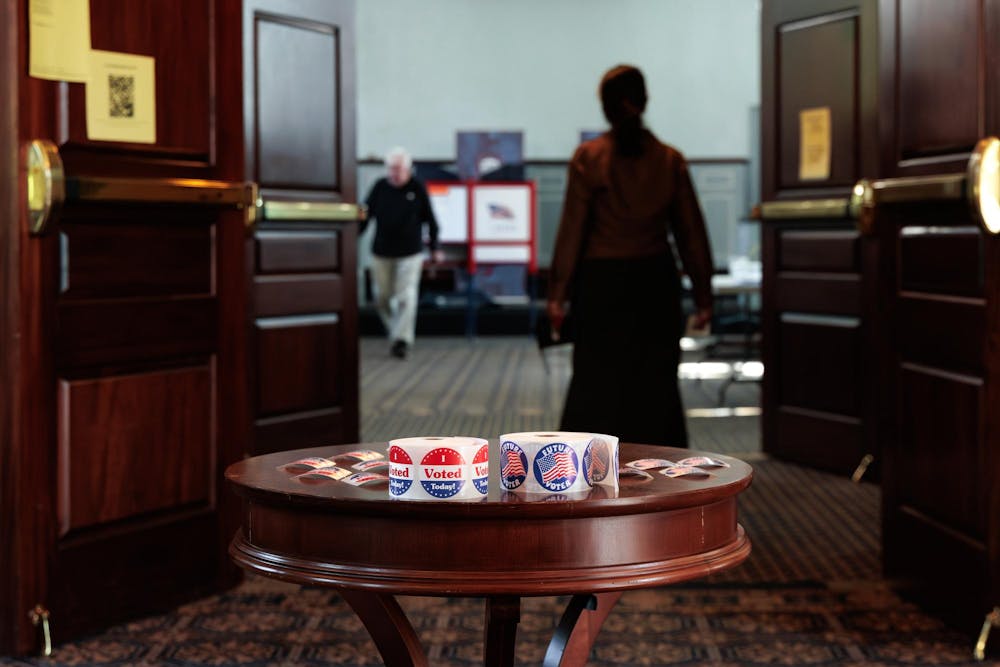
Tuesday was Election Day in Virginia — voters across the Commonwealth had been voting for weeks on whether to approve a Democrat-led plan to redraw the state's congressional maps before the midterm elections in November. If enacted by a Virginia Supreme Court decision validating Tuesday's results, Democrats could expand their advantage in the state's congressional delegation from a six to five majority to a 10 to one majority.
The Associated Press called the race that “yes” won at 8:49 p.m. with 82 percent of votes counted in the Commonwealth. The win means a 10-1 Democrat-favored map has been approved by voters. The new congressional lines will be in effect until after the 2030 census — the next round of redistricting — if Tuesday’s election results are upheld by the Virginia Supreme Court.
The Tazewell County Circuit Court initially struck down the redistricting amendment due to violations of constitutional requirements and procedural rules after the amendment was first introduced in January. The decision was appealed to the Virginia Supreme Court, which deferred its final ruling until the maps were voted on by citizens of the Commonwealth. Now, the Virginia Supreme Court will either uphold or strike down the newly approved map.
Democrats argued they were simply responding to Republican efforts to redistrict first — starting in Texas last summer. Republicans have bashed the map as a partisan gerrymander intended to cement Democrats' advantage and win back the U.S. House of Representatives. A "Yes" vote indicated support for redrawing the maps, while a "No" vote opposed it.
In preparation for Tuesday, national politicians encouraged voters to head to the polls. President Donald Trump spoke with House Speaker Mike Johnson (R-La.) on a telerally call Monday evening, in which he urged Virginia voters to reject the redistricting amendment. Trump called the amendment a “blatant partisan power grab,” criticizing Gov. Abigail Spanberger (D) and “far-left Democrats in Richmond.” Trump warned that if the referendum passes, “Virginia Democrats will eliminate four out of five congressional seats,” leaving voters “wiped out in terms of representation in Washington.”
Democrats brought out their own national figures for the election. Former President Barack Obama repeatedly campaigned for the “Yes” side, as Democrats hoped his popularity with Virginia Democrats would generate enthusiasm. Obama was used by both campaigns this cycle as a tactic, with the “No” side attempting to tie the former president to his past opposition to gerrymandering.
Here is a play-by-play of election day for the redistricting amendment, as reported by The Cavalier Daily throughout Tuesday on four University-area precincts — Slaughter Recreation Center, the Miller Center and Johnson and Trailblazer Elementary Schools.
7:30 a.m. — Early in-person voter turnout in four University-area precincts
While the constitutional amendment received a great deal of attention statewide, some University-area precincts underperformed the statewide average of early votes when compared with turnout in the November 2025 election.
At the conclusion of early in-person voting on the amendment, three of the four precincts — Slaughter Recreation Center, Johnson and Trailblazer Elementary — were below average for their respective precincts compared to November as of Saturday, according to State Navigate.
As of Saturday, the voting location at the Miller Center in Albemarle County saw 444 early votes, or 101.1 percent of early voter totals in November 2025. Slaughter saw 216 early votes, while Charlottesville’s Johnson and Trailblazer Elementary Schools saw 499 and 230, respectively. That calculates to a respective 94.7 percent, 91.2 percent and 74.7 percent of the early vote totals from last November’s election. Miller and Slaughter are above the statewide benchmark, which is around 94.3 percent of November’s early vote.
9:00 a.m. — University-area precincts see significantly lower turnout at 9 a.m. compared to last year
Voter turnout as of 9:00 a.m. significantly lagged behind voter turnout from last year’s gubernatorial race at all four University-area precincts that The Cavalier Daily followed. In terms of in-person vote counts, Miller had seen 41 voters, Trailblazer had seen 58, Johnson had seen 157 and Slaughter had seen 46. Last November by 9:30 a.m., Miller had 80 voters, Trailblazer had 128, Johnson had 197 and Slaughter had 121. In total, this year’s turnout at 9:00 a.m. was just 57.4 percent of last year’s in-person turnout around that time.
Notably, because Tuesday was not a state Election Day holiday, the University continued to hold classes. In a typical general election, students would have the day off of classes.
2:10 p.m. — Out-of-state student encourages peers to head to the polls
Third-year Architecture student Maren Meinhold, hailing from out of state, voted at Trailblazer Elementary Tuesday afternoon. In an interview with The Cavalier Daily, she expressed the importance of exercising her right to vote, regardless of where she is originally from.
“Especially as an out-of-state student living in Virginia, I think it's important to educate yourself on your host state and [learn] more about it, just as someone from outside of the state,” Meinhold said. “Get out here and vote.”
2:30 p.m. — Tablers speak to voters outside of Trailblazer Elementary
Charlie Burns, member of Charlottesville Democrats and first-year Masters of Public Policy student, tabled outside of Trailblazer Elementary School Tuesday morning. He said his role was to give undecided voters information on the vote. Burns said he supports the Democratic campaign because of his disagreement with Trump’s mid-decade redistricting efforts in other states.
“The way I see it, is … we can, as Democrats, roll over and let the other side play by new rules, or we can kind of get down in the mud,” Burns said. “I’m choosing to do some extreme things to hopefully put a check on Trump’s power for at least the next few years.”
On the other hand, first-year College student Abby Brown tabled for the vote “no” side of the redistricting efforts Tuesday morning at Trailblazer, calling the proposed map “totally unfair.”
“[I] want to help talk to voters [and] explain why they should vote,” Brown said. “We get the argument, ‘Oh, Texas did it. This other state did it.’ But we also can’t ignore the fact that other Democratic states have done it, and so it’s not fair.”
4:45 p.m. — Student casts a “no” vote, cites partisanship as sole reason for a “yes” vote
First-year Engineering student Joseph Watkins told The Cavalier Daily that he cast a “no” vote against the redistricting referendum. Watkins’ rationale aligns with that of many prominent Republican politicians who have called the effort a partisan attempt to muster more political control.
“Pretty much every politician is against gerrymandering, and there's really no reason to support it other than partisanship,” Watkins said. “Out of fairness, I voted no.”
4:55 p.m. — Del. Callsen visits Charlottesville polling site, urges students to vote
Del. Katrina Callsen, D-Charlottesville, made a stop Tuesday afternoon at the Herman Key Recreation Center, a polling location near the Downtown Mall, to campaign in support of the redistricting referendum. In an interview with The Cavalier Daily, Callsen encouraged all University students to participate in the election and emphasized the broader stakes of the vote.
“This is really the chance that people have to weigh in on what's happening nationally, and so they need to show up and they [need to] vote,” Callsen said. “What we're doing in Virginia is in response to what Trump has asked Republican states to do, and if you are a Democrat, it's important to protect our voice at the national level, and that requires a ‘yes’ vote today.”
Despite lower turnout reported at University-area precincts, Callsen said she was not concerned, pointing out that referendums with only one item on the ballot often draw fewer voters and that turnout levels so far were still encouraging for that context.
“I'm not concerned because I honestly think that this is in the hands of voters,” Callsen said. “I think it's important to note that this is really about [University students’] future, and so they really need to be showing up and making sure they're voting.”
5:00 p.m. — Students urge others to vote as last votes cast before poll closure
With two hours left in the day to cast a vote, students at polling locations continued expressing the importance of showing up to the polls. First-year College student Amaris Reese, who voted at Slaughter Recreation Center, highlighted the significance of exercising voting rights.
“I … think it’s important if you have the right to vote, or the ability to vote, that you should vote,” Reese said. “Especially me being Black — people fought for me to have this ability. I’m not [going to] take it for granted.”
Second-year College student Sajad Alsafee echoed similar sentiments to other Democratic students interviewed by The Cavalier Daily throughout the day, saying it is important to make voices heard this election and that voting “yes” responds to Republican gerrymanders in other states.
“Especially with this election, Republicans have been gerrymandering for years, and all of the sudden, now we have control in Virginia,” Alsafee said. “I think … Democrats should grow a backbone and actually fight back, and not just play purity politics.”
At Trailblazer Elementary School, The Cavalier Daily interviewed two students side-by-side who voted opposite of one another. Third-year College student Beckett Smith, who was tabling for the “No” campaign at Trailblazer, had been speaking to students outside the polls encouraging them to vote “No.” Smith said he opposes gerrymandering everywhere, including in Republican states.
“Virginia should take this stand against gerrymandering, because I do disagree with what happened in Texas,” Smith said.
Fourth-year Engineering student Sam Chun said while he voted “Yes” as a response to redistricting efforts in Republican states, he too generally opposes gerrymandering.
“I’m not for gerrymandering in most circumstances, so I can see why someone would have a strong opinion about not wanting to do that,” Chun said.
7:29 p.m. — “Yes” ahead in Charlottesville by near-identical margin to Spanberger
At 7 p.m. in the Commonwealth, polls closed for the referendum vote. If individuals were still in line to vote once polls closed, they were still allowed to cast their ballot by law.
Less than half an hour after polls closed, the “Yes” side was ahead in Charlottesville by nearly an identical margin to Gov. Abigail Spanberger’s (D) performance in her 2025 victory, 88 percent to 12 percent.
8:00 p.m. — Same-day registrant numbers down compared to 2025
Compared to last year’s 1286 provisional ballots by same-day registrants cast at the University-area’s four precincts, just 494 same-day registrants cast provisional ballots in the redistricting referendum Tuesday. Notable, however, is the timing of Tuesday’s election — just months after the gubernatorial election, which many students registered for at the time. That could have reduced the need for students to same-day register.
Some press releases thank voters, others thank the Court
Throughout election day Tuesday, legislators and students urged others to make their voices heard by casting a ballot. In a press release Tuesday evening from Spanberger, she expressed gratitude for voters who did just that — specifically, for individuals who cast “yes” votes. She also reassured the citizens of the Commonwealth that the map is temporary, and went on to say she will work to ensure Virginia’s redistricting commission “gets back to work” following the 2030 census.
“Virginia voters have spoken, and tonight they approved a temporary measure to push back against a President who claims he is ‘entitled’ to more Republican seats in Congress,” Spanberger wrote in the press release. “Virginians watched other states go along with those demands without voter input — and we refused to let that stand. We responded the right way: at the ballot box.”
Terry Kilgore, Virginia House Grand Old Party leader, also released a statement Tuesday evening. He is an opponent of the Democrat-favored map, but said Tuesday’s outcome was expected and that he is grateful the Virginia Supreme Court has the final say in the decision.
“Serious legal questions remain about both the wording of this referendum and the process used to put it before voters,” Kilgore wrote in the statement. “These questions have not been resolved, and they now move where they belong — to the courts.”
President Donald Trump posted his reaction to the results on Truth Social Wednesday, calling the election “rigged” and and asking the courts to “fix this travesty of ‘Justice.’”
“A RIGGED ELECTION TOOK PLACE … All day long Republicans were winning, the Spirit was unbelievable,” Trump’s post read. “The Democrats eked out another Crooked Victory … [and] the language on the Referendum was purposefully unintelligible and deceptive. As everyone knows, I am an extraordinarily brilliant person, and even I had no idea what the hell they were talking about in the Referendum.”
Going forward
Like Kilgore noted in his statement, it is now up to the Virginia Supreme Court to validate or strike down Tuesday’s election results. When the Tazewell County Court ruling — which blocked the referendum — was appealed to the Virginia Supreme Court in February, the Court ruled the referendum could occur but only on the condition that it can nullify its results.
Still, the 10-1 Democrat-favored map became immediately effective following Tuesday’s results, and will remain in effect until after the 2030 census — when redistricting occurs again — unless the Court strikes it down. Notably, if the Court validates Tuesday’s referendum results, these new congressional lines will be in place for the 2026 midterm elections.
Read More

Tao Tan discusses financial future of U.Va., rising college tuition trend nationwide
By Lily Kostro | 5 hours agoTan explained how tuition costs will shape the future of academic institutions such as the University.

U.Va. Health cuts scribe hours as AI documentation tools expand across Health System
By Vrinda Vashisht | 5 hours agoScribes in the undergraduate medical scribe program said in interviews with The Cavalier Daily that a new emergency department schedule that began Sept. 15 has reduced or eliminated certain scribe shifts and has decreased scribe availability to clinicians in the Emergency Department.

How does the Honor Committee manage its endowment?
By Isabela Delgado | YesterdayThe Honor Committee manages an endowment upwards of $200,000, and for its 2026-27 academic term, it has budgeted $204,500 — just over its available endowment.