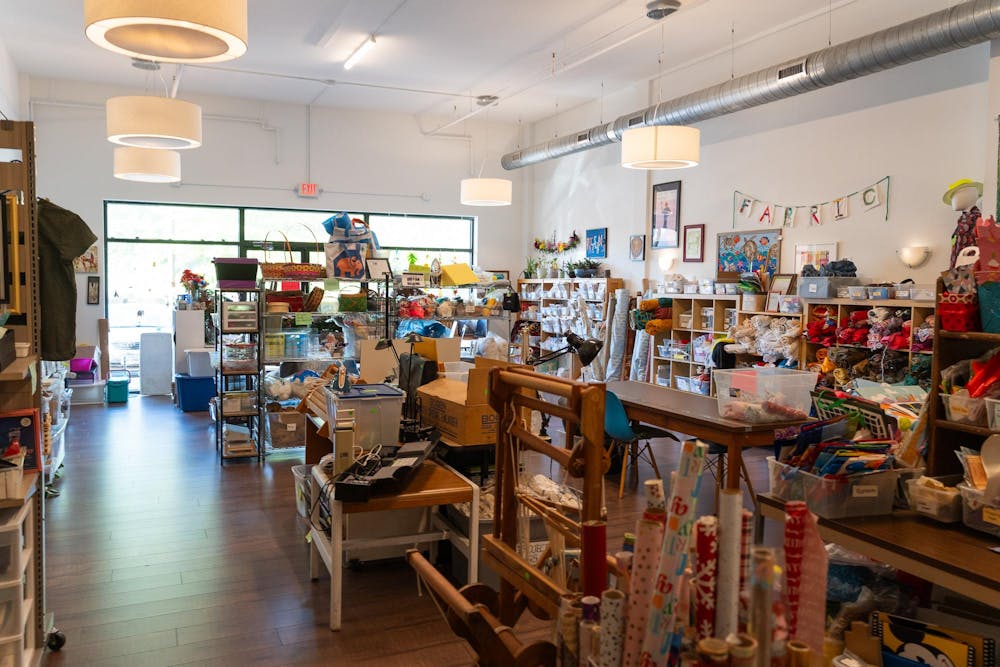
Tucked inside McIntire Plaza on Allied Street, The Scrappy Elephant invites shoppers into something closer to an organized treasure hunt than a traditional craft store. Shelves of donated yarn sit beside bins of fabrics, jars of buttons, half-used tubes of paint and stacks of craft books. All of these materials are sourced from community members and are weighed and priced for resale at The Scrappy Elephant, one of 13 creative reuse centers in Virginia.
The store diverts donated craft supplies brought in by the community and resells them to local crafters in an affordable, accessible manner. According to the shop’s operations manager Ellen Kanzinger, since The Scrappy Elephant opened in 2020, it has kept more than 275,000 pounds of supplies out of landfills, while also donating 50 cents per purchase to local partner organizations including The Arc of the Piedmont and The Free Book Bus.
Founded by Sarah Sweet, a former high school art teacher, the store operates on a simple system of accepting, sorting and selling materials back to the community at an accessible rate. When her daughter was born in 2013, Sweet said she began thinking about climate change’s impact on the future of the planet and how to spur positive change for her daughter — all while aligning that endeavor with her love for art. Sweet said she drew inspiration from the creative reuse centers she visited in cities like Nashville, Tenn., identifying a gap in Charlottesville’s retail landscape between big-box craft chains like Micheal’s and local fine art suppliers like Creative Framing & The Art Box.
“I was down in Nashville, Tennessee, and read an article about this thing called a creative reuse center, and I had never heard of one,” Sweet said. “So I went and visited it, and I was just like, blown away. It was so incredible.”
According to Sweet, The Scrappy Elephant’s name carries dual meaning. The word “scrappy” nods both to the donated craft materials themselves and to the ethos behind the business. As for the elephant part of the name, Sweet said she fell in love with the creatures during her time in Ghana while in college and after graduating.
“I was talking to a creative reuse center in Utah,” Sweet said. “They were called the Clever Octopus, and they said you have to get a name people are going to remember. And so I knew it had to have elephants in it.”
Each donation brought in from the community is weighed before being sorted and priced, giving staff a running tally of material diverted from being thrown away. Kanzinger noted that a few hundred pounds of supplies can move through the store on any given day.
"One donation here, you know, a small box here, a small box there, really can add up to quite a large impact over time," Kanzinger said.
Inventory at The Scrappy Elephant spans nearly every category found at a large craft retailer, including yarn, paper, jewelry-making materials, soap and candle supplies and craft books. The store’s model also pushes back against the bulk packaging norms of mass retailers. Shoppers can purchase a single pipe cleaner, a handful of colored pencils or one spool of thread, rather than a prepackaged set. Kanzinger said that flexibility lowers the barrier of trying a new craft without completely committing to a full kit’s price tag.
The selection, however, depends entirely on what community members bring in — a constraint that the store has turned into part of its appeal. Referred to by staff as “scrappy magic,” the phenomenon occurs when a shopper walks in and needs a specific item — anything from fabric to a frame — just as it arrives via donation from others. Kanzinger said she hears a customer gasp with joy nearly every day upon finding the perfect product. Additionally, Sweet said she frequently finds customers excited by finding the exact item they need.
“So many times I've heard over the past couple of years, people have said, 'Oh, I needed this thing, and I put it in my Amazon cart, and then the next day I looked online, and it was there at The Scrappy Elephant,’” Sweet said.
The impact extends beyond just adult community members, too. Sweet recalled a time when her daughter was in elementary school, and Sweet overheard a classmate of her daughter’s talking to her mom. When the mother offered Michael’s as an option for finding items for a Halloween costume, the classmate mentioned wanting to go to The Scrappy Elephant instead.
“It was really cute … It's so lovely to see that, starting from such an early age, [children are] already learning [that they] don't have to go to some big box store, we can reuse … let's make stuff from what we have,” Sweet said. “That's really so lovely.”
While massive amounts of craft supplies move through the store on a daily basis, some donations carry more emotional weight than others. When longtime crafters pass away, family and friends from the community often bring their supplies to the shop, trusting that the material will be used rather than discarded. Kanzinger recalled an instance where this had occurred — when a member of the quilting community passed away, her friends came together to donate three carloads of fabric.
“Not only are we helping keep arts and crafts supplies out of the landfill, but we're also giving people a place where they know that the things that they once loved and cherished will be loved by somebody else,” Kanzinger said.
Beyond retail, The Scrappy Elephant functions as a community gathering space. The shop hosts classes, weekly stitching groups and poster-making sessions for members of the community, including one for this year’s No Kings Day protest.
Through its NonProfit Rewards program, the store donates 50 cents from each purchase to one of six partner organizations, which can redeem the monetary credit for supplies at The Scrappy Elephant. This initiative allows Charlottesville nonprofits to provide low-cost arts-focused programming across the region. Kanzinger said the Rewards program distributes roughly $700 to $800 in materials through these partnerships each month.
The Scrappy Elephant recently opened its second location in Lynchburg, Va., and Sweet said she would like to see more creative reuse centers grow and expand to enable more communities to keep making art.
“I think whether we open [the stores] or someone else [opens a store], it's just nice to encourage other people to get into this creative reuse world, because it's so much fun,” Sweet said. “Art is so needed for our souls. We need tangible, material things that we can do to calm our nervous systems and deal with all the stress in the world right now. So the more art that we have out here, the better.”
Read More

‘The Social Reckoning’ is many things, but a sequel is not one of them
By Caroline Lee | 1 hours agoSorkin’s script still soars, but its execution often falls flat.

October Book Club: Spooky stories with frightening film adaptations
By Zoe McFarland | 10 hours agoWith the corresponding screen adaptation of each selection, pairing these page turners with their corresponding films invites one to turn an evening read into a cozy fall occasion.

Writer’s Eye brings vivid ekphrastic writing and reflective art education to the Charlottesville community
By Cecilia Sherman | YesterdayThis fall marks the 40th annual Writer’s Eye competition presented by the Fralin Museum of Art at the University.