
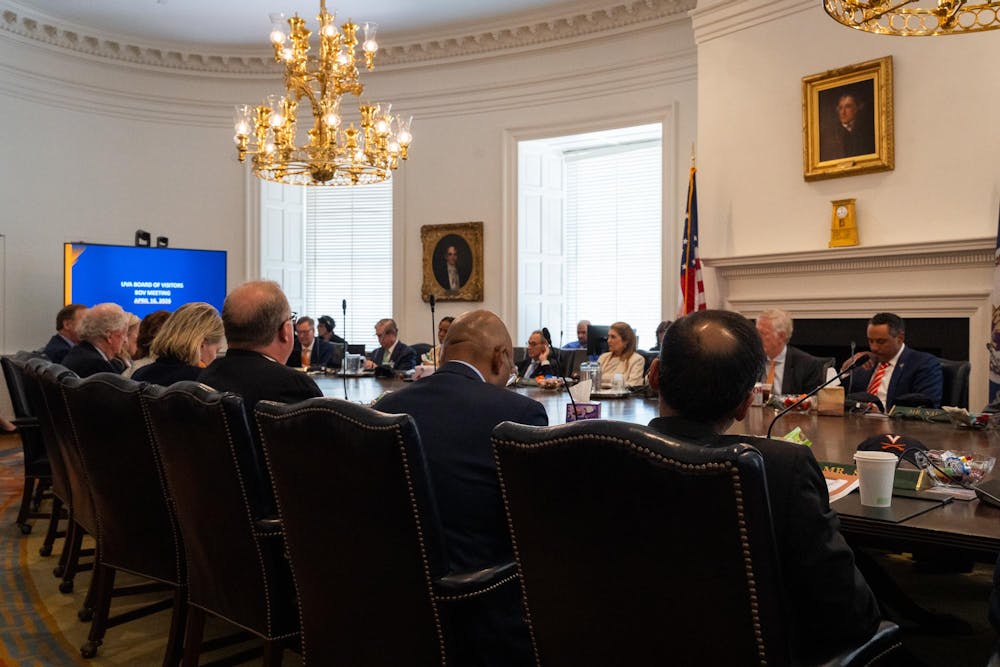
The Board of Visitors’ Finance Committee met Friday and approved a $7 billion budget for the University in fiscal year 2027, with $2.7 billion allocated to the Academic Division and Wise and $4.3 billion allocated to U.Va. Health. The Committee also heard from Jennifer Wagner Davis, executive vice president and chief operating officer, Augie Maurelli, vice president for finance and chief financial officer, and University Treasurer Julie Richardson.
The Finance Committee is chaired by Vice Rector Victoria Harker and is responsible for the University’s financial affairs and business operations. The Committee manages the University’s budget, tuition and student fees.
The University’s organizational structure is made up of three state agencies — the University Academic Division, which is responsible for instruction and research, the College at Wise and the University Medical Center, which is part of U.Va. Health.
Davis said that FY 27’s budget has been affected by legislation passed this session by the Commonwealth, including the minimum wage increase. According to Davis, the University pays its workforce a “living wage” — the minimum hourly wage a full-time worker needs to afford necessities — with the exception of the University’s student workers. The raise in minimum wage, Davis said, would cost the University $200,000 in FY 27 and $1.5 million in FY 28.
Additionally, Davis said the Virginia Military Survivors and Dependents Program is an “unfunded mandate,” which are laws imposed, but not funded, by the government. VMSDEP is a program that gives education benefits to spouses and children of disabled veterans or military service members killed, missing in action or taken prisoner. Davis said that in the past year, the unfunded portion of the program cost the University $3.6 million.
The budget also includes a $6 million increase for the University’s Department of Safety and Security. Davis said that in FY 26, all operating units were reduced by three percent, or an $18 million cut in funding. Davis said that Timothy Longo, associate vice president for Safety and Security and chief of police, told her that cuts to the budget for the Department of Safety and Security would be unwise after the 3 percent cuts issued to all operating units last year. The $6 million increase for DSS would maintain the “appropriate level of staffing,” Davis said.
According to Davis, the budget was increased by $72.1 million due to various pressures the University is facing. The Academic Division has an operating budget of $2.59 billion for FY 27 and is a balanced budget — a budget where revenue equals or exceeds the expenses. Davis said the increased cost for the Academic Division — a 2.9 percent increase from FY 26 to FY 27 — was attributed to different factors, including faculty recruitment and retention and ensuring regulatory compliance.
The College at Wise is also facing several cost drivers, including compensation increases, fringe benefit increases and minimum wage increases, according to the presentation. For FY 27, Wise has an operating budget of $80.1 million and its budget is also balanced. The presentation attributed volatility in the supply chain and competition around the price of higher education as pressures raising their budget by 3.1 percent.
U.Va. Health is dealing with fiscal pressure from different sources, Davis said. She said it has an estimated revenue of $4.41 billion and an operating budget of $4.32 billion for FY 27. Davis said U.Va. Health is facing pressures around cybersafety, cybersecurity and regulatory changes. She also said that the staff at the Medical Center will have a 3 percent raise due to the “competitive market.”
“[U.Va. Health’s financial] world is as dynamic, if not more so, than the academy. So, [we are] thinking about all the changing landscape that they're navigating and leading in,” Davis said. [U.Va. Health’s] modeling is very dynamic, and we monitor it year round.”
Following the budget’s approval, the Committee voted and unanimously approved four capital project financial plans, which designated additional funding for projects that have already been approved.
Among the approved plans was a $30 million addition to the Fontaine Data Center, which is a shared facility between the University and U.Va. Health. Davis said the $30 million will be put towards adding U.Va. Health’s data center to the third floor, taking the total cost of the project from $72 million to $102 million. The Committee also authorized $7 million to finalize the design of the Center for the Arts.
The Committee received a presentation from Richardson regarding the University’s issuance of debt. Currently, the University has $3.3 billion in debt issued in bonds with the earliest debt maturity in 2039, according to the presentation. Debt maturity is the date at which the final repayment of a debt instrument is due to the creditor. Additionally, Richardson said the debt portfolio’s diversity is a strength for the University.
“The diversity really demonstrates our ability to access the capital markets across a broad range of instruments, really depending on the market conditions at the time that we hit the markets,” Richardson said.
Richardson said that the University borrows when the economic opportunity is available and not when money is needed.
“The most important strategic principle underlying our debt management is that we access capital markets based on economic opportunity, not on the timing of capital projects,” Richardson said. “We borrow when conditions are favorable, not simply when a building needs to be built. The discipline is one that we've done for at least two decades at this point, and it's really produced measurable results.”
Richardson said the University does this through debt shelves, which are pre-approval for debt issuances by the Board, that is saved until the best opportunity. This allows the University to issue debt when interest rates are low. Currently, the University has $700 million in unissued debt shelves.
“When the Board provides an authorization to issue, but we're not ready to go to market, we say we put it on the shelf, and so we're calling these pre-authorizations a debt shelf,” Richardson said. “The three debt shelves provided in [2020 and 2021] allowed us to quickly take advantage of the market conditions, and … we accessed the market at really unprecedented times.”
Richardson also spoke on the University’s bond rating — an assessment evaluating the creditworthiness of the University — explaining that it holds a AAA Bond rating from all three credit rating agencies and is one of only four public universities to do so. The three rating agencies include Moody's Investors Service, S&P Global Ratings and Fitch Ratings, and an AAA rating is the highest rating that can be given, allowing for issuers to borrow at lower costs.
“Even at a time when leading institutions are facing volatility, including health care, we still believe in the rating and our approach to managing it,” Richardson said. “Pressures [to the rating include] continued revenue growth, expense pressures [and] policy uncertainty.”
Richardson said rating agencies have a negative outlook when it comes to the ability of public universities to pay back debt. She said that risks from government policy and lower enrollment rates could decrease revenue universities produce, making public universities a riskier investment.
“Moody's had a higher ed briefing … [and] they reiterated their outlook remains negative, and it's really due to the pressures the whole sector is facing,” Richardson said. “U.Va.’s AAA rating is underscored by the strength of our financial foundation [and] the discipline to maintain it.”
The University, however, is taking steps to mitigate risks, including diversifying its sources of revenue and ensuring there is a high demand for education from the University. Davis said a hypothetical downgrade in rating would have large fiscal, reputational and regulatory effects on the University and the Commonwealth.
Looking ahead, Richardson said that the University will look to utilize tax exempt financing to raise $1 billion in debt to cover future projects, including the Ivy Corridor Student Housing, the Paul and Diane Manning Institute of Biotechnology and the Fontaine Central Energy and Utility Plant.
Maurelli gave a presentation to the Committee on the Strategic Investment Fund, which provides funding to “support key initiatives of the University.” Since its establishment in 2016, the SIF has awarded $1.24 billion to the University. Its gifts have been used to fund the University’s 2030 Strategic Plan and to support professorships and research.
The Finance Committee will reconvene during the regularly scheduled September Board meetings Sept. 16-19.

Edward Christopher is a staff writer on the news desk as well as a member of the advertising team for The Cavalier Daily. He is a second-year Commerce student from Northern Virginia. Edward enjoys covering state politics and University developments.
Read More

U.Va. and United Way of Greater Charlottesville launch ‘Give Where You Live’ donation partnership
By Vrinda Vashisht | 5 hours agoThe program is set to run through Dec. 18, and its start date coincided with United Way’s 35th annual Laurence E. Richardson Day of Caring.

Student Council passes bill to create ad hoc committee to review UBE proceedings
By Edward Christopher and Anna Ivanov | 5 hours agoThe Commission will craft a report on the University Board of Elections’ current structure and governance practices, putting forth proposals for corrective action based on its findings.
Board of Visitors discusses the implementation of AI in research and academics
By Jaylynn Perez | 15 hours agoThe Board also received an orientation on changes to NCAA athletics, completed its annual Atlantic Coast Conference certification, heard a report from Aaron Bloomfield, Faculty Senate chair and engineering professor, and discussed the University’s ongoing searches for a provost and several deans.


