

In a Board of Visitors meeting June 6, Dr. Mitchell Rosner, U.Va. Health chief executive officer and executive vice president for health affairs, presented updates on issues the Health System has focused on over the past year, including reworking the finance team and “repairing and developing” the organization of the system to be based in honesty and trust. He also presented the issues still facing U.Va. Health, and posed six questions to Board members regarding how the University can work to ensure the Health System expands efficiently.
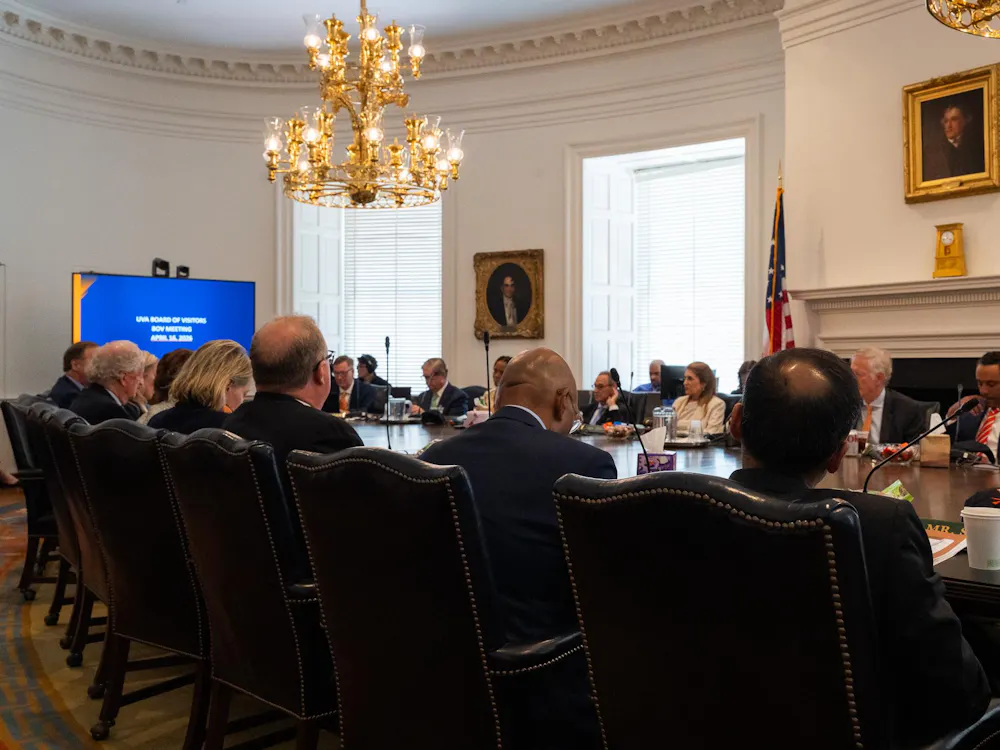
The Cavalier Daily is reporting on the meeting June 6 based on the presentation posted online to the Board’s website. The meeting took place as part of the Board’s retreat to Morven Farm in Albemarle County where members met to discuss areas of focus outlined by Rector Carlos Brown in the March meeting of the full Board. Rosner’s specific presentation pertained to the second of the seven focuses — “advancing patient care and saving lives.”
Rosner first pointed out in his presentation that the meeting did not intend to resolve all “key questions immediately.”
“The goal of this retreat is not to resolve key questions immediately, but to — establish a shared understanding of the challenges and opportunities, align on the strategic importance of the Health System within U.Va.’s future [and] identify areas where further analysis and potential structural evolution may be warranted,” the presentation reads.
The Board appointed Rosner to a three-year term as CEO Sept. 12, and he began his presentation at the June 6 meeting by highlighting issues the Health System has worked to solve over the past year. He pointed out issues within the system from before his leadership, which — according to the presentation — include the hiring of nearly 300 faculty without paying attention to needed infrastructure to support those faculty.
Another issue is the addition of U.Va. Community Health — “the provider group supporting U.Va. Health’s community medical centers and clinics” throughout neighboring areas in the Commonwealth —- which led to “pressure on cash flows” and debt. The presentation also points out the issue of the addition of research faculty without resources to provide them with space and support once their start-up resources are depleted.
Over the past year and under Rosner’s leadership, the presentation noted that focus within the Health System has been to boost faculty morale and improve patient access and the overall operations of the Medical Center.
However, U.Va. Health is still facing issues, which Rosner said include “rising patient demand, expanding clinical activity and greater expectations to serve patients across Virginia.” U.Va. Health is the Commonwealth’s leading academic health system, and with that comes “structural tensions,” according to the presentation.
Regarding finances and capital, the presentation explained that U.Va. Health is changing the broader financial landscape of the University by representing a "significant and growing share” of revenue. U.Va. Health has a yearly revenue of approximately $4.4 billion — over half of the University’s total revenue of $7.1 billion. Rosner said healthcare has a high degree of volatility and variability, however, that must be taken into account as the University considers how to approach the changing financial profile from increases in U.Va. Health’s revenue.
“How should U.Va. evolve its financial and capital strategies to ensure both the long-term strength of the University and the ability of the Health System to invest, grow, and fulfill its clinical and academic mission?” the presentation read.
Rosner also considered the governance of the Health System, which currently has an integrated governance model within the University, meaning it is overseen by the Board. The Board has a Health System Board to specifically oversee the Medical Center, but the presentation asked whether the current governance model enables the “speed, flexibility and accountability” needed to propel the Health System through an “increasingly competitive healthcare environment.”
Regarding a key issue pointed out by Rosner at the start of the presentation — infrastructure — he asked the Board what level of investment and what capital model is needed to assist the next 10 years of growth for the Health System in its clinical care, research and education. Rosner included this as a key question due to his emphasis that patient demand is outpacing current infrastructure.
Rosner next focused on “cost structure and delivery efficiency,” asking the Board how the University can “ensure that project delivery, capital deployment and operational decision-making are cost-effective and competitive with peer health systems.” The University of North Carolina at Chapel Hill Health, West Virginia University Medicine, University of Maryland Medical System and Indiana University Health are some examples listed of peer health institutions.
Philanthropy is highlighted in the presentation as a “critical and growing” funding source for health systems across the country, and Rosner asked the Board how the University can align philanthropic efforts to maximize impact for the Health System.
The last question posed by Rosner at the meeting was in regard to the broad scale, growth and mission of U.Va. Health. Health systems nationally are expanding to increase access to patient care, fund research and education and plan for long-term financial success, the presentation explained. Rosner presented that with similar pressures facing U.Va. Health, it is necessary to have large clinical margins to sustain teaching and research, and left the Board with an overarching question to consider the path of U.Va. Health moving forward.
“What level and model of growth are necessary for U.Va. Health to fulfill its role as Virginia’s leading academic health system?” the presentation read.
The “advancing patient care and saving lives” meeting June 6 was a special meeting as part of the June meetings of the full Board. It is unclear when the Board will meet next to discuss this specific matter, but the full Board will meet again for its regularly scheduled meetings Sept. 16-19.
Lauren Seeliger is a news editor of the 137th term and enjoys covering U.Va. Health and University governance. Lauren is a fourth-year Behavioral Neuroscience student from Fairfield, Connecticut.
Read More

U.Va. and United Way of Greater Charlottesville launch ‘Give Where You Live’ donation partnership
By Vrinda Vashisht | 5 hours agoThe program is set to run through Dec. 18, and its start date coincided with United Way’s 35th annual Laurence E. Richardson Day of Caring.

Student Council passes bill to create ad hoc committee to review UBE proceedings
By Edward Christopher and Anna Ivanov | 5 hours agoThe Commission will craft a report on the University Board of Elections’ current structure and governance practices, putting forth proposals for corrective action based on its findings.
Board of Visitors discusses the implementation of AI in research and academics
By Jaylynn Perez | 15 hours agoThe Board also received an orientation on changes to NCAA athletics, completed its annual Atlantic Coast Conference certification, heard a report from Aaron Bloomfield, Faculty Senate chair and engineering professor, and discussed the University’s ongoing searches for a provost and several deans.


