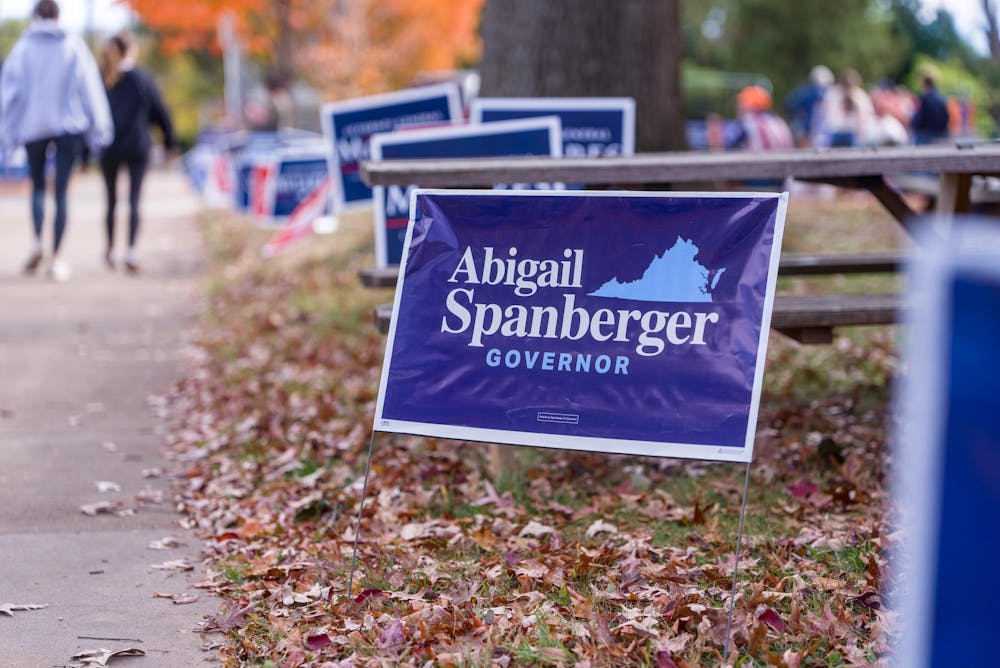
In a letter addressed to Gov. Abigail Spanberger (D) May 29, Wahoos4UVA’s co-chairs — Class of 1974 alumna Ann Brown and Class of 1987 alumnus Chris Ford — asked the governor to look into alternative mechanisms to protect Virginia’s higher education institutions and maintain academic freedom after Senate Bill 494 and House Bill 1385 failed to become law.
Wahoos4UVA is a grassroots organization of alumni, faculty, students, staff and parents formed spring 2025 to counter misinformation and calls for the resignation of former University President Jim Ryan.
The letter asks Spanberger to issue an executive directive to boards of visitors members and the head of the State Council on Higher Education in Virginia regarding board policies and training to act in the best interest of higher education institutions and commit to shared governance. Additionally, the letter requests that Virginia Attorney General Jay Jones issue an opinion on the role of higher education governance boards and asks for a working group to consider legal counsel reform.
“It is important that, even without legislative action, mechanisms be put into place to protect Virginia institutions of higher learning from federal government overreach that would negatively impact academic freedom,” the letter reads.
The letter addresses “federal government overreach” as one of Wahoos4UVA’s motivations for higher education governing board changes. This month will mark one year since Ryan’s pressured departure by federal government actors. In the year since his leave, the University reached a settlement with the U.S. Department of Justice related to civil rights investigations in October and rejected the Trump administration’s Compact for Academic Excellence in Higher Education.
In the fallout from Ryan’s departure, some University groups have criticized the University Board of Visitors for its alleged role in Ryan’s leave and its response in the months following, including its appointment of University President Scott Beardsley Dec. 19.
“The federal government’s overreach, combined with the actions … of some [Board] members in response, resulted in a direct and credible threat to the academic freedom of the University,” the letter reads.
SB 494 and HB 1385 — identical bills patroned by Sen. Creigh Deeds (D-11), Senate Majority Leader Scott Surovell (D-34), Del. Lily Franklin (D-41) and Del. Betsy Carr (D-78) — would have changed governing board membership and the duties of Virginia’s public higher education institution governing bodies, extended board terms from four to six years, required shared governance policies and directed SCHEV to convene related work groups.
After Spanberger’s veto of both bills, Wahoos4UVA wrote with recommendations for further steps outside of the General Assembly legislative process.
“We believe, [and] I think many alumni of U.Va. believe, that the legislature hasn't given up on the issue, and the governor hasn't given up on this set of issues either,” Brown said. “We describe in the letter some principles [that] can get established even before we have legislation.”
According to Brown, two Wahoos4UVA members — Class of 1966 alumnus Richard Marks and Claire Guthrie Gastañaga, Law Class of 1974 alumna — were instrumental in crafting the letter’s recommendations within Spanberger’s authority.
Brown said Marks primarily worked on the recommendations pertaining to board legal counsels, including convening a working group to potentially propose changes to the current structure of these counsels. Marks said in an email statement to The Cavalier Daily that the letter writ large is not asking for reform — rather, it asks for the Governor and the Board to respond to unconstitutional threats from the past year.
“Responding to both immediate and long-term unconstitutional pressures from the Trump administration requires U.Va.’s Board to adopt new, strong protective measures for academic freedom,” Marks wrote. “But that isn’t Board ‘reform.’ It is the Board’s recognizing a stark threat and responding to it.”
Marks laid forth the intended purpose of legal counsels, which is a “constant [and] intense” task, he posits. Each governing board needs legal advice to fulfill its responsibilities of managing a corporation, Marks said, for compliance with various state and federal statutes and regulations.
The University’s counsel is an assistant attorney general who is duty-bound to serve the attorney general, Marks clarified. Marks has published articles on the importance of establishing the independence of university counsels from this political structure to resolve conflicts of interest, because the current framework allows the attorney general’s political interests to bias its demands of university counsels, he said.
“The current statutory structure doesn’t work. It’s an impediment to proper corporate governance. Recent experience proves that point,” Marks wrote.
For university and college board legal counsels across the Commonwealth, SB 494 and HB 1385 would have proposed a mechanism to ask whether these boards should gain authority to hire and fire its counsel like many other states, including Florida, Michigan and Texas.
SB 494 and HB 1385 would have also called upon SCHEV and the Office of the Attorney General — Spangerger’s amendment removed the Office of the Attorney General from this process — to convene a work group to study legal counsel structures at public universities, the use of outside counsel and a process for determining when a university’s counsel was not acting in the institution’s best interests.
“It is important that there be a way to generate open discussion of the merits and demerits of the practice and recommendations for future legislative action,” the letter reads.
Wahoos4UVA urged Spanberger to form a working group, as the legislation would have, to study questions raised about university legal counsel. According to Marks, the working group would prepare proposals for an updated statute to be circulated and debated among all stakeholders — the General Assembly, the Governor, the Attorney General, all Virginia’s state colleges and universities and the public. As a result, legislation would be prepared for the General Assembly’s next legislative session in January.
Marks said Spanberger could identify working groups members with higher education experience and adequate legal and corporate knowledge. Ideally, he said Spanberger would also solicit input from Virginia’s public higher education institutions, expert opinions and input from the public, and he hopes the working group would hold public hearings to gather more community input.
Gastañaga, Brown said, tailored the recommendations to fit the governor’s authority to act. Brown said Gastañaga was instrumental in crafting the letter’s recommendation asking Jones to reverse former Attorney General Jason Miyares’ 2023 directive mandating that governing boards prioritize service to the Commonwealth rather than to the higher education institutions themselves.
“The executive directive and request to the AG are both directed at the same thing — clarifying that the boards of visitors owe a primary duty of loyalty to the institutions they serve,” Gastañaga wrote in an email statement.
The Wahoos4UVA letter mentions Miyares’ 2023 opinion, which posits that members of higher education governing boards have a primary duty to advance the interests of the Commonwealth, not the institutions they serve. Wahoos4UVA asked Spanberger to request for Jones to assert his own opinion on this matter, potentially to overrule Miyares’ “prior erroneous opinion.”
“There's consensus that working to maintain the independence and strength of the institution is the primary obligation of our Board of Visitors at U.Va. and at all the other public institutions,” Brown said.
According to Gastañaga, Miyares' opinion asserts incorrectly that the Board’s primary duty is to serve the Commonwealth, which makes it first loyal to the governor rather than the higher education institutions. All boards of directors have three duties, according to Gastañaga — loyalty to the institution, obedience to the law and care with respect to financial and other responsibilities.
“The U.Va. Board, in my opinion, breached all three,” Gastañaga wrote. “[The Board] also failed to act in the University's best interests in their individual unauthorized negotiations with the federal government.”
SB 494 and HB 1385 both passed the General Assembly March 14 and were sent to Spanberger’s desk March 31. Spanberger returned the bills with her recommendations April 13, and after the General Assembly did not adopt Spanberger’s proposed changes, she vetoed the legislation May 19. Spanberger vetoed the bills because she said they could further politicize public higher education governance, and she said the legislation left the appointment process for board members vague.
“I offered amendments that would remove certain provisions that could further politicize our institutions of higher education and undermine the current efforts of my administration and boards to stabilize governance of the Commonwealth's universities,” Spanberger’s veto explanation reads. “While the General Assembly rejected my amendments, I remain committed to enacting reforms that will strengthen higher education governance in Virginia.”
Spanberger’s veto served as the final rejection, meaning the legislation has no chance of becoming law until the next legislative session, when it can be reintroduced by lawmakers.
The letter addresses Wahoos4UVA’s approval of Spanberger’s expressed intentions to reform higher education to depoliticize university governing boards and maintain academic freedom. As is apparent in her veto explanation, Spanberger, an alumni of the University herself, has expressed interest in engaging with the Board. The day prior to her term in office, Spanberger asked five members of the Board to resign, and the next day, she appointed 10 new Board members.
”We were grateful that your campaign for governor included a focus on failures in governance at … public universities and on the dangers posed by federal interference in higher education,” the letter reads. “We further applaud your commitment to reforms at the [University] in response to … the forced resignation of … Jim Ryan.”
Looking forward, the letter asks Spanberger to consider these alternative mechanisms of governance board reform. According to Brown, Wahoos4UVA has not received a response from Spanberger.
Brown said Wahoos4UVA also forwarded the letter to Beardsley, Board Rector Carlos Brown, Board Vice Rector Victoria Harker and Mark Luellen, senior vice president for external relations at the University.
Considering all that has transpired in the last year at the University, Gastañaga warned against waiting until the next legislative session to act on the matter of university governing boards, especially because any legislation passed in the next session would likely not be implemented until July 1, 2027. Gastañaga said a lot can happen before this implementation date, so change is needed now.
“If there isn't an effort by the Governor and the Attorney General now to clarify the responsibilities of board members and develop a way to hold them accountable to fulfill their duties and comply with FOIA and other applicable rules, there will continue to be issues with university governance and protection of academic freedom, not just at U.Va.,” Gastañaga said.
Grace Little is a news editor for the 137th term. She is a third-year student from Dallas, Texas majoring in Neuroscience and the Interdisciplinary Major in Public Policy, Politics and Media Studies. She enjoys writing about the shifting landscape of higher education.
Read More

An update on Beardsley’s ‘Grounds for Conversation’ initiative
By Nicolas Biernacki | 6 hours agoIn a statement to The Cavalier Daily, University Spokesperson Bethanie Glover described the initiative — Grounds for Conversation — as an effort to learn the University’s strengths and areas for improvement.

Board reviews U.Va.’s athletic competitiveness, highlights success under NCAA changes
By Ruby Budetti | 7 hours agoAccording to the meeting’s presentation, the Board covered seven topics — Virginia Athletics’ organization, value proposition, performance at a glance, peer benchmarking, House settlement and NIL, fiscal year 2026 highlights and economic impact.

Tammy Snyder appointed CEO of the University Medical Center
By Lauren Seeliger | 7 hours agoAccording to the U.Va. Health press release announcing her appointment, Snyder will begin in the role Aug. 3 and is replacing Kathy Baker, interim CEO of the Medical Center.