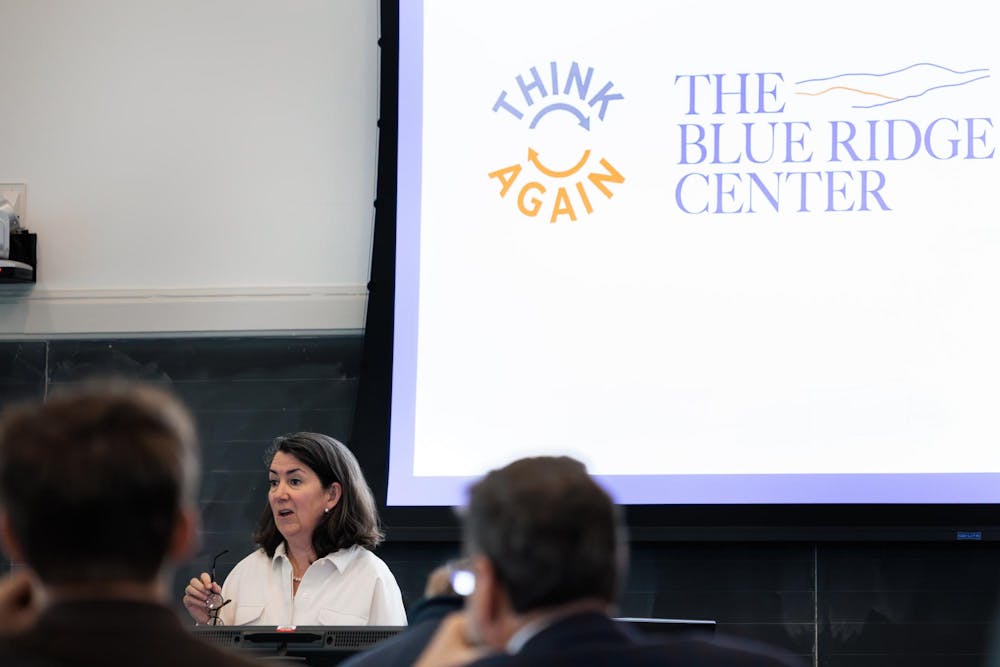
Andrus Ashoo, director of the University’s Office of Citizen Scholar Development, will serve as interim director of Think Again U.Va. Mary Kate Cary, the program’s founder and former director, announced via email June 30 that she would be departing for the University of Denver and that Ashoo would take over as interim director, effective immediately.
Founded by Cary in 2022, Think Again is an initiative that aims to promote “freedom of expression, critical thinking, viewpoint diversity and intellectual humility” on Grounds, according to its website. The program hosts student-facing events such as the student-professor debates “Disagree with a Professor,” as well as faculty debates and an annual student oratory competition centered on the United States’ founding values. In addition to its events, Think Again also publishes a blog and podcast covering subjects like artificial intelligence, thinking, disagreement, ethics and philosophy.
Cary has also served as University deputy chief of staff for communications and strategic initiatives to the president since September 2025 under former University Interim President Paul Mahoney and University President Scott Beardsley. She left to serve as the founding executive director of the National Academy for Free Expression and Pluralism at the University of Denver, a role which she began June 15.
Ashoo previously served as director of the Office of Undergraduate Research at the University before becoming director of the University’s Office of Citizen Scholar Development in 2018. Ashoo also currently serves as a board member for the Center for Christian Study at the University.
Looking ahead to the initiative’s future, Ashoo said he hopes to continue balancing Think Again’s current programming while expanding both student and faculty participation in the initiative’s events. Ashoo described what he sees as challenges surrounding discourse on Grounds, adding that Think Again encourages students to wrestle with ideas and develop intellectual humility.
“We've for some reason entered this period of life at the University where when we disagree with someone, we can no longer hang out with them,” Ashoo said. “I don't want to say we're just trying to get people to fight and get [into] arguments. We want to stimulate curiosity.”
When planning events, Ashoo said that Think Again considers which discussion topics for its events are most likely to attract different groups of students. Think Again often hosts events multiple times per month with the aim to stimulate conversations that continue to take place outside of the formal event times. Past events hosted discussions on U.S. foreign policy, a professor debate on the use of AI and political violence in the U.S.
“We’re trying to think of how [we can] stimulate community building and … more casual spaces where … these conversations aren’t just centered around our events, but they’re continuing after events,” Ashoo said.
Ashoo also discussed the challenge of engaging students who do not typically participate in discourse initiatives on Grounds. He said encouraging students to invite their peers to events could help broaden participation moving forward.
Think Again is among several organizations on Grounds with similar free speech initiatives, including the student-led Civil Discourse Initiative, Middle Grounds and Heterodox Academy at U.Va. Discourse initiatives like these have recently been emerging at colleges nationwide, and in November, the Trump administration redirected $60 million in federal funding — previously in part to support underserved students’ college attendance — to instead be used for initiatives promoting civil discourse.
Despite the number of organizations on Grounds similar to Think Again, Ashooo said initiatives to promote viewpoint diversity are not oversaturated. He said Think Again does not necessarily need to occupy a unique role in these conversations, and that he is simply “happy to contribute to the landscape … and opportunities” for the various events.
“There’s clearly still room to have these sorts of [viewpoint diversity] engagements, and students are excited when they get to have them,” Ashoo said. “We have great relationships with a lot of these student-led organizations.”
According to Ashoo, being a faculty-led initiative offers certain advantages, including broader institutional connections that help secure judges for the initiative’s oratory competition — an annual event in which undergraduates and graduates are invited to prepare speeches in response to some given prompt. This past academic year, students answered the prompt, “Describe an event from American history and explain how it illustrates a founding principle of our Declaration of Independence.”
Ashoo also said the initiative’s faculty connections can help to bring in perspectives different from students’ at discussions and debates. He noted that faculty may be able to develop questions that students might not consider during conversations.
Ashoo explained that Think Again ultimately hopes to foster an environment where students and faculty can engage in difficult conversations despite disagreements.
“I'd like students to know that Think Again genuinely cares about seeing the dignity of other people and wanting students to have that and [to] take each other seriously and [to] see professors as people and not just high up in an ivory tower,” Ashoo said.

Lucia Gambacini is a senior writer on the news desk covering Student Council and other issues pertaining to student life and government. She is a third-year from Richmond, Va. studying Political & Social Thought in the College.
Read More

The Honor Committee discusses ideas for spring semester Honor Week
By Isabela Delgado | 13 minutes agoAccording to Freed, the Committee selected “Honor Beyond” as this year's theme to help convey to the University community that the Committee extends beyond a punitive organization that sanctions students for honor violations.

How is UBE amending its rules and regulations for the 2026-27 academic year?
By Melody Yuan | 18 minutes agoThe University Board of Elections released the first draft of the Board’s Rules and Regulations of the 2026-27 academic year Sept. 1, and a commentary period was held for University students to provide feedback on the draft until Tuesday.

POLL: How did University students spend their summer?
By Grace Little | YesterdayThe Cavalier Daily aims to answer all of these questions and more with its poll — How did Hoos spend their summers?