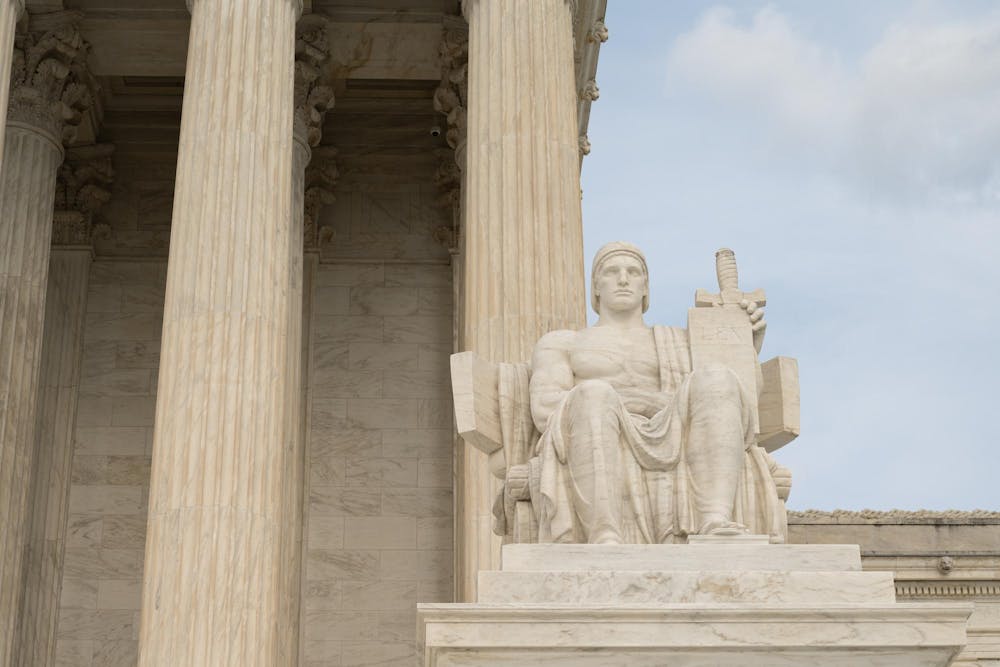
In a 6-3 decision June 30, the Supreme Court officially ruled against the Trump administration’s attempt to restrict birthright citizenship in the case of Trump v. Barbara. The Court held that all children born in the U.S. — including those born to parents who are unlawfully or temporarily present in the country — are citizens at birth under the 14th Amendment’s Citizenship Clause.
Had the Court sided with the Trump administration, that decision would have overturned 158 years of established legal precedent to the contrary. Now, students at the University are expressing a range of emotions, with two who spoke to The Cavalier Daily signaling relief at the Court’s decision, and one expressing opposition.
“Personally, I just believe we're a country of immigrants,” third-year College student Caleb Quiroga said. “We should be honored in a way that someone would take the necessary steps to come to this country and do whatever they can to let their child be a citizen of our great country.”
In Trump v. Barbara, the case centered on President Trump’s Executive Order 14160, which Trump signed on his first day back in office in January 2025. The order asserted that the text of the 14th Amendment — which states those born or naturalized in the U.S. “and subject to the jurisdiction thereof” have the rights of citizenship — does not extend citizenship to children whose mothers were undocumented or temporarily documented and whose fathers were neither citizens nor lawful permanent residents.
In an opinion written by Chief Justice John Roberts, the Court’s majority traced the language of the 14th Amendment back to a legal tradition in English common law where individuals “owed an implied allegiance” to the sovereign protecting them at their exact moment of birth. Roberts asserted that Reconstructionists who extended universal birthright citizenship to all races post-Civil War intended the Citizenship Clause as a direct continuation of the British legal tradition.
“For those children, and all others born in Britain, the rule was the same,” Roberts wrote. “With protection came allegiance, and with allegiance came the status of a natural-born subject. This view crossed the Atlantic with the colonists.”
The majority opinion noted that even the definition of “jurisdiction” at the time the 14th Amendment was passed included the same “limited exceptions” as English common law. It excluded from citizenship only those exempt from following U.S. laws — a group which includes the children of diplomats, but not the children of undocumented foreign nationals.
Quiroga said that, as the son of an immigrant, it worries him to see the citizenship of immigrants’ children as a major point of litigation in the United States. Quiroga said the ruling did not come as a surprise, but the nature of the 6-3 vote left him feeling disillusioned.
“I wasn't shocked,” Quiroga said. “I was just … concerned that there were three justices of the Supreme Court who were willing to overturn centuries of precedent … I really don’t think the Court cares as much about the Constitution anymore, more so just pushing an agenda.”
Similarly, Eastan Weber, University Democrats communications chair and second-year College student, said in an email statement to The Cavalier Daily that while she was pleased with the decision, she was concerned by the closeness of the vote.
“The more concerning side of the vote is the narrow 5-4 [split] on whether or not the 14th Amendment explicitly guarantees birthright citizenship to children of undocumented or temporary immigrants,” Weber wrote. “This vote should not [have been] as close as it was based on how our constitution was written and the precedent that has been set.”
Weber noted that while six justices voted to strike down the Trump administration’s executive order, the actual split on the Constitutional question was 5-4. Justice Brett Kavanaugh, the sixth justice, wrote his own opinion. He clarified that he agreed with the ruling overall, but believed Trump’s executive order violated federal statute 8 U. S. C. §1401(a) — which Congress, not the president, can amend to create exceptions to birthright citizenship.
Conversely, fourth-year College student Beckett Smith said he was disappointed with the ruling, but agreed that it was unsurprising. Smith said he attributes the ruling to language in Trump’s Executive Order which too plainly contradicts the Constitution.
“There is an argument to read farther into [with the law],” Smith said. “But I do think the biggest problem here is just the way that [the executive order was] written … not the Court decision … [It was] disappointing, but not necessarily unexpected.”
Looking towards the dissent, Quiroga said he found several of the dissenting opinions in the case particularly interesting, including that of Justice Neil Gorsuch. Ultimately, as Quiroga pointed out, Gorsuch largely agreed with other justices that the Citizenship Clause applies universally, but he argued that immigrants must establish a domicile — a permanent home in the U.S. — in order for their children to obtain citizenship.
“By definition, temporary visitors to this country do not choose to make a permanent home here, and their children thus cannot claim the privilege of citizenship,” Gorsuch wrote in his dissenting opinion.
As part of its ruling, the Court also relied on United States v. Wong Kim Ark — an 1898 Supreme Court case involving the citizenship of a U.S.-born child of Chinese parents. The Court ruled that while Wong Kim Ark’s parents were subjects of the Emperor of China, they permanently lived in the U.S., and that Kim Ark, who was born on U.S. soil, was a citizen.
The majority opinion in Trump v. Barbara asserted that this case incorporated the common-law principle of birthright citizenship into U.S. law. However, Gorsuch pointed out that both of the parents in Wong Kim Ark were domiciled in the United States at the time of Wong Kim Ark’s birth, and this was key to the majority’s argument in that case. Gorsuch argued the children of undocumented immigrants should be held to the same legal standard.
While Quiroga said he strongly disagreed with Gorsuch’s argument, he noted that he found his view defensible. Smith, who said he supports placing greater limits on birthright citizenship, agreed that the domicile argument was one of the “more promising” arguments raised by the dissenters.
Smith also suggested that birthright citizenship should be “tempered” for practical reasons, and the government should address the unique challenge presented by what the Trump administration calls “birth tourism,” which refers to those entering the country on a nonimmigrant visa to give birth on U.S. soil.
Conversely, Quiroga agreed with the five justices who wrote that once someone is in the U.S., they are subject to its laws and that should be the ultimate determinant of citizenship.
“There's no ifs, ands or buts,” Quiroga said. “You are a citizen if you're born in this country, regardless of the circumstances.”
Weber said she is concerned that Trump v. Barbara could have broader implications for other rights and constitutional protections. She referenced the Safeguarding American Voter Eligibility Act, or the SAVE Act — a federal voting bill that would require proof of U.S. citizenship to register to vote in federal elections. The bill passed the House in April 2025 and was subsequently sent to the Senate, where it remains pending. Weber said she believes the debate surrounding the SAVE Act demonstrates how voting rights has faced similar challenges as birthright citizenship.
“I think that our University community should care about these decisions because if we let this administration continue to vote on constitutional amendments and continue to get … closer votes, we risk going down a slippery slope into having to fight for basic human rights all over again,” Weber said.
While the Court’s decision settled the constitutionality of Trump’s 2025 executive order, efforts to change federal birthright citizenship law have continued. On July 9, Virginia Rep. John McGuire (R) introduced the Birthright Citizenship Clarification Act — which seeks to amend the Immigration and Nationality Act to exclude certain children born in the U.S. from birthright citizenship. The bill would codify exceptions for children whose mothers are unlawfully present or lawfully but temporarily present in the U.S. when the father is neither a U.S. citizen nor lawful permanent resident. The bill was referred to the House Judiciary Committee July 9, where it remains pending.
Smith said he believes changing the constitutional basis for birthright citizenship would be difficult following the Court’s ruling in Trump v. Barbara and would likely require a constitutional amendment. The amendment process requires approval by two-thirds of both the House of Representatives and the Senate and ratification by three-fourths of the states — which is 38 of 50 states.
“[Birthright Citizenship] is going to be hard to [change] with just the way that the Court ruled, and looking at some of the opinions,” Smith said. “I think it's going to be difficult to … overturn [the Court’s ruling] without a constitutional amendment, which obviously is not easy to pull off.”
Since the Court’s June decision, the Trump administration has continued its efforts to limit birthright citizenship. Trump issued two executive orders Aug. 6 seeking to restrict birthright citizenship in certain circumstances and address birth tourism.
The first order — “Continuing to Protect the Meaning and Value of American Citizenship” — cited the Court’s decision in Trump v. Barbara, stating that the Citizenship Clause of the 14th Amendment extends citizenship to children born to parents in the U.S. “for whom no extraterritorial fiction applie[s].” The order further states that it "identifies, non-exhaustively” categories of children born to non-citizen parents who, according to the Trump administration, fall outside the rule of birthright citizenship established by the Court. These children include those of officials on foreign business, of American surrogates and those born in U.S. territories.
Under the Executive Order, the Departments of State and Homeland Security are directed not to recognize citizenship for certain children born in the U.S. when neither parent is a U.S. citizen and specified circumstances apply. These circumstances include cases in which a parent is a foreign government employee or involved in a commercial transaction intended to obtain birthright citizenship.
The second order — “Ending Birth Tourism” — targets foreign nationals who enter the U.S. with nonimmigrant visas for the purpose of giving birth.
The order directs the Departments of State and Homeland Security to update their policies to prevent individuals from entering the U.S. for birth tourism through actions such as denying or revoking visas and travel authorization. The order further instructs them to deny entry for individuals who have engaged in or plan to engage in birth tourism.
Quiroga also said he would not be surprised if, in the future, Congress passes further restrictions on the number of pregnant immigrants who can enter the United States, noting that other countries — such as Australia, the United Kingdom and Germany — place similar restrictions on this figure to curb birth tourism.
“I could see legislation being passed in Congress to restrict immigration for people who are pregnant,” Quiroga said. “[But] as long as the 14th Amendment stays around, I think it'll all be fine.”

Jaylynn Perez is a third-year College student from Chesapeake, Va., majoring in Government and minoring in Public Policy and Leadership in the Batten School. She currently serves as news senior associate editor and video staffer. She frequently covers topics such as student self-governance organizations, University governance and local politics.

Luca Bailey is a third-year Politics student from Free Union, Va. As a staffer on the news and video desks, he has covered topics ranging from the General Assembly and state elections to local politics and University governance. He is also The Cavalier Daily’s beat writer for the Charlottesville City Council.
Read More
Welcome back, Hoos — here’s what you missed this summer on Grounds
By Grace Little | 4 hours agoLooking to late August, classes will commence Tuesday, and various University groups will reconvene after adjusted summer schedules.

U.Va. School of Medicine names two new department chairs, explains selection process
By Michael Racz | 4 days agoIn an interview with The Cavalier Daily, Colin Derdeyn, interim dean of the School of Medicine, explained the selection process of the two chairs and the new chairs’ plans for their departments.
Students react to Supreme Court decision on Temporary Protected Status holders
By Abigail Larkin | 4 days agoThe Cavalier Daily reached out to University student organizations, including the International Relations Organization and Students for Equity and Reform in Virginia, to hear student perspectives on the Mullin decision.