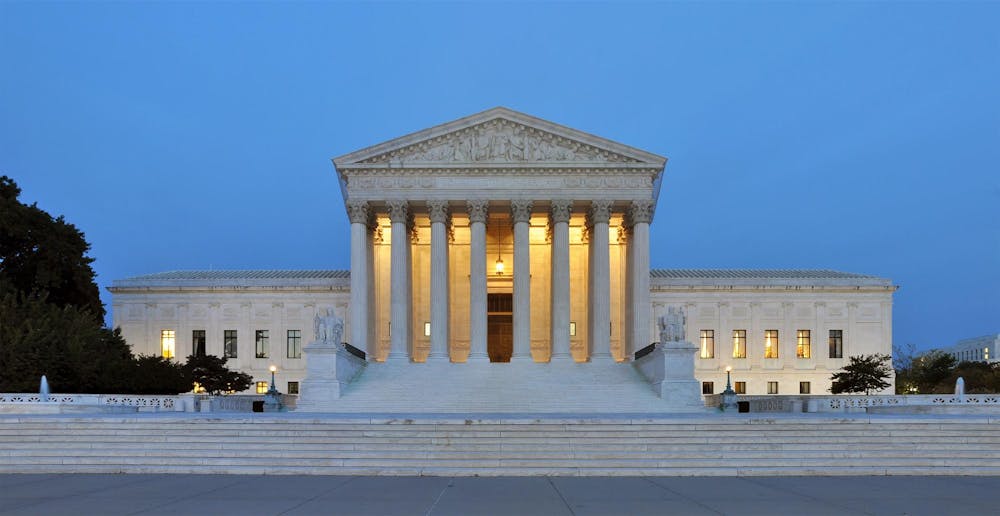
In a 6-3 decision June 25, the U.S. Supreme Court ruled on the case Mullin v. Doe that decisions made by the Secretary of Homeland Security to grant, extend or terminate Temporary Protective Status are not subject to judicial review. The decision means that going forward, the federal administration can revoke TPS status from countries, stripping foreign nationals living in the U.S. of their work authorization and protection from deportation.
According to the U.S. Citizenship and Immigration Services website, TPS is a designation that the Secretary of Homeland Security can assign to a country that is experiencing ongoing armed conflict, an environmental disaster — such as an epidemic or earthquake — or “other extraordinary and temporary conditions.” The designation is for a six-, 12- or 18-month period, which can be extended indefinitely. It is given when it is determined that these conditions make it unsafe for the foreign nationals to return to their home countries.
Foreign nationals who are in the U.S. at the time their country receives TPS are protected from detention and removal by the DHS and are authorized to work legally in the U.S. Since TPS was created in 1990 by the Immigration Act, these designations have typically been extended repeatedly. However, under the Trump administration, DHS has ended or taken steps to end TPS for 13 of the 17 countries that had the designation when Trump took office.
The June 25 decision in Mullin reversed two district court rulings to postpone the termination of TPS for Haiti and Syria — Trump v. Miot and Noem v. Doe. The plaintiffs in both district court cases alleged that former Sec. of Homeland Security Kristi Noem’s decision to terminate the TPS violated foreign nationals’ equal protection rights, as they believed the decision was motivated by “race, ethnicity or national origin.” Additionally, the plaintiffs alleged that the decisions violated the Administrative Procedure Act because Noem “failed to consult with other federal agencies” about the conditions in Syria and Haiti.
The federal government originally gave Haiti the TPS designation after a 2010 earthquake and it extended the status repeatedly given continuing high-crime conditions. Syria was designated with TPS in 2012 due to a civil war, and the designation was also repeatedly extended.
The Cavalier Daily reached out to University student organizations, including the International Relations Organization and Students for Equity and Reform in Virginia, to hear student perspectives on the Mullin decision. Many of the students expressed feeling disappointed but not surprised by the ruling in Mullin.
Second-year College student Nathan Matzig said that the decision made him feel that the federal government is not representing the will of the people. Matzig said it feels “demoralizing” to live with a government that “spreads hate.”
Second-year College student Lucy Robb said it was interesting the U.S. Supreme Court was choosing to limit the power of the judicial branch in favor of the executive branch by ruling that the district courts did not have the power to overturn Noem’s decisions. Robb also said the Mullin ruling made her question the strength of the separation of powers in the federal government.
Additionally, Robb said she believed that the decision was part of a larger theme of how the court has been treating its independence as a branch. Similarly, third-year College student Sara Nottingham said she believed that the decision was representative of the executive branch gaining an increasing amount of power at the expense of the judicial branch.
“I think it's accurate to say that this Supreme Court is enabling an overreach of executive power significantly, and that they are now using their power to enable [President] Trump's campaign against immigrants in our country,” Nottingham said.
Several students also shared concerns that the decision may have been rooted in racism, anti-immigrant sentiment or xenophobia. Robb highlighted portions of Justice Elena Kagan’s dissenting opinion, in which Kagan argued for the relevance of racial remarks made by President Trump and former Secretary Noem regarding immigrants from Haiti prior to the decision. Robb stressed the importance of these racist remarks in understanding the case.
“I think it's certainly arguable that a lot of the concurring [opinions] seemingly ignore various administrative statements surrounding racial comments,” Robb said. “Justice Kagan recounts several of these relevant statements in her dissent from both the president and Secretary Noem, which are also really important to look into.”
Other students said they were concerned over the impact the Mullin decision will have on the safety of TPS holders, whether the TPS holders attempt to remain in the U.S. or return to their home countries. Third-year Commerce student Siddarth Rekhi said he thought it was hypocritical of the U.S. to continue designating the former TPS-designated countries as unsafe, yet request that foreign nationals from those countries return there.
“[Part of my] reaction was one of hypocrisy from the federal government,” Rekhi said. “The same government that is saying that these countries are dangerous for people to visit, [is] opening up the doorway for people to be sent back there, and in some cases against their will.”
Chloe Cella, anthropology graduate student and Intensive Client Management Intern at the International Rescue Committee, raised concerns about the dangerous working situations TPS holders may be in once they lose their status but choose to remain in the U.S. for work. As an intern with the ICM at IRC, Cella works to resettle refugees and those with TPS status in Charlottesville.
“[Ending TPS] is kind of forcing people to illegally work [by severely limiting where they can legally work] … it's going to just end up being a lot of people doing under the table stuff, and that's not [something] that can be monitored for working conditions,” Cella said.
Cella also said that recent changes to federal funding have decreased the amount of IRC's resources used to aid with resettlement. She expressed her disappointment with the Mullin outcome, and emphasized the integral role refugees play in the Charlottesville community.
“I think people don't realize that refugees are embedded into communities across the country,” Cella said. “Charlottesville would not be the place that it is without the refugee community that we have here, and I think that it would be a much worse place if they were not here.”
Some students voiced worry over the economic impact of stripping the right to work from TPS holders. The termination will affect about 350,000 Haitians who were living in the U.S. with TPS before the Mullin decision. New York Congressman Mike Lawler (R-17), criticized the TPS decision for Haiti in a post on X.
“Of the 350,000 + lawful Haitian TPS holders, roughly 1/3 work in our healthcare system. Immediately shutting off TPS will create a crisis in our hospitals, nursing homes, and in the I/DD community.” Lawler wrote.
Matzig and Nottingham both discussed their concerns with the impact of the termination of TPS for Haiti on the healthcare industry.
“My mom is a healthcare worker and she [told] me that a lot of Haitian immigrants provide a lot of the really foundational care for people who … are in nursing home facilities [and] assisted care facilities.” Nottingham said. “A significant loss of that population is going to be really hard on people with elderly family members and people who need care.”
The TPS decision falls among several other drastic changes in U.S. policies on refugees and TPS in the transition from the Biden administration to the Trump administration. The Trump administration announced Oct. 30 it would be lowering the annual cap on refugees legally allowed in the country from 125,000 to 7,500 per year, before increasing it to 17,500 May 21. Rekhi and third-year College student Kamina Mentore discussed their beliefs that the TPS decision, in combination with other policies such as lowering the refugee cap, will have negative impacts on the reputation of the U.S. globally.
Mentore said she believes the ruling represents a change in the historic reputation of the U.S. surrounding immigration policy.
“Overall it paints the U.S. in a light of just being unempathetic, but also, I feel like the U.S. has historically had a reputation of being very open for immigrants,” Mentore said. “I think that it's sad to try to twist this anti-immigrant agenda in a country that's entirely built off of the labor of immigrants.”
Rekhi agreed, emphasizing his belief that a decline in U.S.’s international reputation will result from this decision and other immigration policy changes the Trump administration has made, such as decreasing the annual refugee cap, because the changes are so different from the policies of the Biden administration.
“It shows that we will go back on our word and that our opinions are changed so frequently that no one can really trust us,” Rekhi said. “It decreases our reputation severely because it undermines trust, [brings] our internal division out, and that makes us really hard to work with.”
In the wake of the June 25 Mullin decision, DHS announced that the termination of TPS for Syria and Haiti was effective July 27. Soon after, terminations were also announced for Burma, South Sudan and Somalia.

Abigail Larkin is a staff writer on the news desk. She is a third-year student in the Batten School of Public Policy, majoring in public policy and foreign affairs. Abigail is from Norfolk, Va., and she enjoys writing about state and national politics.
Read More

From the Archives: Fraternity life
By Maisy Callahan and Emily Conway | YesterdayMore fraternities decide to partner with the Historic Renovation Corporation, a University-affiliated agency that provides tax credits for the restoration of historic buildings.

Center for Politics hosts Tom Perriello to discuss AI, congressional responsibilities
By Melody Yuan | YesterdayAt the event, titled “The Deep Divide Between How the People and the Powerful Are Thinking About AI,” Perriello also referenced his Sept. 22 article “To Wary Working People, AI Preemption Is the New Nafta” in The New Republic during his discussion.

U.Va. Health’s telehealth program approaches 1 million visits
By Vrinda Vashisht | 2 days agoThe program arose from the challenge of U.Va. Health physicians traveling to communities across Virginia to treat patients who could not easily reach Charlottesville.