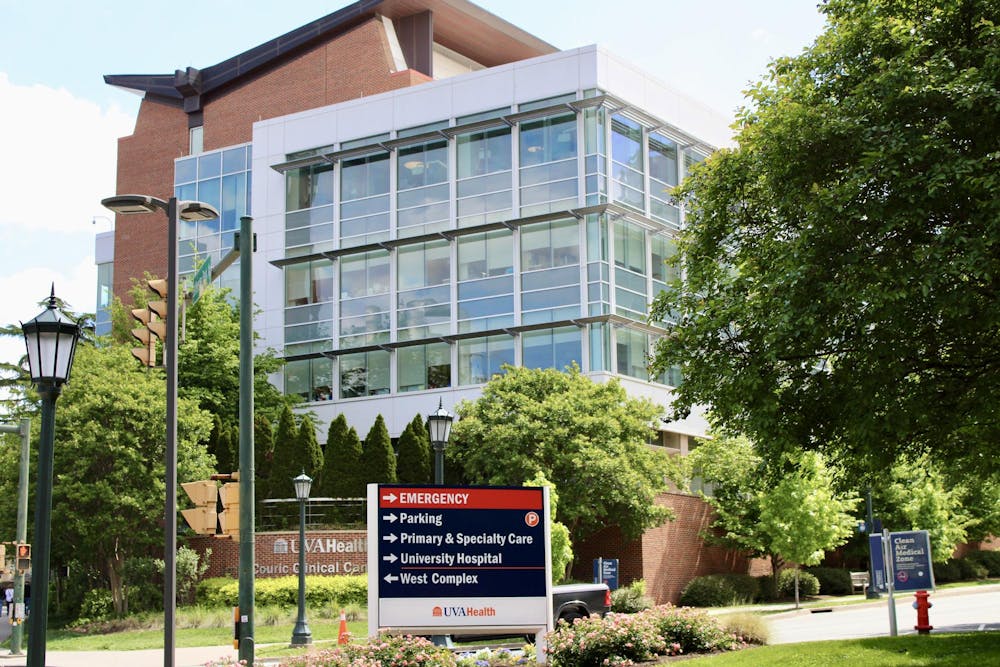
U.Va. Health’s telehealth program is nearing the 1 million visits benchmark more than three decades after its inception in 1995. The health system has had more than 897,000 telehealth appointments since the program’s launch, according to an impact report presented to the Health System Board in September. Center for Telehealth Director Karen Rheuban — a pediatric cardiologist who co-founded the program — said she expects the telehealth program to pass the 1 million visit mark this year.
In fiscal year 2026, U.Va. Health recorded about 150,000 video and phone visits, with a 96 percent patient satisfaction rate. The University’s Center for Telehealth — also known as the Karen S. Rheuban Center for Telehealth — now offers virtual care in more than 60 clinical disciplines, including infectious disease treatment, high-risk obstetrics and remote patient monitoring, according to Rheuban.
A telehealth visit can be as simple as a video or phone call with a U.Va. Health provider from home or work, using the patient portal MyChart, Rheuban said. In other telehealth visits, patients go to a local hospital or federally qualified health center, where remote examination tools allow University specialists to meet the standard of in-person care, she said. An example of this is a remote ultrasound which Rheuban explained can be performed at one of these qualified health centers and can streamline maternity care.
The program arose from the challenge of U.Va. Health physicians traveling to communities across Virginia to treat patients who could not easily reach Charlottesville. The physicians in the pediatric cardiology division, for example, traveled to Bristol, Va. for two days every other month before the establishment of the telehealth program.
“That meant 58 other days, patients would have to travel for us to access care,” Rheuban said. “That was the vision behind establishing the telemedicine program, which was to bring earlier timely access to care for our patients.”
According to Rheuban, for patients in far Southwest Virginia, the trip to Charlottesville can mean an hours-long drive that can have consequences for their health. Patients in rural communities have higher mortality and morbidity rates than those with ready access to care, according to Rheuban.
“We know that distance is destiny,” Rheuban said. “If you don’t have access to health care, your outcomes are not going to be as good as those who do have access.”
The University’s telehealth program was cofounded by Rheuban and retired Lt. Col. Eugene Sullivan, an engineer who came to the University from the U.S. Department of Defense. The early years of the program were difficult, according to Rheuban, when few people knew what telehealth was, technology was expensive and insurance did not reimburse for it.
Changes in public policy allowed U.Va. Health’s telehealth program to scale, according to Rheuban. A provision of the Telecommunications Act of 1996 built appropriate infrastructure to help the healthcare model thrive. This cut the cost of the connection for the program for rural healthcare providers from almost $6,000 a month to $200, Rheuban said. Reimbursement for the program itself came more gradually — Virginia Medicaid began expanding coverage in 2003, and the General Assembly required insurers to cover telehealth in 2010.
The program was unable to reach more people until COVID-19, when Medicare and Medicaid began covering telehealth visits for patients in their homes. The broadband infrastructure and electronic medical record platforms to support those visits were in place. Some patients without home internet connected from parking lots, using the Wi-Fi of a nearby school, according to Rheuban.
A Virginia Telehealth Network report found that 75 percent of Virginia providers were using telehealth as of March 2022, while roughly 70 percent had not used it before March 2020. The Center has also drawn more than $40 million in competitive grants and philanthropic funding to expand access across the Commonwealth, Rheuban said.
One of the program’s best-known services is telestroke, built with the Department of Neurology’s vascular neurology stroke team. Because stroke prevention requires quick action to restore irreversible brain damage, medications for strokes formed by blood clots must be given shortly after onset. Since community hospitals often lack an on-site stroke neurology team, according to Rheuban, U.Va. Health specialists examine the patient remotely through telehealth visits, review the CT scan and direct emergency staff onsite on medication administration.
The service has operated for more than 12 years, and patients in community hospitals now receive the treatment at the same rate as those who arrive at the U.Va. emergency department — in some cases as quickly as 25 minutes after arrival, according to Rheuban.
The telehealth program has also tested bringing stroke care into the ambulance, with a U.Va. Health study called iTREAT. This is a tablet-based system that lets neurologists assess stroke patients by video during transport. The test results showed that 98 percent correlated with bedside assessments, according to Andrew Southerland, executive vice chair in the Department of Neurology and the head of the U.Va. Health team that conducted the study, in a U.Va. Health article.
“The goal of our study is to advance the assessment of acute stroke to the pre-hospital setting — to the ambulance transporting the patients to the hospital,” Southerland said in the article.
The high-risk obstetrics program — a program also under the telehealth umbrella approaching the million-visits benchmark — connects pregnant patients with U.Va. Health maternal-fetal medicine specialists. A health center network in Lexington, Va. reported not having a single preterm delivery because of its relationship with U.Va. Health’s specialists, according to Rheuban. The community’s hospital in Lexington closed its obstetrics unit in 2020, so patients still travel for delivery — Rheuban noted some may travel to Augusta Health and others to U.Va. Health.
Looking forward, the biggest uncertainty for telehealth is Medicare coverage, according to Rheuban. During the pandemic, Medicare patients were able to receive telemedicine regardless of where they live. Congress has extended this coverage through 2027, and Rheuban said she hopes that the pending legislation will make this permanent. However, in 2028, most patients will need to be in a rural area and at a medical facility to be eligible to receive telehealth services due to the extended coverage expiring December 2027.
“Medicaid is not a problem. Commercial payers are not a problem. It’s Medicare,” Rheuban said. “That coverage certainty is really important, both for patients as well as for us as a system.”
When asked about the U.Va. Health telehealth approaching 1 million visits, Rheuban said the credit belongs to many people.
“It takes a village,” Rheuban said. “It’s about U.Va. providers being willing to [participate in telehealth]. It’s about understanding that care can be delivered via technology. It’s [about] enabling reimbursement of services. It’s [about providing] ready access to broadband communication services.”
Rheuban also emphasized the importance of this service in expanding healthcare to all of Virginia.
“We are the University of Virginia, not the University of Charlottesville,” she said. “We care for all Virginians, regardless of their payer status, regardless of their location.”
The Cavalier Daily contacted two stroke neurologists and two telehealth neurotechnology experts. They did not respond for comment in time for publication.
Vrinda Vashisht is a staff writer on the news desk. She is a second-year College student studying Neuroscience.
Read More

Center for Politics hosts Tom Perriello to discuss AI, congressional responsibilities
By Melody Yuan | 43 minutes agoAt the event, titled “The Deep Divide Between How the People and the Powerful Are Thinking About AI,” Perriello also referenced his Sept. 22 article “To Wary Working People, AI Preemption Is the New Nafta” in The New Republic during his discussion.

U.Va. reports increases in rape, aggravated assault and liquor law violations in 2025
By Jaylynn Perez | YesterdayThe report has been published annually since 1991 under the federal Jeanne Clery Campus Safety Act.

Yael Grushka-Cockayne discusses artificial intelligence and future of business education
By Jaylynn Perez | YesterdayThe webinar — titled “Why Darden? Our Next Chapter” — brought together prospective, admitted and deferred students across Darden’s Master of Business Administration programs.