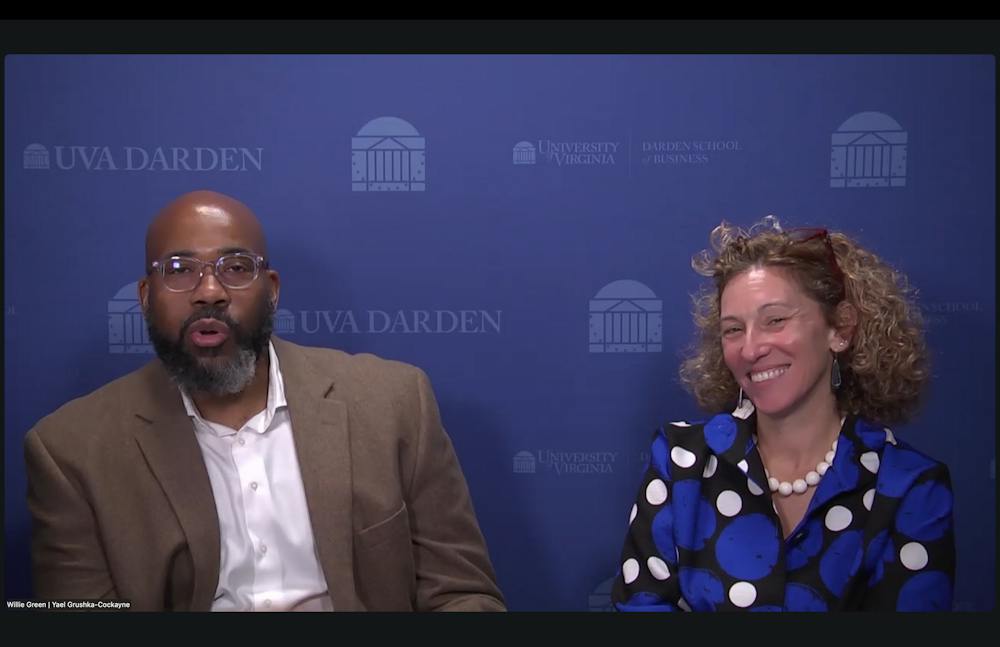
The University’s Darden School of Business hosted a webinar Monday in which Yael Grushka-Cockayne, dean of the Darden School of Business, and Willie Green, senior assistant dean of admissions for Darden, discussed how the School prepares students to lead in a changing business world.
The webinar — titled “Why Darden? Our Next Chapter” — brought together prospective, admitted and deferred students across Darden’s Master of Business Administration programs. The event drew 673 registrants from 62 countries and covered the School’s approach to artificial intelligence, the return on investment of an MBA and how Darden prepares students to make decisions amid uncertainty.
Grushka-Cockayne began her role as Darden’s 10th dean Aug. 1, succeeding University President Scott Beardsley, who stepped down as dean in January 2026. In June, Grushka-Cockayne told The Cavalier Daily that her first priority as dean would be to listen to students, faculty, staff and alumni and build on the school’s existing momentum. She also emphasized preparing students to use AI while understanding its limitations and evaluating its outputs.
“What brought me to Darden keeps me at Darden,” Grushka-Cockayne said. “We think about people in the world and actually how they conduct their business. … How we use leverage cases and real stories is very practice oriented, and it's not theoretical.”
Grushka-Cockayne’s appointment as dean of Darden has previously drawn criticism from the University’s chapter of Students for Justice in Palestine — a student contracted independent organization that advocates for the end of the Israeli occupation through education about the Israeli-Palestinian conflict and Palestinian culture.
In July, SJP condemned a Darden gathering for prospective MBA students in Tel Aviv, Israel, and called for the event’s cancellation and the University’s full divestment from Israel. The gathering took place as scheduled. In August, SJP called for Grushka-Cockayne’s resignation, citing her past service in the Israel Defense Forces and her professional background. Grushka-Cockayne has not publicly addressed SJP’s criticisms regarding her appointment, and she did not discuss the controversy during the webinar.
During their discussion on the role of AI in Darden’s classroom, Grushka-Cockayne and Green explained how Darden is incorporating AI into classroom instruction while maintaining its case-based approach to learning. She emphasized the value of Darden’s case method — which requires students to evaluate competing arguments and make recommendations based on incomplete information. According to Grushka-Cockayne, the approach prepares students to participate in workplace discussions, analyze complex problems and collaborate with colleagues.
Grushka-Cockayne said some courses use AI tools that allow students to interact with simulated historical figures or business stakeholders. She said the tools give students opportunities to ask questions and consider different perspectives before classroom discussions. However, Grushka-Cockayne noted that students must be able to verify AI-generated analyses rather than accept the results without scrutiny.
Green also said students must develop skills that technology cannot replace, including empathy, critical judgment and the ability to assess information when the correct answer is unclear.
“You will need to be able to deal with the ambiguity of the situation that has never been done before. AI and all the models are built on old situations [and] practices,” Green said. “The human judgment you need in those circumstances is going to be the differentiator of how you win as you go.”
Regarding Darden’s curriculum, Grushka-Cockayne said that the school offers more than 25 electives related to AI and data analytics. The school also offers a decision-making sciences concentration and has established the LaCross Institute for Ethical AI in Business. The LaCross Institute — established in 2024 — examines the ethical implications of AI and how its use affects people and other stakeholders, including employees, customers and communities.
Beyond technological advances, Grushka-Cockayne said adaptability is essential as companies respond to changing supply chains, tariffs and geopolitical pressures. Rather than preparing students for a fixed set of workplace conditions, she said that Darden aims to teach students how to continue learning as industries change and respond to uncertainty.
“We need to make sure that we train our students to think in that agile way — to be more nimble [and] to think more entrepreneurially,” Grushka-Cockayne said.
The discussion also addressed the return on investment of an MBA as tuition costs rise across higher education. According to Darden’s published cost of attendance for the 2026-27 academic year, tuition and fees for first-year full-time MBA students total $83,000 for Virginia residents and $88,000 for non-Virginia residents. Darden estimates the total cost of attendance — including housing, food, transportation and other expenses — at $118,196 for Virginia residents and $123,196 for non-Virginia residents per academic year.
Green asked Grushka-Cockayne how prospective students should evaluate the return on investment of an MBA. Grushka-Cockayne said students should consider both immediate career outcomes and the long-term benefits of the degree. She said those benefits include professional relationships, opportunities for advancement and the ability to navigate career changes.
“The value and the ROI from Darden cannot only be measured [by short-term gains] and shouldn’t be measured that way because this is a lifelong investment,” Grushka-Cockayne said.
During the Q&A section, an attendee asked how a prospective student should know whether a professional degree program is the right fit for their goals. Green identified humility, intellectual curiosity and comfort with ambiguity as qualities that help students succeed at Darden. He said students should be willing to acknowledge what they do not know, consider unfamiliar perspectives and work through complex problems without always having complete information.
According to Green and Grushka-Cockayne, Darden’s admissions process considers applicants’ academic backgrounds, professional experiences, recommendations and personal accounts of their goals and experiences. The process also includes an interview and video essay. Grushka-Cockayne said the process helps the school assess applicants’ experiences and the perspectives they could contribute to classroom discussions.
Prospective students applying to Darden’s full-time MBA program for the Class of 2029 can submit applications by six deadlines during the 2026-27 admissions cycle. The next deadline is Jan. 7, followed by deadlines March 1, April 1 and May 1. More information about application deadlines is available on the school’s website.

Jaylynn Perez is a third-year College student from Chesapeake, Va., majoring in government and Public Policy and Leadership. She currently serves as a news senior writer and video staffer, after previously serving as senior associate editor for the news desk. She enjoys covering topics such as University governance and local politics.
Read More

At rare three-way meeting, City, County and University officials discuss regional coordination
By Luca Bailey | 21 hours agoThe meeting also gave City, County and University officials an opportunity to discuss areas of mutual concern.

Federal judge upholds Virginia law allowing immigrant students to receive in-state tuition
By Jaylynn Perez and Ruby Budetti | 21 hours agoSenior U.S. District Judge Robert Payne of the U.S. District Court of the Eastern District of Virginia ruled Oct. 5 that Virginia can continue allowing immigrant students to receive in-state tuition at public colleges and universities.

The Faculty Senate discusses international student visa policies, parking challenges
By Jaylynn Perez | YesterdayAdditionally, the Faculty Senate heard from Brie Gertler, interim executive vice president and provost, who gave updates on the ongoing dean searches as well as resources for faculty members with concerns regarding online harassment and academic freedom.