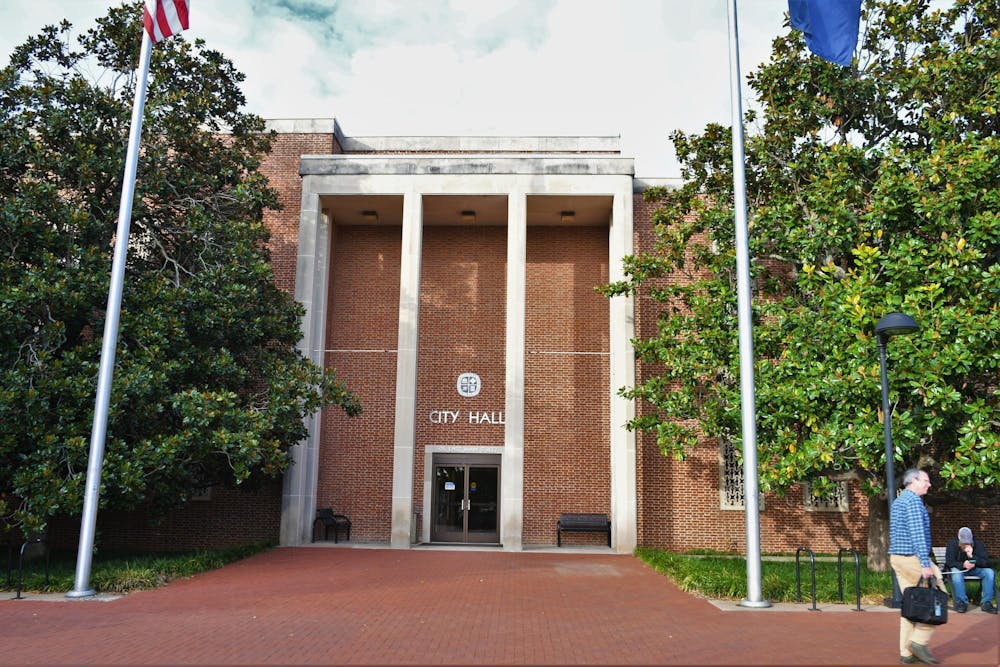
The Charlottesville City Council and the Albemarle County Board of Supervisors convened for a special joint meeting at City Hall Oct. 6, with representatives of the University also in attendance. At the meeting, officials from all three entities received updates on joint projects involving transportation, support for the region’s unhoused population and land use.
The meeting also gave City, County and University officials an opportunity to discuss areas of mutual concern. At one point during the meeting, City and County officials asserted that there has been a lack of clear communication on the University’s long-term goals from key decision makers, and pushed for more transparency from a regional committee composed of City, County and University staff that coordinates land use.
A special joint meeting between the City’s and County’s governing boards takes place every other year, with the previous meeting having taken place at the County’s administrative offices Sept. 17, 2024. Jennifer Wagner Davis, University executive vice president and chief operating officer, represented the University Oct. 6.
During introductory remarks from City Manager Samuel Sanders, County Executive Jeff Richardson and Davis, the three expressed a commitment to continued collaboration between the City, County and University moving forward.
“Tonight exemplifies regionalism for the greater Charlottesville area,” Sanders said. “We just go together. The County is so tightly wrapped around the City and extends far beyond, the University is an engine in the center that elevates [our] collective profiles while impacting the local fabric just the same, and the City is small and unafraid to fill up more than its space with an opportunity to serve all who come.”
Richardson, Sanders and Davis noted that the County, City and University are currently in the process of developing or updating their respective strategic plans.
University President Scott Beardsley appointed a 22-member committee to gather community input and draft a long-term strategic plan for the University July 13, to succeed the 2030 “Great and Good” plan spearheaded by Jim Ryan, School of Law professor and former University president. According to Sanders, the City will soon undergo the process of crafting a new strategic plan of its own, while Richardson said that the Albemarle County Board will update its five-year strategic plan — which runs through 2028 — in the next year.
“We love the idea of collaborating across areas of mutual interest,” Davis said. “[We’re] really looking forward, as we build the next strategic plan, in finding ways to continue to get the best of each other.”
Proceeding to the three reports on the agenda, Charlottesville Director of Transit Garland Williams presented on the City’s four year plan to expand Charlottesville Area Transit’s services and reduce wait times through the hiring of additional bus drivers.
CAT is a city-run transit service which has offered bus and trolley rides in the City and County since 1975, offering completely fare free rides six days a week since 2020. Bus and trolley rides do not require proof of City residency, and serve University students, City residents and County residents alike.
These transportation services remain free with the help of funding from outside sources, including the County and the University. According to Williams’ slideshow, the County accounts for approximately 18.4 percent of the agency’s $16.8 million budget, while the University foots the bill for roughly 1.4 percent. The rest of the funding is accounted for by the City, the Commonwealth, federal sources and advertising costs, according to the slideshow. Notably, the University also has a separate fare-free bus system — University Transit Services — which exclusively operates on Grounds.
Williams explained that for CAT’s year-one goals in the plan, the agency will seek to decrease wait times to as low as 15 minutes in the mornings and afternoons along a few select routes downtown and in the County — routes five, six and seven. The agency also hopes to ensure the majority of routes have a final bus trip beginning at 10:30 p.m. by February 2027, and to offer infrequent services along most routes on Sundays by 2028. The changes at each stop can be viewed in Williams’ slideshow. To meet these and other goals in CAT’s four-year plan, the City will bring on an additional 10 bus drivers per year.
Garland further explained that CAT brings in a significant amount of federal funding through the Small Transit Intensive Cities program, which rewards small cities of 50,000 to 200,000 residents for high transit performance across six criteria. The City typically brings in around $1.5 million in additional revenue for its high performance in three categories — vehicle revenue miles per capita, vehicle revenue hour per capita and passenger trips per capita. Conversely, the City still comes up short in terms of passenger miles per vehicle revenue mile, passenger miles per vehicle revenue hour and passenger miles per capita.
However, Garland said that if the University voluntarily reported data for even one of its UTS routes through the City’s transit systems, CAT’s and UTS’ performance combined could potentially match some of those additional unmet criteria for Charlottesville. In response to a question from Council Member Michael Payne regarding the “concrete next steps” for a unified voluntary reporting strategy, Garland said City and University officials have already engaged in preliminary discussions.
“I think the University is moving down the path, getting the education that it needs and research done to make an informed decision,” Garland said. “I think we'll get there pretty quickly.”
In a separate presentation, Jeffrey Dumars, Albemarle County’s director of facilities and environmental services and chair of the Land Use and Environmental Planning Committee, delivered a bi annual presentation on the committee’s work in the first six months of 2026.
In 1986, the City, the County and University’s Board of Visitors signed the “Three-Party Agreement,” a document that pledged voluntary coordination and information-sharing between the three entities on issues related to land-use. Any projects that fall within a designated buffer zone in which development would have a “significant effect” on other entities are voluntarily shared with them, giving them the chance to provide comments and review.
The Land Use and Environmental Planning Committee exists as a result of that agreement, succeeding the planning commission and coordination council, which the agreement initially established. According to Dumars, it is a staff-level committee that works to “coordinate land use and development plans” in accordance with the agreement, to consider infrastructural and environmental issues facing the region and to advise the City, County and University on these and related matters as appropriate, according to Dumars. LUEPC is made up of representatives from all three entities — including the University Architect, the University Building Official and the University of Virginia Foundation’s Director of Real-Estate.
According to Dumars, some of the topics the committee discussed at its regular meetings this year included affordable housing and transportation projects, as well as ensuring reconciliation between the University Grounds Plan and the City and County comprehensive plans. He also said LUEPC took steps to ensure effective coordination within the three entities’ capital construction programs.
Similarly, Dumars said there has been a lot of ad-hoc coordination to ensure projects from Highway 29 through the Fontaine Corridor down to Jefferson Park Avenue — another area of heightened construction activity — are properly coordinated. In practice, this often looks like ensuring sidewalks connect, and that they are mitigating any major right-of-way impacts, according to Dumars.
Immediately after the presentation, Payne asked Dumars about potential changes to the committee’s operations. Payne said that he does not believe LUEPC’s meetings provide a real point of entry for community feedback, citing the fact that the meetings themselves are not open to members of the public or the media, among other concerns.
Council member Lloyd Snook echoed Payne’s sentiments, saying that he does not know what LUPEC does. He also said that this, in turn, makes it difficult to fully grasp the long-term plans of the other entities, which could be helpful in the Council’s day-to-day decision-making.
“I have no idea what you guys do,” Snook said. “I have no idea what kind of joint planning efforts might be going on … [the planning] is no good if the rest of us don’t learn about it … I would love to be able to say that I know where the County is going to be emphasizing significant population growth, or where the University is going to be putting another 1000 students, and then we [can] have CAT put a bus out there. We don't work that way, and partly because we don't have the information [from LUEPC].”
Board Chair Ned Gallaway pointed out that the staff on the committee work under the direction of the Council, Board and University leadership. He posited that LUEPC is working to enforce decisions that have already been made at a higher level.
In response, Payne said that his concerns boil down to a broader lack of communication from the University, in particular. He posited that some changes to improve the City’s and County’s lines of communication with the University could be necessary — whether they be changes to LUEPC or other measures. Supervisor Mike Pruitt agreed with this point, conceding that University staff who work on LUEPC likely do not have significant decision-making power, but suggesting a source of “tension” is a lack of availability from those who do make key decisions at the University.
“None of us talk to the president of U.Va.,” Pruitt said. “If we do, it’s incidental. None of us talk with the Board of Visitors of U.Va. … We rarely talk with senior vice presidents … it’s a special treat. I think it is a natural posture of the way we are separately organized, but I think that is kind of the source of the tension … By extension, I feel like my constituents don't have that level of access to decision making power at U.Va.”
In response, Davis said that Sanders, Richardson and herself meet with Beardsley on a regular basis. She said that if the elected officials themselves have “questions or comments or concerns,” University leadership is always willing to meet. Finally, she asserted that the University itself works in a fundamentally different way from the City and County.
“Our workforce is almost 40,000 people now, and we're a $7 billion operating entity,” Davis said. “So we are big, and we're complex, and we're also highly decentralized, but it's not impossible to access us as leaders.”
During another presentation, Misty Graves, City director of human services, delivered a brief presentation explaining the City’s process for clearing a homeless encampment along the Rivanna Trail Sept. 1. The clearing was followed by the immediate opening of an emergency homeless shelter at 2000 Holiday Drive to serve many displaced residents. Notably, Graves said that following the clearing, the City’s Department of Human Services now plans to hire three additional staff — a supervisor and two outreach specialists — to continue connecting unhoused residents with necessary resources like welfare benefits and housing connections, including at any “pop-up encampments” that have appeared since the clearing. The City’s handling of the clearing drew praise from several Albemarle County supervisors Oct. 6, including Pruitt.
“It is not lost on me that y’all are building the plane while you’re flying,” Pruitt said. “Rest assured, I get questions about this project from my constituents a lot. The consistent statement I've said over the past two months has been how impressed I am with how the City has executed and planned for this … I think it’s some truly remarkable work.”
Kaki Dimock, County chief human services officer, delivered a presentation on permanent supportive housing projects in Albemarle County, mainly speaking on the Vista 29 housing project, which is set to open on Premier Circle later this year. The project is the result of a joint partnership between Charlottesville and Albemarle County.
Dimock said the project will consist of 80 permanent supportive housing units — a kind of affordable housing with indefinite leasing that connects its residents with essential services to help them live independently, such as employment and healthcare resources. City and County officials said they believe the opening of this permanent supportive housing project shortly after the Holiday Drive shelter will allow Vista 29 to serve as the next rung on the ladder for those in the shelter that require more intensive support in their day-to-day life.
A recording of the full meeting can be found on the “Cville Communications” YouTube page. At the end of the meeting, Sanders and County officials agreed on the idea of discussing increasing the frequency of these meetings so that they take place annually. The next regular meeting of the Charlottesville City Council will take place Oct. 19. The next regular meeting of the Albemarle County Board of Supervisors will take place Oct. 21.

Luca Bailey is a third-year College student majoring in politics from Free Union, Va. As a staffer on the news and video desks, he has covered topics ranging from the General Assembly and state elections to local politics and University governance. He is also The Cavalier Daily’s beat writer for the Charlottesville City Council.
Read More

Federal judge upholds Virginia law allowing immigrant students to receive in-state tuition
By Jaylynn Perez and Ruby Budetti | 1 hours agoSenior U.S. District Judge Robert Payne of the U.S. District Court of the Eastern District of Virginia ruled Oct. 5 that Virginia can continue allowing immigrant students to receive in-state tuition at public colleges and universities.

The Faculty Senate discusses international student visa policies, parking challenges
By Jaylynn Perez | YesterdayAdditionally, the Faculty Senate heard from Brie Gertler, interim executive vice president and provost, who gave updates on the ongoing dean searches as well as resources for faculty members with concerns regarding online harassment and academic freedom.

Sen. Kaine, Rep. Dingell reintroduce legislation to support student survivors of sexual assault
By Jaylynn Perez | YesterdayKaine said in the press release that the legislation would help ensure survivors have access to medical care, counseling and academic support provided by their universities while continuing their educational and professional goals.