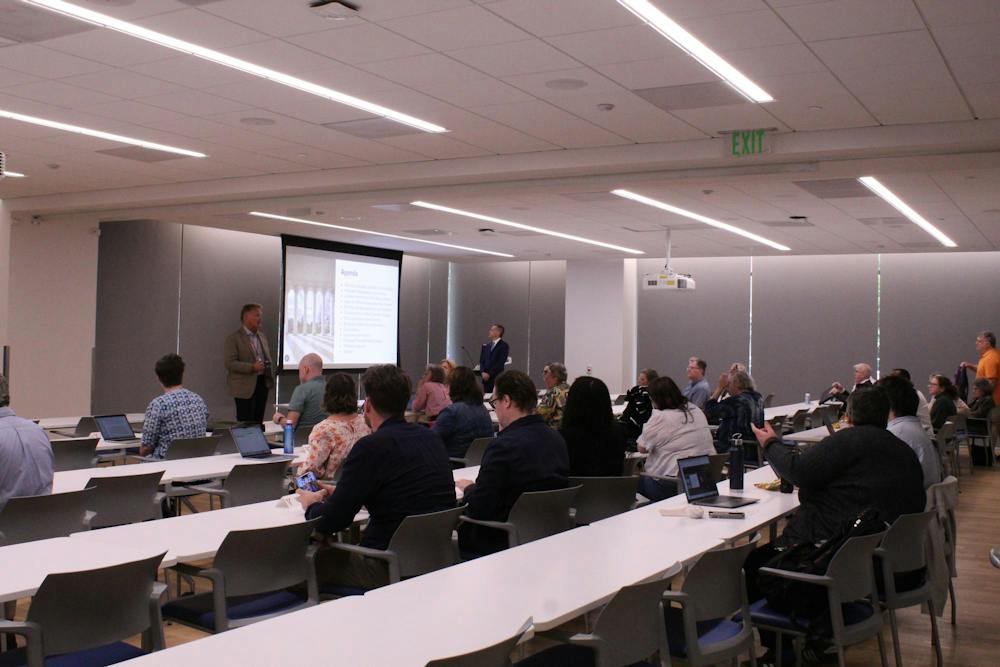
The full Faculty Senate convened Friday to hear several presentations on issues affecting the University community, including an update from Dan Kramer, director of the International Studies Office, who outlined how recent federal policy changes regarding student visas have created “uncertainty” for international students. Gheretta Harris, associate vice president of business services, also presented an update on the ongoing reassessment of the University Bookstore’s operations.
Additionally, the Faculty Senate heard from Brie Gertler, interim executive vice president and provost, who gave updates on the ongoing dean searches as well as resources for faculty members with concerns regarding online harassment and academic freedom. Architecture Prof. Jessica Sewell — who serves as the Faculty Senate’s representative on the University’s Parking and Transportation Committee — also discussed concerns about parking access, permits and transportation services.
According to Aaron Bloomfield, Faculty Senate chair and Engineering professor, the presentations were intended to inform senators about issues affecting the University community and help them consider which topics the Faculty Senate might address during the remainder of the 2026-27 academic year.
Kramer discussed federal proposals affecting international students’ visa status and work authorization. He highlighted the proposed Department of Homeland Security rule that would replace the existing “duration of status” policy with a fixed period of admission. Under the existing policy, F-1 students — those on full-time academic visas — can remain in the United States while pursuing their academic program. The new rule would limit F-1 students’ admission to the length of their academic program — up to four years — and require students who need additional time to apply for an extension. A nationwide preliminary injunction was issued Sept. 14, blocking the rule from taking effect while legal proceedings continue.
In response to a question from Sewell about the effects of these student visa policy changes, Gertler said that international undergraduate enrollment increased among students entering the University for the 2026-27 academic year, while international graduate enrollment has declined by about one-third. According to Gertler, the overall enrollment has remained roughly stable as domestic enrollment has increased.
According to Kramer, the federal policy uncertainty has also created challenges for curricular practical training — which allows eligible international students to take internships that are part of their academic programs. Kramer said that internships now need to be required by a student’s academic program to qualify for CPT authorization and that internship providers would need formal agreements with the University. The University’s International Studies Office has temporarily suspended new CPT requests for internships tied to optional course credit, while continuing to process requests for internships required by a degree program.
Kramer said the International Studies Office is continuing to work with the University Counsel to develop formal agreement templates for internship providers that are part of students’ academic programs. He further directed faculty and staff to refer students to the International Studies Office for individualized guidance on any questions. According to Kramer, the office provides additional support through town halls, webinars with immigration attorneys, advising and peer mentoring as students navigate the policy changes.
Harris presented an update on the University’s assessment of the University Bookstore, which began after Cristy Huffman, former director of the bookstore, submitted her retirement notice over the summer. The University hired the Collegiate Retail consulting group in July to evaluate the bookstore’s operations and identify potential changes following the leadership transition.
According to Harris’ presentation, the consulting group will assess customer experience, finances, course materials and digital content, merchandise, Cavalier Computers and potential outsourcing options, as well as marketing, communications and operations. The review also includes listening sessions with faculty, staff, students and bookstore employees, as well as surveys and analysis of the higher education bookstore industry. Harris said the findings will be presented to University executive leadership Nov. 10.
“A transition is a good time to really kind of take a look at the operations, the services that are being provided and to really understand what the direction the bookstore should be for the future,” Harris said.
During the discussion, Judy Thomas, director of faculty programs at the University’s libraries, suggested creating a faculty advisory committee to provide input on the bookstore’s future. Harris said she asked Stephen Ninneman, interim director of the bookstore who was in attendance, to note Thomas’ suggestion. According to Harris, the University Bookstore plans to hold an open house Oct. 30 to showcase new renovations to the front end of the building and to bid Huffman “farewell.”
During her presentation on parking and transportation, Sewell outlined the department’s operations and ongoing transportation projects, as well as concerns raised by faculty and staff. According to Sewell, the University Parking and Transportation department maintains 18 parking structures and more than 100 parking lots, as well as a fleet of 41 buses and on-demand paratransit services.
Bloomfield said that parking and transportation have generated more feedback and concerns from the Faculty Senate than any other issue. Sewell said that one area the department is reviewing is the University’s permit system — including whether faculty and staff could use a single permit across multiple parking lots and garages rather than being restricted to designated locations.
Faculty and staff parking rates vary by location and permit type. For the 2026-27 academic year, annual permits range from $312 to $1,224, while daily rates range from $3.75 to $10.75, according to the Parking and Transportation department’s website.
The presentation also outlined the department’s revenue sources and operating expenses. Parking and Transportation receives $13.1 million from parking permits, $6.7 million from the student transportation fee and $1.6 million from citations. The department also receives $1.6 million from air services and $2.1 million from other parking revenue — including ParkMobile.
Beyond its finances, Sewell described concerns about the online permit-purchasing interface, communication about summer parking rates and closures during inclement weather or football games. The presentation also highlighted the possibility of opt-in text alerts to notify users of changes.
Parking policies — particularly those regarding carpool permits — were another point of concern brought up by the Faculty Senate. A carpool permit is a type of permit that allows at least two full-time University employees who commute together an average of three days per week to share parking privileges and split the cost of a permit.
The Faculty Senate specifically discussed whether both vehicles registered under the same carpool permit could receive citations when parked on Grounds simultaneously. Several faculty members raised concerns about substantial fines in these situations, particularly when people who typically carpool occasional need to drive separately.
Other projects outlined in the presentation included work on the North Grounds and Fontaine parking garages, expanded evening and weekend bus service and surveys to gather feedback from bus passengers and people who use accessible parking. According to Sewell, the department is also developing a “strategic micromobility plan” addressing scooters, bicycles and other transportation options.
As part of her updates, Gertler announced that the University recently added a reporting webpage to its existing online resources for faculty, postdoctoral researchers, graduate students and staff to report experiencing online targeting related to their work at the University. Such treatment can include harassment, trolling and doxxing. Doxxing is the act of publicly sharing someone’s private or identifying information online without their consent. The option to report such online targeting exists alongside a list of other concerns community members can report on the site.
The reports will be directed to different University offices depending on the reporter’s role. Reports involving faculty members go to the Center for Faculty Wellbeing and Development, while reports involving postdoctoral researchers and graduate students go to the Office of Graduate & Postdoctoral Affairs. Reports involving staff members are directed to Employee Relations.
Gertler said that the University has heard from faculty members who continue to experience online targeting, although University officials cannot share every detail of individual cases publicly. She said the University handles reports involving faculty members in a way that protects academic freedom. She directed the Faculty Senate to the Office of the Provost’s separate websites on academic freedom and free speech — which provide information about relevant policies and guidance for members of the University community.
The full Faculty Senate will convene Nov. 13 at 2 p.m., while the Executive Council will meet Oct. 30 at 2 p.m.

Jaylynn Perez is a third-year College student from Chesapeake, Va., majoring in government and Public Policy and Leadership. She currently serves as a news senior writer and video staffer, after previously serving as senior associate editor for the news desk. She enjoys covering topics such as University governance and local politics.
Read More

Sen. Kaine, Rep. Dingell reintroduce legislation to support student survivors of sexual assault
By Jaylynn Perez | 1 hours agoKaine said in the press release that the legislation would help ensure survivors have access to medical care, counseling and academic support provided by their universities while continuing their educational and professional goals.
Jefferson Trust awards $812,064 in Fall Major Cycle Grants
By Charlotte Gabriel | YesterdayThe Jefferson Trust awards both Flash Grants and Major Cycle Grants on a monthly and biannual basis, respectively.
At City Council meeting, staff preview snow removal efforts for anticipated winter weather
By Luca Bailey | YesterdayThey also heard from a Charlottesville community member who argued for the importance of large-scale development by-right, received updates on the new emergency homeless shelter at 2000 Holiday Drive and invested in several new affordable housing projects.