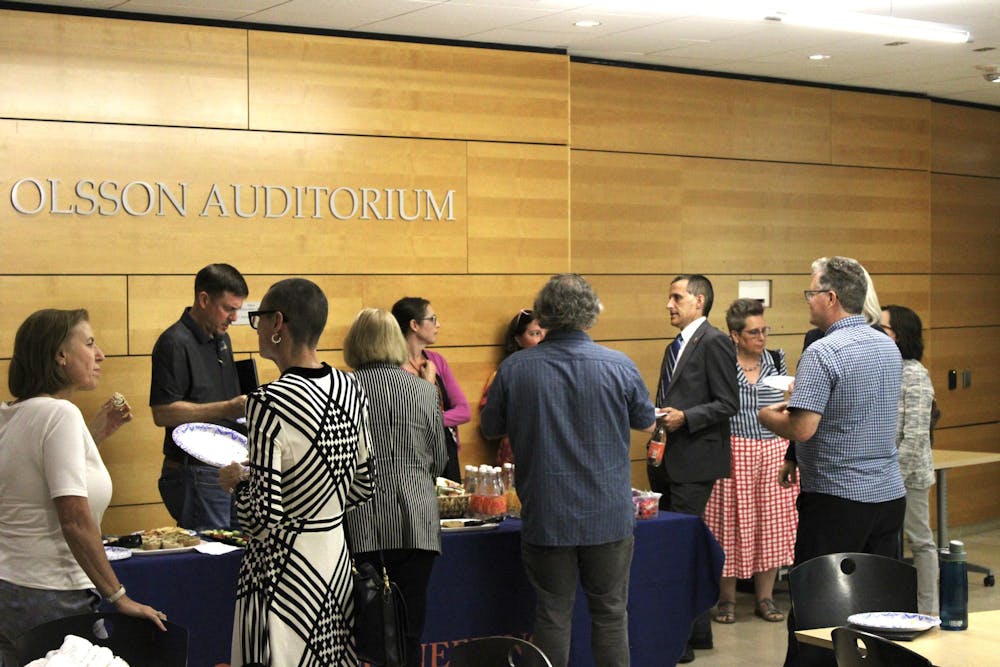
The Faculty Senate began its first meeting of the academic year Friday with a presentation from Jennifer West, dean of the School of Engineering and Applied Science, and R. Marc Johnson, vice president for strategic initiatives in the Office of the President, on the University’s newly launched strategic planning process. The meeting also included updates from University President Scott Beardsley and Brie Gertler, interim executive vice president and provost, on the University’s dean searches and global presence.
West and Johnson — who are both co-chairs of the strategic planning committee — outlined plans to gather input from across the University community and develop the University’s strategic plan, which outlines the University’s priorities for the next five to 10 years. The strategic planning committee began its work over the summer and includes faculty, staff and students, as well as ex-officio members from the Board of Visitors and University administration. Andy Pennock, associate professor of public policy, represents the Faculty Senate on the committee.
According to Johnson, the strategic planning committee’s work is centered on the University’s mission statement, which he described as the “north star” for the planning process. Johnson also said that the committee is drawing from the University’s founding vision, including Thomas Jefferson’s emphasis on educating citizen-leaders, advancing mathematics and sciences and addressing the health needs of the population.
As part of the strategic planning process, West said the committee released a survey over the summer — which it did July 23 — to gather general input from the University community. The survey received more than 13,000 responses, according to West, including responses from alumni, students, faculty and other community members.
“We clearly will not be able to act on every idea and every opinion, but we think that to have the strongest plan, we need to have input from every corner of our university,” West said.
According to West, the committee also launched a series of engagement workshops Friday intended to provide members of the University community with opportunities to further discuss potential priorities. Johnson said the committee wants the process to involve “meaningful engagement and dialogue,” rather than relying solely on survey responses. The workshops will be conducted in small groups, with additional sessions planned to accommodate more participants, according to West.
Following West and Johnson’s strategic planning presentation, Beardsley discussed several issues he said could factor into the University’s long-term strategic planning. He said his recent “Grounds for Conversation” events gave him an opportunity to hear from members of the University community. One theme he said he repeatedly heard was the importance faculty and students place on their relationships with one another. According to Beardsley, parking and traffic were also recurring concerns during those conversations.
Beardsley also provided updates on the University’s leadership searches. He said that the search committee for a permanent provost has been formed and is being led by Gregory Fairchild, dean and chief executive officer of U.Va. Northern Virginia.
The provost search is being conducted by the University’s Executive Search Group — the University’s internal search firm — and is expected to bring forward four candidates, including at least one internal and one external candidate. Beardsley said he hopes to see this search completed by the end of the calendar year.
Beardsley highlighted that the University recently completed its search for the dean of the Darden School of Business, with Yael Grushka-Cockayne beginning her term Aug. 1. According to Beardsley, searches for the deans of the School of Architecture, School of Medicine and School of Data Science are currently underway, while searches for the McIntire School of Commerce and Frank Batten School of Leadership and Public Policy are expected to begin in the coming weeks.
Aaron Bloomfield, Faculty Senate chair and engineering professor, noted that following former Nursing Dean Marianne Baernholdt’s resignation Aug. 11, the School of Nursing does not currently have a permanent dean. No timeline for that search was given during the Faculty Senate’s meeting.
In response to questions from Pennock and Politics Prof. Len Schoppa regarding dean searches and reappointment reviews, Gertler said she wants searches to follow a consistent framework that ensures faculty, staff and students have opportunities to provide input, while allowing flexibility to account for differences among schools.
For dean reappointment committees, Gertler said that those are usually composed of three to five individuals from within their respective schools — most of whom are faculty members, and at least one of whom is typically a staff member. The committee gathers feedback from faculty, staff and students, reviews a self-study prepared by the dean and compiles a report for the provost and University president.
For dean searches, Gertler said the first step is assembling a search committee that is both “reasonable and representative” of their school. She said she wants faculty, staff and students to feel comfortable providing feedback to the search committees.
“I really care about the process seeming fair to people,” Gertler said. “I really want people to feel comfortable talking to the search committee.”
While discussing the composition of a dean search committee, Gertler said that the committees are typically co-chaired by the provost and a tenured faculty member from the school. Each search committee also includes a Faculty Senate representative.
Gertler also noted that the University may use the Executive Search Group or an external firm depending on the nature of the position. For the School of Data Science, Gertler said that the University chose an external firm, because there are fewer comparable schools, as the data science field is still developing.
Following the formation of a search committee, Gertler said schools typically hold listening sessions and may conduct surveys, particularly in larger schools where gathering input from faculty, staff and students can be more difficult. The committee then compiles candidates who participate in a first round of interviews over Zoom and a second round on Grounds.
Gertler also discussed proposed changes to the Uniform Guidance. The Uniform Guidance is a set of federal rules issued by the Office of Management and Budget that governs how universities manage federal research awards, including allowable costs, reporting and compliance requirements. Under the proposed changes, federal agencies would conduct a pre-issuance review of discretionary grant awards to determine whether applications comply with “applicable laws, federal agency priorities and the national interest.”
The changes were originally scheduled to take effect Oct. 1. However, Gertler said a continuing resolution passed by Congress and signed by President Donald Trump paused the implementation of the changes to the Uniform Guidance. The resolution includes a provision prohibiting the OMB from issuing or finalizing the proposed changes to the Uniform Guidance — or putting them into effect if already finalized — through Dec. 11.
The resolution also extends federal funding through Dec. 11, giving Congress additional time to pass Fiscal Year 2027 appropriations legislation, which could determine whether the changes are implemented, revised or abandoned.
Gertler also provided an update on graduate enrollment at the University. She said preliminary data show a decline in international graduate students alongside an increase in domestic graduate students. Gertler said that the University’s incoming graduate cohort remains relatively consistent with enrollment levels in recent years, though effects vary across schools. Because the University’s census date — the point at which enrollment is considered settled — is Sept. 18, Gertler said the data is not yet final.
In discussion about the University’s global presence, Gertler announced that the University is opening its first permanent “presence” on the African continent Wednesday with the opening of the U.Va. Office for Southern Africa in Cape Town, South Africa. The office is located in a facility owned by the University of the Western Cape, with which the University has a longstanding relationship, according to Gertler. She said that the location will provide spaces for classes and meetings and serve as a base for visiting faculty and students conducting research.
Beardsley said that expanding the University’s global presence could be part of the University’s broader strategic direction.
“I think we have an opportunity to be a bit more global,” Beardsley said. “There’s a number of things I'm hoping [our] strategy will articulate how we should go about that a bit more.”
Rather than pursuing large overseas campuses, Beardsley said he would like the University to consider ways to expand international experiences for students, bring international students to Grounds and increase research collaborations.
As part of her updates, Gertler said that the University is moving forward with plans for a new Center for the Arts after the Commonwealth approved approximately $205 million in construction funding. The Center is planned for the east end of the Emmet-Ivy precinct and will include a 1,200-seat performance hall and a 150-seat recital hall. The Fralin Museum of Art and Kluge-Ruhe Aboriginal Art Collection will move to the Center, along with the College’s department of music and dance program.
During her updates to the Faculty Senate, Jeri Seidman, faculty representative to the Board of Visitors, highlighted her interactions with Board members and said she has been speaking with Rector Carlos Brown and Vice Rector Victoria Harker about shared governance, rebuilding trust, academic freedom and maintaining faculty control over the curriculum.
“I've really felt like [Brown and Harker] wanted to know [and] wanted to understand … I have appreciated their curiosity and their interest in hearing from me very broadly,” Seidman said.
Architecture Prof. Jessica Sewell said that she supports Seidman’s emphasis on shared governance, arguing that the University should establish formal policies protecting faculty participation rather than relying on the practices of individual administrations.
As the meeting concluded, the Faculty Senate identified issues they would like to monitor, including the University Financial Model, federal research guidance and the strategic planning process. Other issues the Faculty Senate indicated it will continue monitoring include accessibility and walkability on Grounds, artificial intelligence in teaching and research and grade inflation.
Bloomfield said he plans to poll the Faculty Senate in the coming weeks to determine which issues should receive the most attention during the academic year.
The full Faculty Senate will reconvene Oct. 9 at 2 p.m.

Jaylynn Perez is a third-year College student from Chesapeake, Va., majoring in Government and minoring in Public Policy and Leadership in the Batten School. She currently serves as news senior associate editor and video staffer. She frequently covers topics such as student self-governance organizations, University governance and local politics.
Read More

POLL: How did University students spend their summer?
By Grace Little | 35 minutes agoThe Cavalier Daily aims to answer all of these questions and more with its poll — How did Hoos spend their summers?

U.Va. Health first in Virginia to use a temporary heart pump in a pediatric patient
By Isabela Delgado | YesterdayAccording to the National Institutes of Health, the Impella device is a miniature catheter-based device, in which a long tube is “placed in the left ventricle across the aortic valve" to pump blood and maintain a systemic circulation.

Student Council considers reduced 2026-27 academic year budget
By Lucia Gambacini | 2 days agoRepresentatives ultimately adopted an amendment to the proposed budget, but tabled consideration of the legislation to this Tuesday’s meeting.