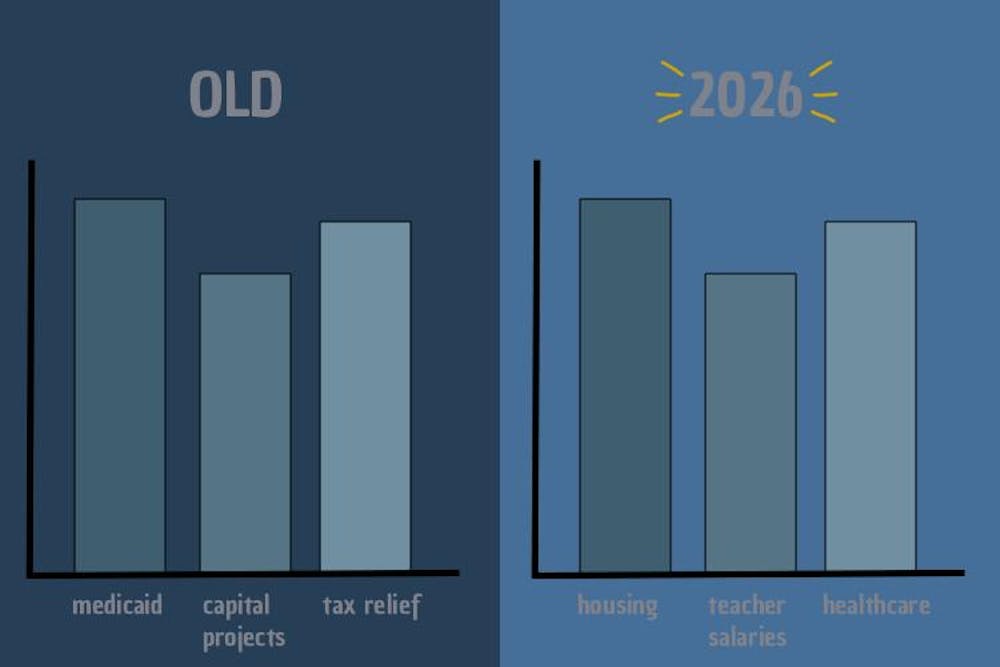
The General Assembly approved a two-year, $205 billion spending plan for the Commonwealth June 29. This biennial budget — which went into effect July 1 — increased discretionary spending for higher education institutions’ research funding, academic administration and other operations amid millions in federal grant pullbacks for universities across the Commonwealth.
The budget also cut back $27 million in previously suggested state funding for construction at the Paul and Diane Manning Institute for Biotechnology, and it contains provisions which will allow the University to move forward with plans for a previously-delayed Center for the Arts building.
In even-numbered years, the General Assembly adopts a biennial budget which outlines how the Commonwealth will spend hundreds of billions of dollars in state revenue. Legislators had a deadline of June 30 to finalize this plan before the previous budget expired at the close of the fiscal year. After four months of gridlock between both houses over whether to axe $1.9 billion in tax exemptions for data centers — the General Assembly eventually implemented a new tax on their energy consumption as a compromise — lawmakers adopted the budget with Gov. Abigail Spanberger’s (D) amendments June 29. In doing so, they narrowly averted what would have been the first-ever state government shutdown in Virginia’s history.
Sen. Creigh Deeds (D-11) serves on the Senate Finance and Appropriations Committee, which is responsible for the Senate’s budget drafts. He explained to The Cavalier Daily that, while the University can and often does raise a significant amount of funding from private sources, it is ultimately owned by the Commonwealth and relies heavily on funding from the General Assembly’s budget. The Commonwealth fronts much of the bill for the University’s operations, for construction and maintenance on Grounds and to maintain affordable access for students.
This year, the Commonwealth made significant new investments in the University’s operations. The General Assembly budgeted roughly $268 million per year to assist with the University’s operational expenses — $18 million more than in the previous budget.
The bulk of this operational support is the $219 million set aside to fund “Educational and General Programs” — which include support for the University’s 12 schools, employee salaries, administrative operations and research projects. Support for Educational and General Programs rose by roughly $11 million this year from the previous budget.
Notably, most other public Virginia colleges and universities witnessed similar increases in their state operational support in the new budget, including George Mason University, Virginia Commonwealth University and the College at Wise.
Deeds confirmed that the General Assembly’s increased investments in higher education institutions are intended to “backfill” millions in federal funding cuts that have impacted Virginia’s colleges. According to data from the U.S. Department of the Treasury, higher education institutions across the Commonwealth have suffered a total of $175 million in grant terminations throughout President Donald Trump’s second term in office, including over $74 million in lost research grants for the University.
Many of these new state investments in higher education institutions first appeared in a budget draft that former Gov. Glenn Youngkin (R) drew up for lawmakers in December, which the new General Assembly then amended extensively. The Democrat-led General Assembly moved forward with the higher education investments outlined during Youngkin’s term and approved significant additional funding increases of its own, primarily to accommodate higher education institutions’ requests for additional operational funds to support affordable access for students.
According to Lauren Posey, University executive director of state government relations, the University and other schools first received this additional budget funding in FY 25, but the additional funding was set to expire this year. The University and other public colleges filed a joint amendment request for the continuation of the increased funding for two more years, which lawmakers ultimately added to the budget. $3 million for the University’s Educational and General Programs this year and $6 million next year will come from this amendment lawmakers adopted.
In the past, the University also received a sizable share of state funding through the Virginia Innovation Partnership Authority — an agency of the Commonwealth which seeks to facilitate innovation, research and entrepreneurship in Virginia through grants. The University’s VIPA funds primarily assisted with constructing the Manning Institute on Grounds, which is set to open in December 2027.
In 2024, lawmakers budgeted a total of $46 million in VIPA funds toward the Manning Institute. This year, however, the General Assembly amended Youngkin’s proposal to pull back nearly $27 million in funding for the project. Youngkin had suggested investing $30 million in the project through VIPA this year, but the General Assembly cut the number down to $3 million.
The Manning Institute is a planned 350,000 square-foot laboratory and research space under construction which will mobilize its research to combat cancers, cardiovascular disease and other life-threatening conditions. The Institute is named for Paul Manning, a former member of the University’s Board of Visitors and philanthropist who gave $100 million to the project in 2023.
According to Deeds, legislators were reluctant to continue funding an institute in Manning’s name after his alleged role in the discussions that led to the resignation of Jim Ryan, former University president and Law professor, in June of last year.
Ryan contended that Manning, former Rector Rachel Sheridan and former Vice Rector Porter Wilkinson effectively served as a channel for the Trump administration’s demands and pressured him to resign in closed-door meetings. Spanberger requested Manning’s resignation from the Board shortly before taking office in January, alongside Sheridan, Wilkinson and two other Board members.
According to Deeds, his fellow SFAC committee members strongly associated Manning with Trump and Youngkin — who appointed Manning to the Board in 2023. Deeds said the committee put forward a draft that wiped out all of the Institute’s VIPA funding, while the committee’s equivalent in the House suggested reducing the Manning Institute’s share of funds to $6 million. The final figure of $3 million was a compromise reached by both chambers in a conference committee, according to Deeds. For his part, Deeds said he advocated for the General Assembly to continue funding the Manning Institute.
“This institute is much larger than any individual,” Deeds said. “The research done there is going to save lives … I suggested that those kind[s] of investments pay off for all Virginians in the long haul … and I told them, besides that, Paul Manning wasn’t a bad guy. It was just the timing of the situation.”
Lawmakers also added a provision which mandates that the University must update its memorandum of understanding with VIPA. The update guarantees that investments the General Assembly makes in the construction of the Manning Institute will be matched dollar-for-dollar with non-state funds.
Jennifer Siciliano, U.Va. Health’s chief external affairs officer, told The Cavalier Daily in an email that the Institute was always intended to be a “strong public/private partnership.” Siciliano said the University will continue seeking out private funding sources to supplement this now-limited state support.
“In addition to the Commonwealth’s investment, we continue to pursue both corporate and private philanthropic opportunities to complete the construction of the building efforts, acquire the world class talent needed and to advance the discoveries and fund research to create the innovative medicines that will take place at the Institute,” Siciliano wrote.
Developing the Institute is a key proposal outlined in U.Va. Health’s 2022-2032 Strategic Plan — an extension of Ryan’s 2030 “Great and Good” Plan specific to the Medical Center.
Democrats in the General Assembly also moved forward with their support for a Center for the Arts building at the University, including it in a list of higher education projects which will receive funding from the Commonwealth’s $1.7 billion capital construction pool.
The Center for the Arts is a planned 210,000 square-foot performing and visual arts center which will be located at the Emmett-Ivy Corridor. The building would function as a centralized home for the Department of Music, the Department of Drama, the Fralin Museum of Art and the Kluge-Ruhe Aboriginal Art Collection. The Center would include a 1,200 seat auditorium, an amphitheater, classrooms, rehearsal spaces for the performing arts and museum spaces.
According to Deeds, there has been some “disagreement” in Richmond over whether to fund a Center for the Arts at the University. The General Assembly sought to amend the previous budget in 2025 and add the project to the Commonwealth’s list of approved capital projects which receive state funding, but Youngkin issued a line-item veto of this provision, barring the project from receiving the millions in state funds needed to move forward.
Youngkin again moved to exclude the Center for the Arts from the Commonwealth’s list of capital projects in his December budget draft, but the General Assembly amended the proposal and added the Center to this list. The Commonwealth’s investment in the project will allow it to move forward after a year of uncertainty.
Posey and Deeds both noted that as a capital investment project, the Center for the Arts will be a public-private partnership, and the University will also be responsible for raising private funds of its own to supplement investments from the Commonwealth.
“It's not going to come cheap or easy, but [the Center] is going to be an unbelievable facility once it's finished,” Deeds said.
Another addition the Democrat-controlled General Assembly made to Youngkin’s December budget draft was the creation of a $70 million fund to assist Virginia universities in their efforts to help students pay the cost of attendance through 2028. Under this provision, the Commonwealth will set aside $20 million in FY 27 to support public higher education institutions as needed with efforts to consolidate and restructure their current financial aid structures based on new enrollment projections.
In FY 28, the remaining $50 million will be divided among each higher education institution in the Commonwealth, with roughly $1 million going toward the University to further help maintain affordable access.
Currently, the University pledges to meet 100 percent of demonstrated financial need of all undergraduate students. The University meets this pledge through a collection of need-based grants and scholarships collectively known as the AccessUVA program.
The new budget also increases discretionary funding for the State Council of Higher Education — which administers a variety of educational programs and state scholarships — by roughly $100 million from the previous fiscal year. The General Assembly further directed $7.3 million in SCHEV funding toward establishing a new Internships Virginia initiative. The program, as established, will work directly with employers to expand paid or credit-bearing internship opportunities for university students. Much of the program’s infrastructure will come from the existing Virginia Talent and Opportunity Partnership.
For University employees, they can expect to see their salaries increase over the next two years as a result of the General Assembly’s budget amendments. The final budget mandated a 3.5 percent pay raise for state employees this year, and another 3.5 percent pay raise in FY 28. This salary increase applies to most employees on Grounds, as the University is a public school and agency of the Commonwealth.
University Spokesperson Bethanie Glover explained in an email to The Cavalier Daily that in accordance with this provision, University leadership approved 3.5 percent pay raises for faculty and staff June 30. Eligible staff for the raises include those covered by the University staff HR plan, “classified staff” hired before July 2006 who do not participate in this plan and professional research staff. Part-time or short-term “faculty wage staff” and some eligible graduate-level teaching assistants also received these pay raises, according to Glover.
Through the budget, University President Scott Beardsley and other college presidents across the Commonwealth also received a 3.5 percent increase in their state salaries from last year. Although most of Beardlsey’s $1.3 million salary comes from other sources — such as private gifts or endowment funds — a portion of his salary comes from state funding. This increase in presidents’ state salaries will raise the amount Beardsley can receive from the Commonwealth from $249,692 to $258,431. The General Assembly has approved similar increases to college presidents’ state salaries in years past, including a 3 percent state salary increase for college presidents in the previous biennial budget in 2024.
While the University’s Office of External Relations did not have an official statement on the budget at the time of Posey’s interview with The Cavalier Daily, she noted that in general, she believed the outlook for the University seemed positive.
Posey noted that the General Assembly made a number of these new investments in the University within the broader context of cuts to federal funding, including in healthcare. Aside from federal cuts to higher education funding and tuition, the Commonwealth is grappling with $26 billion in cuts to Medicaid spending resulting from the passage of Trump’s “One Big Beautiful Bill Act.” In a December interview with The Cavalier Daily, Deeds said the legislature would attempt to assume the costs of federal disinvestment to “keep as many people insured as possible,” further limiting state funds.
“All in all, we're feeling great,” Posey said. “I mean, with any budget cycle, there are pressures … we're [working] with legislators who are looking at [different] priorities that they want to fund … and so we're deeply appreciative of any investment that they choose to make in the University.”
When the General Assembly reconvenes in January, they will not craft a new budget, as the newly-approved spending plan will be in effect for two years. Legislators will have the opportunity, however, to amend the existing plan before the start of FY 28.

Luca Bailey is a third-year Politics student from Free Union, Va. As a staffer on the news and video desks, he has covered topics ranging from the General Assembly and state elections to local politics and University governance. He is also The Cavalier Daily’s beat writer for the Charlottesville City Council.
Read More

EdPolicyWorks — checking in on a center connecting research to education policy
By Charlotte Gabriel | 13 hours agoAccording to the website, its research spans college access and success, early childhood education, school leadership and accountability, teacher quality, labor market trends and methodology and measurement studies.
University Computer Science department remains hopeful in the age of AI
By Lidia Zur Muhlen | 15 hours agoAccording to National Student Clearinghouse, undergraduate enrollment in traditional information and computer science degrees at four-year institutions fell by 8.1 percent in the fall of 2025 compared to fall 2024.

Student Council confirms rules and ethics chair, discusses graduate student input
By Lucia Gambacini | YesterdayThe Representative Body voted to reappoint J.D./PhD candidate Benvin Lozada for his third term as rules and ethics chair.