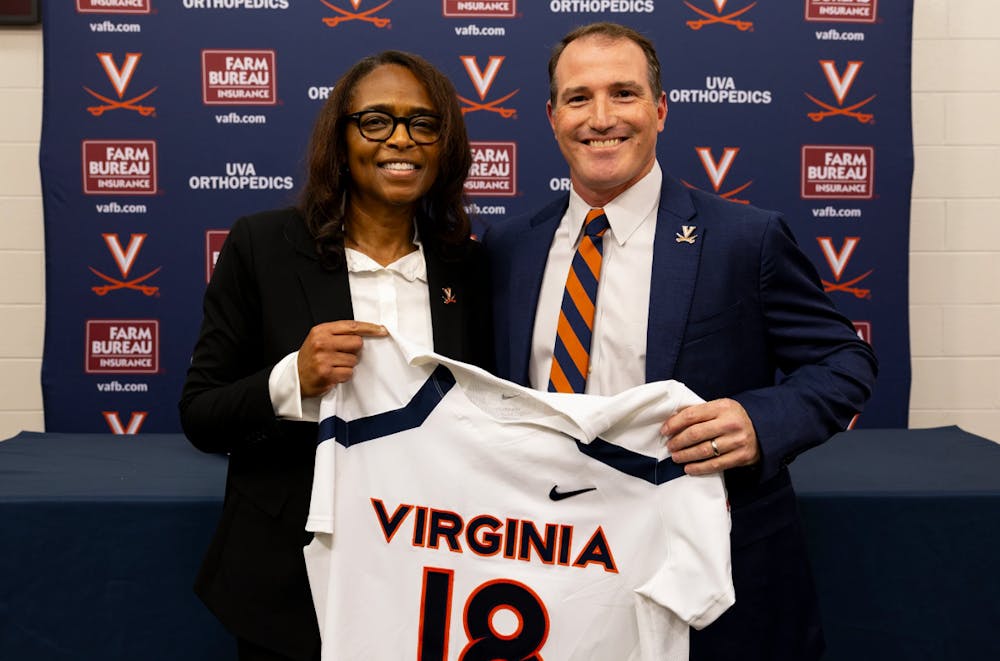
Coach Kevin Cassese is excited. Virginia lacrosse players are excited. But should the fans be?
Excited or not, fans should approach the upcoming season with caution, as the choice of Cassese inspires more questions than answers. Virginia men’s lacrosse is at an inflection point, with the potential to return to the mountaintop after a five-year absence or to slowly slide away from the steps of the stellar, elite programs. In the future, will the hiring of Cassese be looked back on as a success, or as a rash decision that could torpedo a season — or worse, an era?
May 18, Lars Tiffany was let go as head coach of Virginia men’s lacrosse amid a complicated situation that has since spurred a lawsuit from Tiffany. A national search began to find the fifth head coach of Virginia men’s lacrosse in the NCAA era. May 26, it was announced that his replacement would be none other than his associate head coach and offensive coordinator, Cassese.
Although assistant coaches have taken the reins following the departure of a head coach, it tends to occur on an interim basis — similar to the departure of Coach Tony Bennett and his replacement by Ron Sanchez on a season-long interim basis.
In a case where it might have been prudent to not publicly acknowledge the intrigue surrounding him and his predecessor, Cassese said to Jeff White of Virginia Sports May 27, “There’s always two sides of a relationship, so [Tiffany’s] got to be a willing partner of that as well. But at least on my side, I have zero ill will.”
The surrounding context of the lacrosse season — including a season with high highs and low lows — further complicates the situation.
Put simply, Cassese’s record has left much to be desired. Cassese has had moderate success in his previous tenures — but moderate success is not the tradition of Virginia men’s lacrosse, which has averaged a national championship just shy of every five years in the 21st century. Furthermore, his assistant coaching choices show two distinct directions he sees for the program — a new direction with new leadership or a path led by those with closer ties to Tiffany.
His coaching career began when he was hired as Tiffany’s first assistant at Stony Brook. Although the man-up unit for the Seawolves led the nation with a 45.7 percent efficiency rate, the team finished 10-6 and No. 4 in the America East Conference.
After one season, Cassese separated from Tiffany for over a decade and a half, as Cassese returned to Duke, his alma mater, to serve as assistant coach there. He would serve as interim head coach in the offseason following the resignation of Mike Pressler.
The team was successful with him as an assistant coach, winning 17 games, going undefeated in conference play, winning the ACC Tournament and making it all the way to the national championship game. Part of that magic might be attributed to Cassese, who left for Lehigh after the close of the 2007 season. But not all of it, as that season was the first of three consecutive ACC Championships and eight consecutive Championship Weekend appearances for Duke, who seemed to manage just fine without Cassese.
Cassese would spend the next 16 years at Lehigh, toiling away to find wins for the Mountain Hawks. His result was the best coaching record in Lehigh history, with 136 wins and 104 losses. It is notable that Cassese instituted relatively consistent winning for a program that had little notable success since the Eisenhower administration. However, he did so in a conference decidedly weaker than the ACC, and his winning percentage is significantly lower than any NCAA-era Virginia coach.
Lehigh won the Patriot League thrice during Cassese’s tenure, qualifying for the NCAA tournament in 2012, 2013 and 2021. Despite those conference championships, Cassese’s Lehigh teams finished fifth or below in the Patriot League twice as often as they won the conference. In the NCAA Tournament, Lehigh never advanced beyond the opening game under Cassese, holding a 0-3 postseason record and a -17 points margin.
While Cassese was at Lehigh from 2008 to 2023 and qualified thrice for the tournament, Virginia missed the tournament only three times themselves, and further bolstered themselves with seven Championship Weekend appearances and three national championship victories. Needless to say, Cassese falls short of the Virginia standard in this regard.
Cassese came to Virginia following the 2023 season, replacing Sean Kirwan in the long shadow of the back-to-back NCAA Tournament victories for the Cavaliers. The team chugged ahead in 2024, making it to Championship Weekend for the 26th time. However, the wheels fell off in 2025 as the program saw only its second losing season under Tiffany. A singular bright spot was the man-up unit, which still ranked in the top 10 nationally. A man-up unit can only do so much in their limited 30-second and one-minute spurts, though.
In the early part of the 2026 season, it seemed that Cavalier fans were to be treated to a redux of the previous season. Virginia righted this ship in the latter half, culminating in a white-hot, exhilarating ACC Championship weekend — before tumbling down against Georgetown just shy of possibly playing three of four tournament games in front of a home crowd.
Some of the blame for that season-ending loss can be attributed to a one-game setback for graduate student goalie Jake Marek. Much of the blame, though, can be placed on the Cassese-led offense, which outshot the Hoyas but were significantly less efficient with their shots than the visitors.
The events of previous year for Virginia men’s lacrosse — the highs, the lows and everything in between — bring us to today. The three prior Cavalier coaches — Tiffany, Dom Starsia and Jim Adams — came to Virginia in the midst of their careers, following successful several-year tenures at high-level Ivy League schools. Cassese is in the midst of his career, that much can be given, but Lehigh is no Brown or Penn, and the Patriot League is not nearly on the level of the Ivy League.
Cassese was not the assistant coach during the back-to-back championship runs of 2019 and 2021. Instead, he oversaw the offense that was responsible for one of the more miserable season-and-a-half stretches for Virginia men’s lacrosse.
He has had his bright spots, though — it is especially relevant that 20 years apart, his offenses have a knack for success when up a man. Additionally, players speak highly of him — as can be seen by the significant amount of talent remaining in Charlottesville.
The opening and closing of the lacrosse transfer portal for undergraduate students has come and gone, and only a single player entered — Johnny Hackett, a senior midfielder who wound up at Ohio State. Virginia brought in two transfers and otherwise kept non-graduating players at Klöckner Stadium for another year, including team leaders like senior defender John Schroter, senior attacker Ryan Colsey and senior midfielder Joey Terenzi.
“It’s either our guy or somebody else we haven’t worked with before, and we’re taking our guy any day. We love our guy and we’re going to stick with our guy,” Schroter said to Jeff White of Virginia Sports May 27.
In the intervening weeks between the hiring of Cassese and now, the new head coach has begun to assemble his staff, hiring new assistants for both sides of the ball.
The hiring of former Vermont head coach Chris Fiefs as defensive coordinator and associate head coach has possible upside, considering Fiefs’ ACC experience at national championship-winning North Carolina in 2016. At the same time, Fiefs has some similarities to Cassese — a lengthy tenure at a small school with a less-than-stellar record.
However, the hiring of Virginia alumni Mikey Herring and Matthew Nunes as assistant coaches also could lead one to question the direction of the program. Herring and Nunes are both good players, but players formed under Tiffany’s leadership. They both also have less experience on the sidelines — Nunes in particular has only a year of coaching under his belt.
Fiefs represents one way for Virginia — the well-worn path of experience, paved with various coaching endeavors culminating in a power-conference gig. He coached against Tiffany once while at Vermont, but otherwise did not overlap with the former Cavaliers coach.
Herring and Nunes represent another way — that of dipping back into the memories of the good times. Cassese clearly saw something in those men, enough to hire them. However, one may wonder if that thing is a sense of legitimacy.
Only time will tell if Cassese is a good fit for a Virginia program hungry for Championship Weekend and a possible eighth national championship. Good things are possible — but by no means guaranteed.

Drew Dillman is a staff writer and X account manager on the sports desk. He is a fourth-year College student, majoring in history. Drew is from North Little Rock, Ark., and he enjoys writing game recaps. Outside of The Cavalier Daily, Drew is president of Shakespeare on the Lawn, a classical theater group at the University.
Read More

While playing in the back, Mia Abello is always looking forward
By Eleanor Lynch | 7 hours agoFor Virginia field hockey, a player who regularly steps up to take that shot is fourth-year back Mia Abello.

Virginia begins backslide with Florida State loss
By Joe Schwiesow | YesterdayVirginia could not “get-right” between their first two losses, and now they lack much breathing room and time to right the ship.

With win over Queens, Virginia’s fuddling dilemma on full display
By Michael Liebermann | Yesterday“It’s balls into our penalty area,” Gelnovatch said. “It’s all it is.”