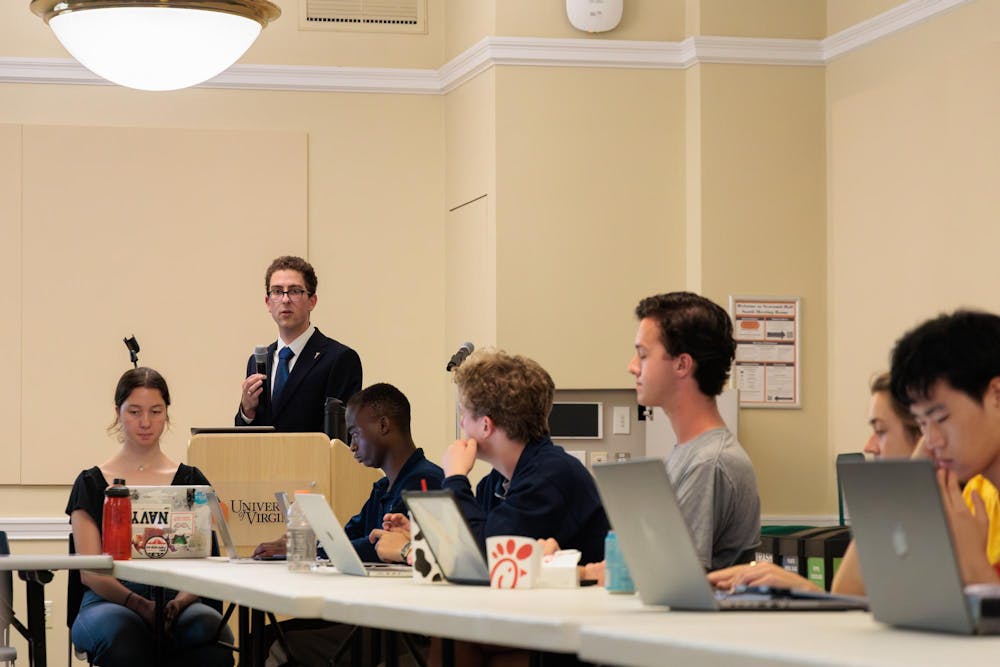
Student Council met Tuesday for their second general body meeting of the academic year. Philip Ermanoski, chief financial officer and fourth-year College student, presented the Council’s proposed 2026-27 academic year budget. Representatives ultimately adopted an amendment to the proposed budget, but tabled consideration of the legislation to this Tuesday’s meeting.
This year’s proposed budget would total to $232,105.30, significantly less than last year’s budget of $279,819.11. Ermanoski explained that the reason for this decrease was because the total utilization rate of the Council’s previous budget hovered around 70 percent, leaving an estimated $70,000 in unused funds. He noted that the money left unspent is funding which could have been used to support Contracted Independent Organizations on Grounds.
“This is not good for StudCo [and] this isn't good for the University,” Ermanoski said. “Ultimately, we let go of $70,000 that could have gone to CIOs. We are making it one of our top priorities … this year to increase our utilization rate.”
Saehee Pérez, vice president for administration and fourth-year College student, also noted that this funding could have gone towards supporting Council initiatives. Examples of recent Student Council initiatives include an ongoing capital campaign to raise funding for Support and Access services — a branch within Student Council that offers free resources to students like textbook reimbursements, legal services and a shuttle service to nearby airports.
One substantial change from last year’s budget came from within the Cabinet office, where the Council decreased support for the Arts Fund, which promotes artistic endeavors on Grounds. Under the proposed budget, this funding would decrease from $20,000 to $8,000. Ermanoski explained that the decrease occurred because the Arts agency spent almost all of its annual budget in the fall semester of last year, leaving very little funding for the spring. He noted that the Council can revisit the issue of providing further funding at a later date as needed.
The International Student Affairs agency — which handles international student concerns and interests — also saw decreased funding. Ermanoski explained that while the agency aimed for three Council-sponsored “cultural exchange nights” to take place last year, only one was held. This newly proposed budget accounts for a goal of one to two cultural exchange nights per semester.
Funding for Support and Access Services decreased by $58,200. According to Ermanoski, this is partly due to the budget for sexually transmitted infection testing kits being moved to Safety and Wellness. Within the Support and Access branch, the Textbook Access Office — which subsidizes textbook costs for students — saw an increase by $5,000, and the Mutual Aid fund remained the same. The presentation noted that unlike last year, the budget does not account for the addition of a $23,000 wall to the Council’s office spaces in the Student Activities Center, which will save the Council funding as well.
The Legislative Affairs budget would also increase under the new budget to account for the ACC Days of Advocacy on Capitol Hill — a collaborative advocacy event featuring the Student Councils of several ACC schools — which will take place Feb. 8-10. The Safety and Wellness budget greatly increased to account for the STI testing kits that the Council provides at free STI testing events, which costs $20,000 for the fall semester. The Council hopes to house the initiative entirely through Student Health and Wellness in the spring.
The new budget would also increase the Representative body’s discretionary funding from $500 to $1500. At the meeting, Pérez noted that because the budget will be approved this year far earlier than in years past, members of the Representative Body may have additional initiatives that they hope the Council will fund which they have not yet thought of. These extra discretionary funds will allow Representatives to work with Ermanoski even after the budget is finalized to identify additional initiatives to receive funding, Pérez said.
The Executive and Administrative Operations budget rose by $5,450 to account for the Student Council Gala which, according to the presentation, is not usually included in the budget.
The Coalition Engagement and Organizations budgets both remained relatively the same.
Batten Rep. Imane Akhanous proposed an amendment to further allocate $1,600 from the Representative budget to support Mental Health/Wellness Week at the School of Law — a week-long initiative in October with sponsored events aimed at promoting the mental well-being of law students. The amendment passed, with 22 votes in favor and one visible abstention.
The Council then tabled the budget legislation as amended for this Tuesday’s general body meeting, where they will vote whether to officially adopt the proposal.
Third-year Commerce Representative Hayden Matay asked if there were any updates on establishing an endowment for the Council. Michael Mitchell, Council president and fourth-year Commerce student has outlined the establishment of an endowment as a key priority for his tenure, arguing that the additional funding source will provide the Council with greater long-term financial stability and decrease its reliance on revenue from Student Activities Fees. At the meeting, Mitchell responded that the Executive Body is “working on” the endowment, but did not elaborate further.
Pérez also briefly mentioned that an endowment would reduce the Council’s reliance on the president's fund — the fund supported by both Jim Ryan, former University President and School of Law professor, and University President Scott Beardsley, who have each promised funding for the Council. According to Pérez, the Council is still utilizing $250,000 gifted by Ryan, which will last until FY 28.
Mitchell also announced that the University Board of Elections 2026-27 Rules and Regulations draft is now online and outlines the rules the UBE requires that University elections follow. He added that public feedback will be accepted on the draft through Tuesday.
Ian Travis, co-chair of community concerns and fourth-year College student, also brought up changes made to University Transit Services. He explained that University Transit Services is now officially titled U.Va. Transit, and that instead of SafeRide, it is U.Va. Ride. He added that the North Grounds Parking Garage — a six-story, 1,030-spot parking garage under construction near Massie and Copeley roads — is set to open later in the semester and will have a covered bus stop and e-chargers.
The Council will reconvene Tuesday at 6:30 p.m. for its regularly scheduled general body meeting.

Lucia Gambacini is a senior writer on the news desk covering Student Council and other issues pertaining to student life and government. She is a third-year from Richmond, Va. studying Political & Social Thought in the College.
Read More

Students pay University Mandatory Fees — what do they cover?
By Isabela Delgado | YesterdayThe amount a student pays in fees is dependent on several factors, such as a students’ residence in- or out-of-state and their school of enrollment.

Honor Committee introduces proposal to change sanction appeal process
By Isabela Delgado | 3 days agoThe proposal includes the addition of a governing body that would oversee the appeals process and decide if a student's appeal is deemed legitimate.
From the Archives: 2000s
By Peyton Franz and Alayjah Gillus | 3 days agoCavalier Daily writer, John Adams, pranks students with a column stating that a newly installed “no TJ” policy will go into effect, preventing graduates from Thomas Jefferson High School for Science and Technology from attending the University and expelling all current students who graduated from TJHSST.