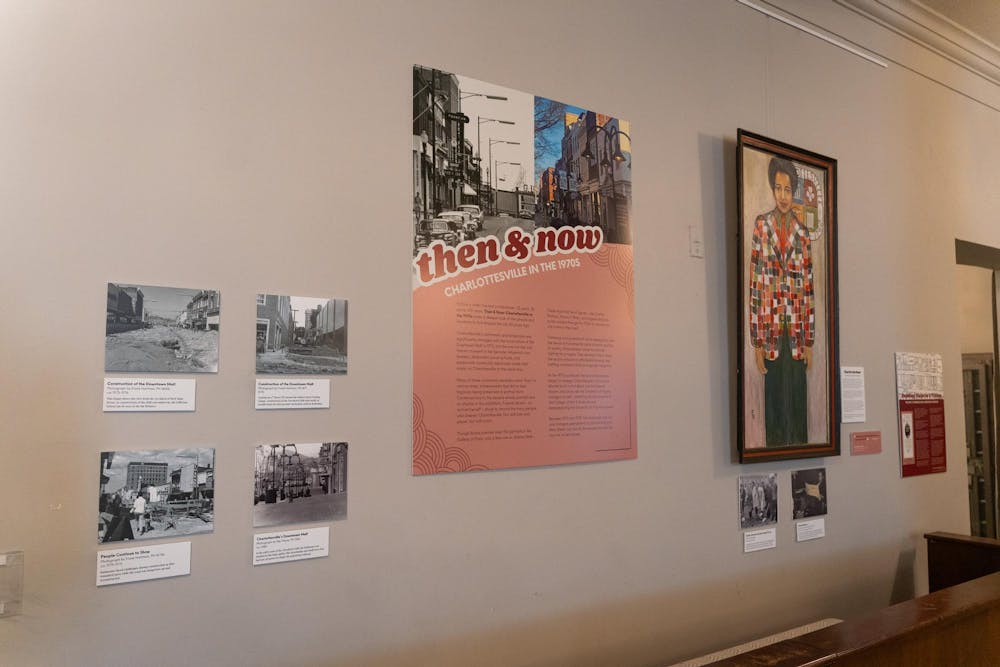
In celebration of the Downtown Mall’s 50th anniversary, “Then & Now: Charlottesville in the 1970s” contextualizes the present by providing an intimate view of life and social activism in Charlottesville five decades ago. The exhibit was curated by the Albemarle Charlottesville Historical Society, a non-profit organization dedicated to showcasing the history and culture of the Albermarle-Charlottesville area. Anchored by portraits of local activists, the exhibit utilizes paintings, photographs and historical documents to tell the story of the Downtown Mall's construction and the factors that led to its inception in 1976.
At Vault Virginia, within the 110-year old Bradbury Building — which formerly housed the People’s National Bank — at the heart of the Downtown Mall, the exhibit guides visitors through a documented decade of change across the walls of the first floor. It highlights not only the opening days of the Downtown Mall, but also the nationwide watershed movement for social change that was the 1970s. Pieces within the space detail local strides in feminist and Black history, as well as racial challenges through time, including the demolition of the Vinegar Hill neighborhood.
The exhibit revolves around 10 portraits painted by Frances Brand — a prolific local artist whose “Firsts” collection highlights individuals who made pioneering civil strides in the Charlottesville and Albemarle community, such as those at the forefront of social activism, civic leadership or their field of study. With over 150 portraits in this collection, the paintings provided ample material for the creation of “Then & Now.” Selecting which depictions would be displayed, however, proved to be a challenge according to Perry Raymond, ACHS collections and exhibit assistant.
“The first step in the exhibition was selecting who was going to get put in the Vault,” Raymond said. “It was really hard because thematically we had to work out the similarities and differences between everyone and make sure that we were representing a broad scope of all the people who were influential to Charlottesville in the '70s.”
Utilizing Brand’s portraits and photographs sourced from ACHS’ historical collections, the exhibit is divided into five categories — one being specific to developments at the University, for example. Each describes social progress — often concerning civil rights — across the greater Charlottesville area, with small accompanying plaques that contain historical information. According to ACHS Executive Director Olivia Brown, an aim of “Then & Now” is to bring attention to Charlottesville’s rich local history in civil rights activism.
“In schools, we're taught about … Martin Luther King Jr., we learn about Malcolm X, we learn about Rosa Parks, or even … Ruby Bridges and the Little Rock Nine,” Brown said. “We have exactly those stories here in our local community, and we just have to learn about them.”
Some of these related figures include Grace Tinsley, who was appointed as the first female Black member of the Charlottesville City School Board in 1971, and Nancy O’Brien, who was elected as the first female mayor of Charlottesville in 1976.
Another featured trailblazer — and a more recent leader — is Satyendra Huja, who was the first Indian Sikh mayor of an American city. Huja served two terms as Charlottesville’s mayor from 2012 to 2016, and Raymond said that Huja had been responsible for the development of artistic sculptures throughout the city. Brown said that focusing on these efforts of immediate community figures while also considering nationwide societal themes was vital to fully capturing Charlottesville’s past.
“We wanted to put up an exhibit that talked about [the Mall], but also then looked more broadly at the area in the 1970s as a whole decade,” Brown said. “[The exhibit] also thematically [looks] at things like civic leadership, social activism and how those general topics tied into the work of these people who we were highlighting.”
Beyond tales of social activism, the exhibit paints a candid picture of day-to-day life in 1970s Charlottesville. Alongside civic leaders were images of local events such as the Dogwood Festival and the annual University Easters weekend tradition. Towards the end of the exhibit, one section showcases a local calendar on the Downtown Mall’s opening day, where visitors can bask in the humble mundanities of Parent Teacher Association meeting schedules or community theater performances.
The ACHS sifted through an array of historical sources during the creation of “Then & Now.” According to Raymond, arranging these often donated, sporadic primary works led to a unique curatorial research process.
“We have a collection of vertical files … but they’ve been filled and collected over the years with newspaper clippings, pamphlets, manuscripts, photos, all these things that people, either in the library or from the community, have donated,” Raymond said. “Being able to work in the collections that way to pull things that wrote the panels and found the supplements … that was the coolest part.”
Locally donated materials situate the display as an intimate look at both Charlottesville’s history and that of its constituents. Brown explained that the chronicles of only 50 years ago are still contributing to the future vision of the time-honored city, being fresh in the mind of local residents.
“We’re not so far removed from a 50-year-ago history,” Brown said. “To look at the ways that we have succeeded in improving our community, and the vision of some of these leaders, what they were hoping for [and] that we haven't succeeded in areas where we can still improve, that's really one of the benefits of highlighting local people in this way.”
The exhibit’s artifacts detail that vital moments of social activism happen not only on a national level but also on a local one, per the efforts of groundbreaking community members. Raymond — a Charlottesville native herself — said that knowing these important figures who lived in her own community shaped her perspective of local history.
“We can’t necessarily take these [social changes] for granted because of all the people who have worked so hard to make Charlottesville what it is now,” Raymond said. “There’s people on the local, the state, the federal level. All these people who work together to drive social change and being able to honor the people who grew up right down the road from us who make local history so important was definitely the best part for me.”
Weaving the story of local activism and its effects on daily life in the 1970s, the exhibit reminds locals of the people and moments that led Charlottesville to be the city it is today. “Then & Now: Charlottesville in the 1970s” will be on display through Sept. 15. Located on the first floor of Vault Virginia, admission is free and open to all curious about or celebrating Charlottesville’s evolution over a half-century.
Read More

Hoo’s Watching: Turning the page to the screen
By Sofia Hahn | Yesterday2026 seemed to usher in an abundance of literary adaptations that quickly turned into cultural phenomena.

Malcolm Todd brought everyone and their roommates to JPJ for the 2026 Wahoo Welcome Concert
By Amelia Lucien | 2 days agoTodd expressed continuous enthusiasm for Charlottesville and the University, referring to the University as the “coolest student body yet.”

‘Lost Weekend’ tells a reflective, honest story
By Alice Oakey | 2 days agoAfter six years without a solo album, Bridgers’ fans had high expectations, and they will feel as though she delivered on a project that is both sonically and emotionally moving.