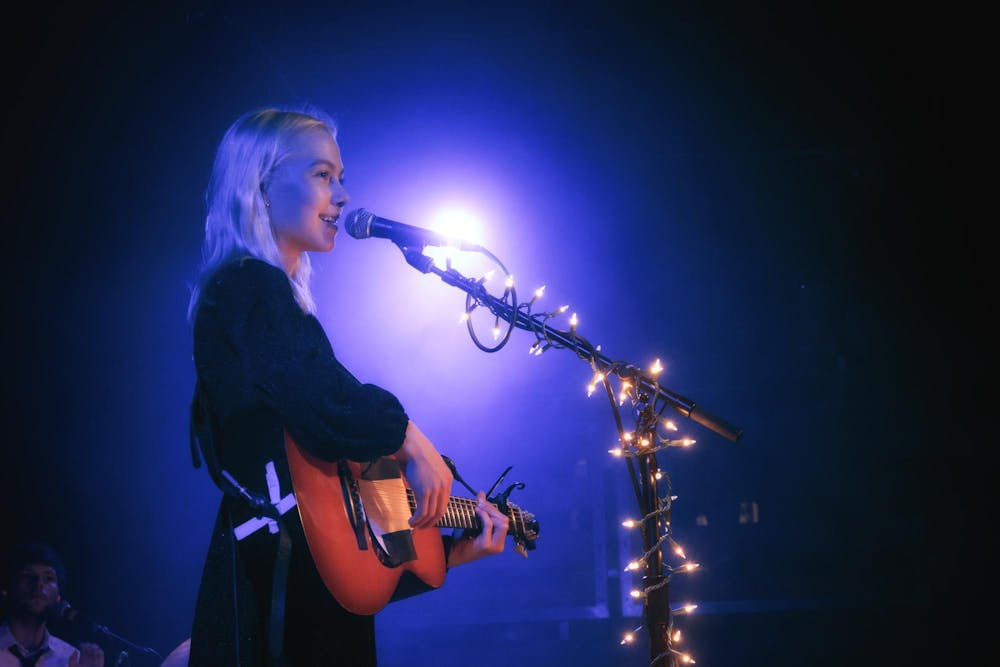
Singer-songwriter Phoebe Bridgers released her third solo studio album, “Lost Weekend,” Friday. The indie-folk artist’s music has previously stood out for its haunting lyrics and exploration of the complexities of being a young woman in the contemporary world, and Bridgers shines where she always does in “Lost Weekend” — with artful, descriptive and deeply personal lyrics in thoughtfully composed tracks. The album is distinctively Bridgers’ familiar style, but it carries an air of maturity and reflectiveness that distinguishes it from the albums of her young adulthood.
“Lost Weekend” is not only her longest album, having five additional songs over the 11 in 2017’s “Stranger in the Alps” and 2020’s “Punisher,” but also her first solo album in six years. Bridgers released “the record” in 2023 with her supergroup Boygenius alongside Julien Baker and Lucy Dacus and then largely stepped back from the public eye and all social media platforms. Since Bridgers’ 2020 album “Punisher,” she called off her engagement with actor Paul Mescal, grieved the passing of her father — which she announced in 2023 — and entered a romantic relationship with actor and comedian Bo Burnham.
After a long silence, Bridgers performed a pop-up show May 8 at a small venue in Roswell, New Mexico. She followed that show with a tour of the United States, spontaneously popping up in small, local venues of midsize cities. While Bridgers has said that she does not like her lyrics to be interpreted literally, it appears that “Lost Weekend” was at least partially inspired by real and personal events, being dedicated to her late father.
Bridgers begins “Lost Weekend” with “The Outside,” as listeners hear distorted, layered versions of her voice before her true voice breaks through singing about struggles with dissociation, her father’s funeral and the sensation of playing in front of screaming crowds. The song feels classically her own — including a melancholy tune on the piano and soft, layered vocals — but also breaks expectations by using technology where Bridgers distorts her voice. Beginning with this contrast positions Bridgers to play with the relationship between technology and reality on “Lost Weekend.”
The second tracks of Bridgers’ projects have traditionally been high-tempo hits, a pattern maintained with “Lost Boys” — the only single she released ahead of the album. “Lost Boys” again launches listeners into the project by pairing a catchy melody with narrations from what appear to be about the three main relationships that inspired the album. Following “Lost Boys,” Bridgers breaks into the heart of the album with “Kill Me” and “The Governor’s Waltz.” These tracks — along with tracks like “Haunted” and “I Can’t Wait” — ground the album in its retro, paranormal feel, feature beautiful melodies and feel distinctly from her hands.
While Bridgers’ discography is generally devoid of upbeat music, “Bobby” and “Liberty Tree” are rare, happy love songs on the album. Bridgers sings on “Bobby” that “this could be the end of wanting” and asks “what are you doing the rest of my life, Bobby?,” indicating excitement that stands out amongst her other work. It starkly contrasts her famous lyrics about love like “if you were a waiting room, I would never see a doctor / I would sit there with my first aid kit and bleed,” on 2014’s “Waiting Room.” “Bobby” and “Liberty Tree” clearly reference Bridgers’ current boyfriend, Bo Burnham, and feel like a mature acknowledgement of experiencing contentment and growth. Audiences will welcome Bridgers communicating the emotions of a perhaps less complicated love, where it sounds like she has been mused by happiness after years of the opposite.
The artist further expresses contrasting emotional intricacies throughout tracks about her late father. She has explored her complicated relationship with her father, who struggled with addiction, on past songs like “Kyoto” and “Summer’s End,” and now spends much of “Lost Weekend” untangling this grief. “One more time, for old time’s sake / I’ll watch him get carried away,” she sings in the first verse of “The Outside.” Bridgers ends track 11, “Never Going Back!,” with a voicemail from him teasing, “Being a rock star takes up a lot of your time, I'm guessing.” In these moments, listeners can feel the authenticity imbued in the album as Bridgers shares such intimate and private gifts.
“Lost Weekend” feels the most raw and honest when Bridgers is singing about her father, negotiating with the grief she feels despite their thorny dynamic. On track nine, “Still Standing,” she sings “Feeling indifferent, wearing black / sometimes I want you back / but not today,” and “I can’t imagine you dead / but you are every day / thank you for everything.” “Lost Weekend” is a look into Bridgers’ soul and a courageous exploration of the grief of relationships lost both familially and romantically, and the happiness that has risen from those ashes.
Bridgers’ May and June pop-up tour similarly revolved around a sense of intimacy, being set up primarily across small venues prohibiting recording devices. Her performances were announced on paper fliers mere hours before Bridgers was set to play, and lucky or local fans in audiences were able to hear tracks off “Lost Weekend” full months before its release. By rewarding diehard fans and limiting technology, Bridgers formed a strong, genuine audience connection and built the album's retro aesthetic.
After six years without a solo album, Bridgers’ fans had high expectations, and they will feel as though she delivered on a project that is both sonically and emotionally moving. Bridgers’ music has aged with her, and “Lost Weekend” is a testament to her growth. Although the album reveals a new maturity, Bridgers stayed true to her strengths in ethereal and hypnotizing vocal arrangements, thoughtful lyrics and intense vulnerability.
Read More

The Hooligans break down barriers for student dancers
By Kelsey McIntyre | 12 hours ago“People dancing is an expression of togetherness because ... music helps bind us, and dancing is an expression of emotion and a way of communication,” Oliver said. “That's why people do it in a dance circle.”

The Virginia Dance Company trades competition for community
By Eloise Diffley | 3 days agoThe Virginia Dance Company is composed of a tight-knit group of dancers, most of whom have danced competitively and consistently throughout childhood and high school.

Hoo’s Watching: Anatomy of a teen TV show
By Caroline Lee | 5 days ago“Crew Girl” is not reinventing the wheel, nor is it particularly interested in doing so.