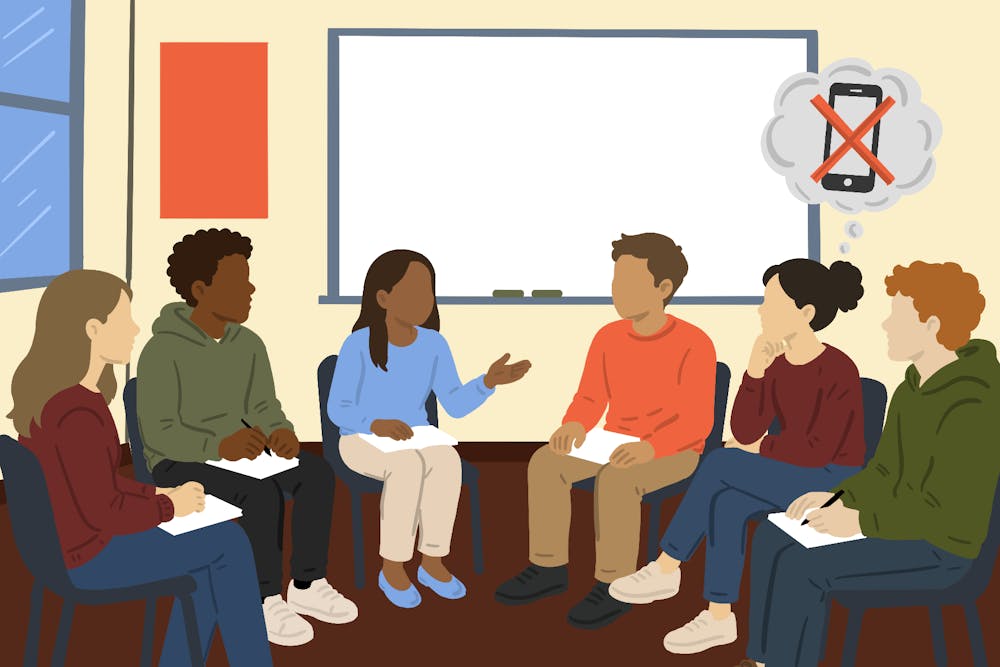
Two years after the University began offering tech-free courses through its Summer Technology Sabbatical, the program has expanded, with courses offered this summer in psychology and engineering. The classes require students to “refrain” from using all devices during class time, as the University’s Summer Technology Sabbatical website states that “constant connection” to devices can negatively impact learning and comprehension.
The program is run through the Office of the Provost, which invites faculty to teach a section of an existing course without devices during the summer session. The policy requires students to keep laptops and other devices away while class is in session with exceptions for emergencies and accessibility accommodations.
Beyond that requirement, the program does not prescribe how instructors run their courses — there is no common curriculum, no shared assessment and no program-wide survey of participating students, leaving decisions about course materials, assignments and enforcement of the tech-free environment to individual professors.
The three technology sabbatical classes this summer were PSYC 3240, “Animal Minds,” taught in session two by Assoc. Psychology Prof. Daniel Meliza, PSYC 4640, “Psychology of Emotions,” taught in session three by Assoc. Psychology Prof. Adrienne Wood, and STS 2600, “Engineering Ethics,” taught in session three by Asst. Engineering and Society Prof. Jesse Pappas.
Summer session is divided into three four-week terms, with session one running May 18 to June 12, session two from June 15 to July 10 and session three from July 13 to Aug. 6. Classes meet for two hours and 15 minutes each day of the week, except Sunday.
Wood said she has taught PSYC 4640, “Psychology of Emotions,” many times during the regular academic year in seminar style lectures with around 25 students. During the summer, however, she taught nine students. She said that the difference in the time and the number of students in a semester-long course versus a summer session made comparing the two environments difficult.
“There’s a couple confounds,” Wood said. “One is that this is a smaller class … and then the other confound is the fact that it’s a one-month class, so you get this really immersive [experience]. You get to know each other really well.”
Setting the differences between the two class environments aside, Wood said the effect on conversation in a no-tech environment was clear — students were engaged in both small-group and full-class discussion in a way that she said she would not see when laptops are open.
Meliza, who taught PSYC 3240, “Animal Minds,” as a technology sabbatical course in the first summer session, was more cautious about crediting the absence of devices as the reason for higher participation. He said his section enrolled 17 students, which — compared to the University’s Student Information System — is much smaller than the lecture format he taught in fall 2025 with 120 students.
“It’s hard to say [the effect of the tech-free environment] … because the size of the class is different,” Meliza said. “Yes, there was, per-capita, more participation. But when you have 17 students and you know everyone’s name, it’s easy to call on people and force them to talk.”
Meliza also pointed out that the students who enroll in these courses know that they would be in a tech-free environment, and summer session attracts a different population of students than the fall or spring, which he said makes him hesitant to draw any direct comparisons.
Pappas, who taught his STS 2600, “Engineering Ethics,” class in the third summer session, surveyed his 17 students at the end of the course to see what they thought of the tech sabbatical program and the class specifically. The survey was unique to his course and it asked students to rate several dimensions of the course — including their attention, their participation in discussion and their sense of connection with classmates and the instructor — against what they would expect in a course that permits devices. Students rated each dimension on a five-point scale and were also asked whether the format should continue.
The highest-rated dimension in Pappas’ survey was the connection with classmates and the instructor, in which students scored a 4.08 out of 5, on average.
Pappas said his classroom was device-free throughout, but he chose to have students put away their own devices rather than collect them at the door, and noted that he did not have to enforce the policy after the first day.
“Students read the room, and when [it] reads as a place where nobody is on their phone, staying off your own phone becomes the obvious choice,” Pappas said.
Pappas said more than half of his students named the same downside in the no-tech classroom — that they could not check something on a device in a given moment. One student wrote that she would regularly intend to look something up after class and forget by the time the class ended, and another wanted to bring in a news article to raise in discussion and could not retrieve it.
Another student reported that being unable to search the internet during class reduced their ability to participate, Pappas said. For one of these students, she wrote that topics arose that she wanted to ask about but could not look up.
More than 80 percent of Pappas’ students said they supported the format of the tech sabbatical program continuing in some form, though several described sustaining attention without technology as exhausting.
What the format did change, all three interviewed professors said, was how the courses were taught. Meliza’s course relied heavily on chalkboard instruction, paper handouts and student-led journal clubs in which students took turns presenting and facilitating discussion. He said using a chalkboard rather than digital slides allowed for a different teaching approach, in which some topics could be further expanded upon than in a large lecture.
“It’s very easy with slides to just run down the track,” Meliza said. “And when you are drawing things out by hand, you realize things that you hadn't thought about when you were making the notes. And it’s very easy to pivot.”
Wood said the constraint of teaching without devices pushed her toward activities she would not otherwise have used, including a dice-based game about the academic publication process, a round of charades and a debate using only notes and articles handed out during the course. She said the format also gave her visible proof that students had done the reading — something that she does not have when everything is online.
“You can get a little cynical as a professor and think, ‘oh, no one’s even doing the reading,’” Wood said. “But … I could just see that they were really engaging deeply with [the readings].”
Wood said the main challenge with the course format was the cost of preparing the physical notes and articles for her students. She said the University’s print services will not produce copies of copyrighted articles without licensing fee payments. Specifically, Wood pointed out that for a 25-student section, a single article could cost roughly $500 — across a semester of readings, she said, that is not a bill a professor could afford.
“I personally paid to print off all the students’ binders, and I’m not going to be able to keep doing that, so I need to figure out a workaround,” Wood said.
Wood said she is teaching PSYC 4640, “Psychology of Emotions,” again this fall and plans to implement the tech-free format across the full semester, likely by giving students instructions to print and assemble their own materials. She said she intends to teach all her 4000-level courses tech-free going forward, but does not expect the 350-person lecture she also teaches to follow suit. She said this is because students in a test-based lecture are far more focused on efficiently taking notes than students in a discussion seminar and could panic without a keyboard.
Meliza is not teaching Animal Minds this fall, having been assigned to cover a different neuroscience course. He said the break gives him time to think about how the format would scale to a larger enrollment.
"I may do [tech-sabbatical] again as a summer session," Meliza said. "But I anticipate … in general, keeping things as low-tech as possible [in future courses]."
The Summer Technology Sabbatical remains a summer-only program, and for now, the format’s continuation rests with individual professors. Pappas said he would run the sabbatical during the academic year with some changes — as students wrote on the survey that sustaining attention in a no-tech environment proves challenging. Wood also said she plans to carry the no-tech classroom into her fall section of PSYC 4640, “Psychology of Emotions.”
Komal Reddymachu is a second-year College student majoring in government and English. He is a staff writer on the news desk and has been writing for The Cavalier Daily since his first semester at the University. Komal enjoys writing about all topics, but he especially enjoys covering events around Charlottesville.
Read More

U.Va. reports increases in rape, aggravated assault and liquor law violations in 2025
By Jaylynn Perez | 3 hours agoThe report has been published annually since 1991 under the federal Jeanne Clery Campus Safety Act.

Yael Grushka-Cockayne discusses artificial intelligence and future of business education
By Jaylynn Perez | 4 hours agoThe webinar — titled “Why Darden? Our Next Chapter” — brought together prospective, admitted and deferred students across Darden’s Master of Business Administration programs.

At rare three-way meeting, City, County and University officials discuss regional coordination
By Luca Bailey | YesterdayThe meeting also gave City, County and University officials an opportunity to discuss areas of mutual concern.