Editor’s note: This article contains mentions of sexual assault.
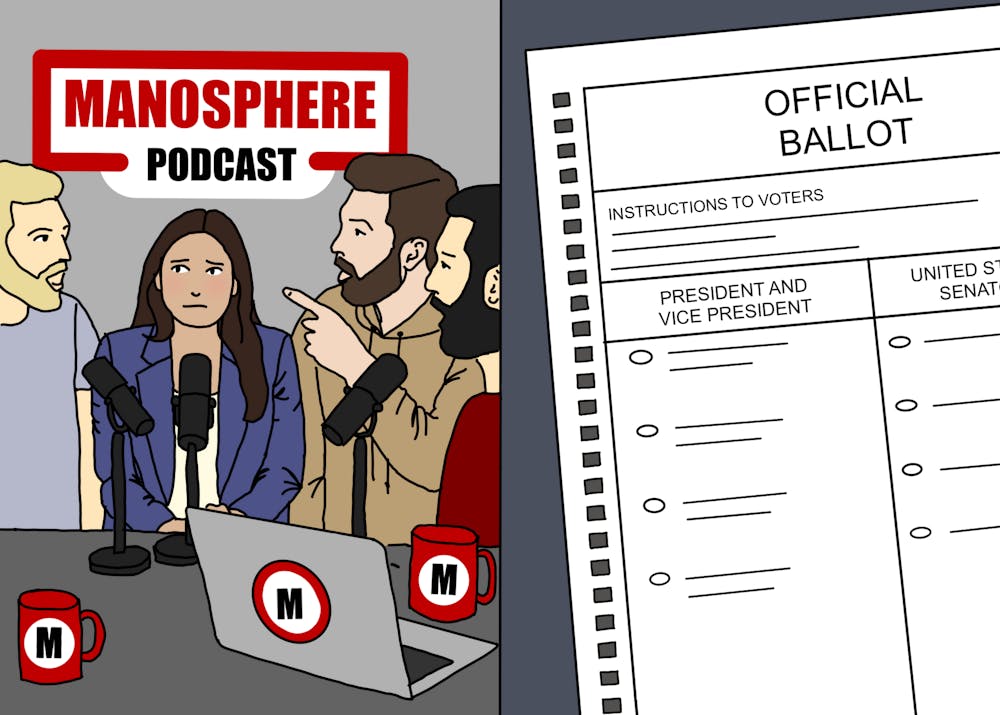
Over this summer, you have probably scrolled past an Instagram reel of a room of men with podcast microphones talking about women's roles on podcasts such as “Whatever” with Brian Atlas, “Fresh and Fit” with Myron Gaines and “Tate Speech” with Andrew Tate. This online discourse encompasses a controversial online phenomenon known as the “manosphere.”
Discourse on these manosphere podcasts often starts with self-improvement and fitness content, but then rapidly shifts toward commentary on men’s and women’s roles according to their biological differences. This justifies the logic behind manosphere content — that “real women” should be feminine, submissive and traditional to align with physical differences, and men should meet impossible fitness standards and embrace domineering attitudes to be considered masculine. The mindset of these influencers has significant consequences.
For instance, on the “Whatever” podcast, a regular guest believes sexual violence is “only bad for certain people.” On the “Fresh and Fit” podcast, Gaines demonizes the feminist movement, and even shares that a woman’s value is defined by what “caliber of man she can attract and obtain.” This content has been made attractive to college-aged men by making them feel insecure for not being able to meet impossible self-improvement standards. Since it is difficult for young men to meet these exceptional standards, heightened insecurity can make them more vulnerable to apply this rhetoric to their own lives.
The impact of such rhetoric has now left our screens. Studies have shown that younger men who follow these manosphere influencers were more likely to internalize misogynistic ideas and vote accordingly. Therefore, the manosphere has a dangerous political impact, as it encourages outdated gender roles and prepares young men to accept hierarchy as natural and favorable. Unfortunately, this has become a gateway to other extremist right-wing ideas that justify the subordination of minorities. Certain internet personalities, namely Nick Fuentes and Andrew Tate, have taken the manosphere from an online meme into a real political ideology through massive social media influence. When that worldview enters politics, the rights and autonomy of women become negotiable — and appear on the ballot each election cycle.
While one might consider discourse around rigid gender roles to be old-fashioned rhetoric, this ideology has now entered educational spaces. Gaines of the “Fresh & Fit” podcast has appeared on college campuses through Uncensored America chapters, a non-profit organization that hosts polarizing figures to encourage discussion. Gaines degrades women at these events by promoting his book entitled “Why Women Deserve Even Less.” He refers to women as "incredibly entitled, rude and narcissistic,” and even called for the repeal of the Nineteenth Amendment on the Pennsylvania State University campus. While free speech on campuses is important, bringing speakers that call for the oppression of women based on stereotypes is harmful and not conducive to a safe learning environment for all identities. Pushing patriarchal attitudes in an educational space does not allow for students to enter the real world through an equitable lens — if organizations on campuses continue to provide a platform for these creators, these influencers will not just monetize patriarchy, but they will also shape harmful opinions that influence how we educate college-aged men as a whole.
While digital media is just a platform, the messages shared in this space impact our day-to-day lives. Recent movements for household voting, growing proposals to restrict abortion and reproductive care access, the growing number of Generation Z men voting right-wing and attacks on the Nineteenth Amendment often start digitally, demonstrating how an online space can create harmful political movements by translating trendy social media posts into belief systems. Understanding how the media amplifies misogynistic rhetoric thus gives universities the chance to push back.
Political candidates have also become aware of this growing online culture, and have utilized the male-oriented platform that the manosphere provides. During the 2024 Presidential Election, President Donald Trump appeared on “The Joe Rogan Experience,” Logan Paul’s “Impaulsive,” Theo Von’s “This Past Weekend” and Andrew Schulz’s “Flagrant.” While the male majority of Trump’s votes cannot solely be accounted for due to manosphere content, young male voters still swung significantly to the right in 2024, arguably in part due to increased online content that promotes conservative ideas.
While banning or regulating podcasts is not the answer, society can consider increasing media literacy for young men to support their well-being. Increased literacy, in combination with more conversations about healthy masculinity and positive role models, could help audiences distinguish healthy masculinity from domination, entitlement and emotional suppression. The University could welcome guest speakers, fund men’s support groups on Grounds and add manosphere content as an example of harmful discourse in media literacy classes. Ultimately, the University and society can take action to help men and women understand how the manosphere harms everyone. But without such intervention, women's rights will continue to be on the ballot every election.
Jenna Caron is a senior opinion columnist who writes about politics for The Cavalier Daily. She can be reached at opinion@cavalierdaily.com.
The opinions expressed in this column are not necessarily those of The Cavalier Daily. Columns represent the views of the authors alone.
Read More

TAYLOR: Do not sell your soul for the résumé
By Nat Taylor | 2 days agoWhile no company is perfect, truly ignoring your moral integrity only leads to psychological distress and the erosion of the personal values that our University is meant to help build.

WELLS: The shame is not Cornell’s alone
By Stephen Wells | 3 days agoSo why do universities look the other way? Why do they endlessly tolerate the gross conduct of fraternities that operate in a despicable manner right under their administrations’ proverbial noses?

ADDISON: Criticism without introspection is a waste
By Lucas Addison | 4 days agoThe Community of Trust must be more than a phrase we invoke to describe ourselves. It must be a standard by which we hold ourselves accountable.