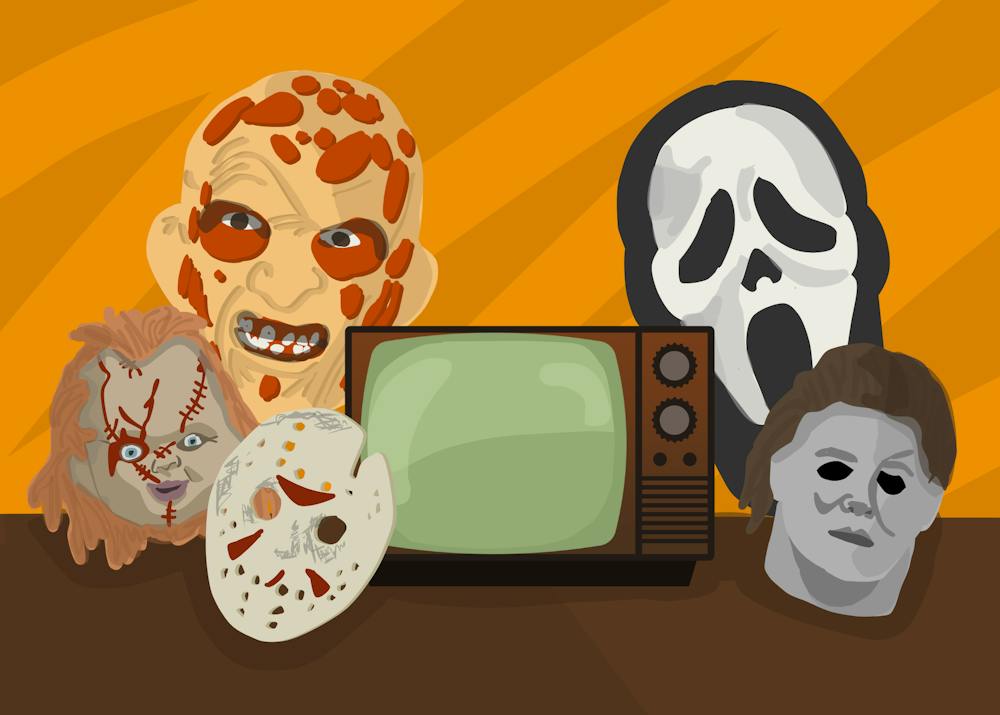
With the end of October fast approaching, there are few better ways to celebrate the Halloween season than watching a scary movie. The past several decades of horror cinema have led to a laundry list of clichés — masked killers with knives, ghosts lingering in corners and jumpscares galore — arguably overused to the point of losing their efficacy. But fear, a primal, instinctual emotion, manifests itself in a myriad of ways. There are, after all, over 500 named phobias. While it may be a stretch to call these three films “horror,” they nonetheless strike terror just as much as conventional scary movies. Whether drawing from existential, societal or psychological fears, these films will disturb and unsettle all those brave enough to watch.
“Safe” (1995)
Life itself becomes the villain in Todd Haynes’ disquieting masterpiece “Safe.” Julianne Moore gives a stunning performance as Carol White, an affable but uninteresting housewife who begins experiencing a host of unexplained neurological and physical symptoms such as nosebleeds and blackouts. As her condition becomes increasingly debilitating, and as doctors are unable to find what is wrong with her, she begins to suspect that she has developed an extreme allergy to chemicals in the outside world. Desperate to get better, Carol abandons her suburban lifestyle to live in the Wrenwood community, a new-age self-help commune, but is unable to find respite.
Haynes’ direction is nothing short of a masterclass, maintaining a chilling, detached tone laced with ambient dread throughout. A large part of “Safe” is shot in cramped wide shots, rendering the viewer helpless as they watch Carol continuously suffer. Haynes has explicitly cited the film as an allegory for the HIV/AIDS crisis, but the genius of “Safe” lies in its ability to operate on multiple thematic levels simultaneously. Carol’s illness could just as easily be read as a physical and subconscious rebellion against patriarchy, a manifestation of alienation in modern society or a commentary on the slow poisoning of the human body from industrial pollution. And in an era of essential oils and vaccine hesitancy, the predatory Wrenwood compound feels as relevant as ever. “Are you allergic to the 20th century?” reads a poster in one scene. 31 years later, in the 21st century, “Safe” remains eerily prescient, its message hanging over the present like a thick cloud of smog.
“The Cremator” (1969)
This landmark Czechoslovak film stands as one of the most haunting illustrations of evil. The titular cremator is Karel Kopfrkingl — played by Rudolf Hrušínský in an all-time sinister performance — a crematorium worker in Prague in the late 1930s. He believes in a perverted form of Tibetan Buddhism, where death and cremation is seen as liberation from earthly suffering. When the Third Reich begins invading Europe, Karel quickly aligns himself with the ideologies of the Nazi Party. As his soul becomes increasingly corrupted, he begins to commit acts of unthinkable brutality.
Directed by Juraj Herz, a Holocaust survivor, and released just one year after the Warsaw Pact invasion of Czechoslovakia, “The Cremator” is frightening in its depiction of the rise of authoritarianism. Karel, polite and well-spoken on the outside, slips into fascist modes of thinking with terrifying ease. The film’s discordant editing and frequent use of narration deftly portray his psyche as he descends further and further into depravity. Despite the evil of his actions, he truly believes that he is doing them out of a place of kindness, “saving” them from a life of suffering. With “The Cremator,” Herz displays the way individuals are able to justify even the most indefensible actions, laying the groundwork for atrocities on a mass scale. At a time where authoritarianism always seems to be a looming threat, the film’s warning could not be any more salient.
“Funny Games” (1997)
No stranger to controversial art, Austrian filmmaker Michael Haneke created his most scandalous work yet with “Funny Games.” This home invasion thriller focuses on a family whose vacation is interrupted by the arrival of two mysterious men. Over the course of a night, the duo subject the family to extreme physical and psychological torture in the form of twisted “games.”
The experience of watching the film is excruciating and above all, frustrating. The film does not show the majority of the actual violence, instead cutting away. Haneke breaks several unspoken cinematic rules — he has no trouble killing pets and even children. And one of the torturers, Paul, occasionally breaks the fourth wall to address the audience directly. “What do you think? Do you think they’ve a chance of winning?” Paul smugly asks the camera in one scene, as if he already knows the answer is no.
If it sounds like Haneke is deliberately trying to rile the audience, that is because he is. In “Funny Games,” Haneke forces the audience to think about the way they engage with violence in cinema. With the popularity of action and horror cinema, people often relish in and actively encourage violence, perhaps without thinking about the implications. By stripping the film of any sense of entertainment, Haneke argues that the viewer themselves, hungry for blood and death on screen, is in fact complicit or even responsible for the family’s torture. The film’s confrontational attitude will certainly not sit well with many people, but its central thesis is fascinating to ruminate on, and it remains as one of the most debatable films in recent history.
Watching these three films will likely not require having to sleep with the lights on after, but the fear that they inspire is much more profound. Through their various conceits and stories, the films explore the darkness lurking in society and the depths of the human mind. More than any slasher or ghost story, these horrors are very much real.
Read More

The Clearly Collective refashions wearable souvenirs into subtle works of art
By Eloise Diffley | YesterdayThe company specializes in combining formal architectural design with vibrant color to create a wearable piece of meaning.

The Radio Music Society at U.Va. bridges contemporary pop music with classical instruments
By Carly Smith | 3 days agoThe Radio Music Society combines a musical practice and genre on opposite sides of the spectrum — string quartets and pop music.

Season four of ‘Ted Lasso’ lands on a positive note, but still falls flat
By Catherine Ziegler | 4 days agoAlthough season four has elements of progressive character growth and touching themes, its execution comes off as superficial.