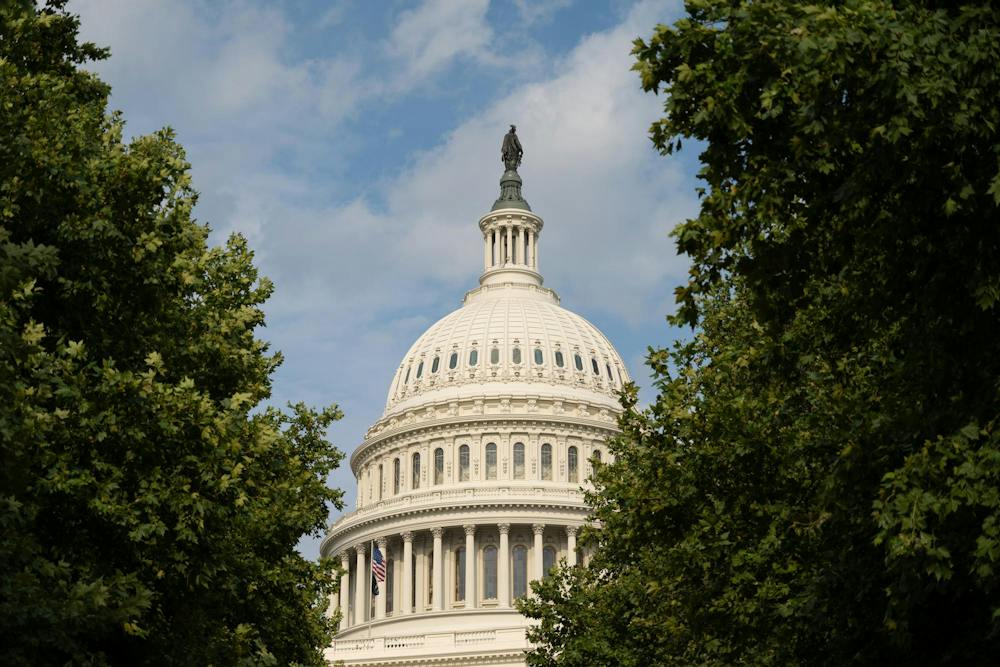
On Sept. 12, Republican Sen. Ted Cruz of Texas took to the “College GameDay” desk for 10 minutes to espouse the merits of his bipartisan bill, the Protect College Sports Act. Cruz, who was relentlessly booed by the Austin, Texas crowd, expects that the bill will come to the Senate floor for a vote within the next two weeks. Indeed, the Senate voted to invoke cloture on the bill Tuesday, setting it up for a vote imminently.
Should the Protect College Sports Act pass the Senate, it would require a majority passage vote in the House of Representatives and signage by President Donald Trump to enter into law. Cosponsored by Democratic Sen. Maria Cantwell of Washington, the bill covers a vast array of issues that the NCAA has tried and failed to successfully regulate.
Too vast, perhaps — at the expense of targeted solutions, the bill is a mammoth framework that tries to fix everything at once. The Protect College Sports Act contains some strong provisions formalizing Name, Image and Likeness policies and combating agent exploitation, but it does not incorporate the concerns of student-athletes about school mobility and caps on earnings. The bill puts strict limits on revenue sharing that could limit the NCAA’s regulatory flexibility and the potential income of student-athletes in the future.
Also worrying is the lack of enforcement initiative, as the bill reimposes limits but does not empower the NCAA or its conferences to investigate or punish violations any more than it did before the NIL era. Ultimately, it serves the interests of the major conferences and the NCAA before those of the athletes those institutions should seek to elevate.
The bill aims to provide a federal framework for NIL regulation, impose restrictions on transfers and establish regulations and fee caps on agents. It codifies the revenue sharing limits established by the 2025 House v. NCAA settlement — nearly $21.6 million per school this year — and preserves the athletes’ right to pursue NIL deals under a new framework.
Notably, though, the bill limits NIL deals between athletes and third parties to levels of compensation “paid to individuals with a similar profile, reputation, or notability who are not student-athletes or prospective student-athletes.” In other words, the bill puts an ambiguous limit on how much athletes can earn from NIL deals that are not between an athlete and their school. In an era where gray zones and ambiguity dominate, regulations that do not provide clarity in areas where athletes stand to benefit risk doing more harm to the student-athletes than good.
For a school like Virginia, where NIL deals are primarily third-party-driven, this could lead to smaller deals for Cavaliers seeking compensation. And given the ambiguous framing of this limitation, Virginia’s student-athletes could earn far less than their counterparts at other flagship universities purely on the basis of “notability.” This provision does not have the interests of the athletes at heart — whether or not the bill addresses those interests at all is an open question.
Further, advertising and lobbying disclosures reveal much about the key players in the bill’s development, the stakeholders that helped shape the bill’s most important aspects. Most obviously, ESPN chose to give Cruz 10 minutes of airtime on its flagship college football program. Former Alabama Coach Nick Saban and current Colorado Coach Deion Sanders both appeared in commercials promoting the bill — the former is an analyst on College GameDay. The Walt Disney Company, ESPN’s parent company, mentioned the bill in its lobbying disclosures.
The NCAA’s two biggest conferences, the SEC and the Big Ten, both support the bill, though they opposed it up until late July. The switch came after the Senate Commerce Committee, which drafted the bill, made several key revisions. One of these revisions is the “retention fund,” which allows schools to spend up to $22.5 million above the revenue-sharing cap to retain their own players. They can also spend an additional $5 million, matching spending from schools to athletes in women’s, Olympic and non-revenue sports.
It is obvious why the SEC and Big Ten would want such a provision. Smaller conferences — even the ACC and the Big 12 — cannot afford to spend twice as much on revenue-sharing without cutting other programs. Even if they wanted to cut said programs, they cannot, as the Protect College Sports Act requires schools to maintain the overall number of roster spots and scholarships across non-revenue sports.
Is this in the best interest of the athletes? For those who go to the nation’s biggest schools, undoubtedly. They can continually renew deals with their schools worth hundreds of thousands, even millions of dollars.
But for athletes at smaller schools seeking more lucrative opportunities, these rules could unfairly restrict compensation as well as athlete flexibility. The bill codifies the five-year eligibility rule, with a hard cap at age 24. It allows for just one transfer without a one-year penalty, with an exception if the head coach leaves.
This means that athletes seeking opportunities at the best programs could be blocked by transfer restrictions and hamstrung by tight, overprescribed budgets at their home schools. Late bloomers — Bryce Perkins and Chandler Morris come to mind for Virginia — would not have the chance to earn life-changing money at a better school if they have already transferred once. Athletes who will earn millions in the professional ranks can delay their entry in favor of their schools’ maxed-out retention funds.
The bill is an opportunity for the federal government to claim victory in a battle that threatens to tear collegiate athletics apart. But the bill protects the interests of the NCAA and major conferences before those of the student athletes. It empowers the wealthiest, most powerful conferences and schools to take advantage of the new system and leaves smaller institutions in the dust. And despite the claims of notable public figures, the bill does little to incentivize spending on Olympic sports programs.
Targeted reforms spread across multiple bills are less politically feasible, but they could fix individual issues more effectively and limit the influence of non-athlete stakeholders. Federal policymakers might consider eschewing such a dramatic shift in favor of more incremental, limited change. By cramming the Protect College Sports Act through Congress, Cruz and company risk boxing college sports into solutions that may breed a host of problems.
Legislators should go back to the drawing board and seek out individualized regulations and bills that target key aspects of the issue. Though the bill is undoubtedly ambitious and the status quo is unsustainable, the Protect College Sports Act is not the answer.
Read More
Virginia swim and dive returns, unphased and unbeaten in the first meet of the season
By Lauren Halak | 7 hours agoWomen's swim and dive kept at their blistering pace of success with a victory, while the men showed signs of progress as well with their combined first place finish.

Virginia men’s soccer gets outshot 26-4 and beats No. 6 Stanford 3-2
By Michael Liebermann | 14 hours ago“Get it done by any means possible."

A return to Scott brings a return to form for the Cavaliers on UVA Strong Day
By Ben McNiff | YesterdayRecovering from their loss last week, the Cavaliers used a strong passing performance to bulldoze over the Blue Hens 42-3.