With the drumming cadence of water enveloping the room in a melodic symphony, the “Lemniscata” exhibition at the University's Ruffin Gallery transforms the space into a celebration of water’s rhythm, flow and vitality. On display Aug. 28 through Oct. 9, the fountain-like installation and accompanying pieces by New York-based artist Sasha Fishman explore the circulation of water through both human-made and natural environments, referencing the figure-eight form and continuous motion evoked by a lemniscate, or infinity symbol.
A biomaterial researcher and sculptor, Fishman’s work exists at the intersection of craft and science. Her sculptures incorporate marine biomatter, toxicology and engineering, drawing specifically on the structures and systems found throughout the natural world. Across exhibitions at the Indian Ceramics Triennale, various universities and the Jewish Museum in New York City, Fishman has continued to explore the connections between the vivacious energy of the natural world and the engineered structurality of human-made forms. “Lemniscata” is no exception, further touching on the connection between the natural and the artificial.
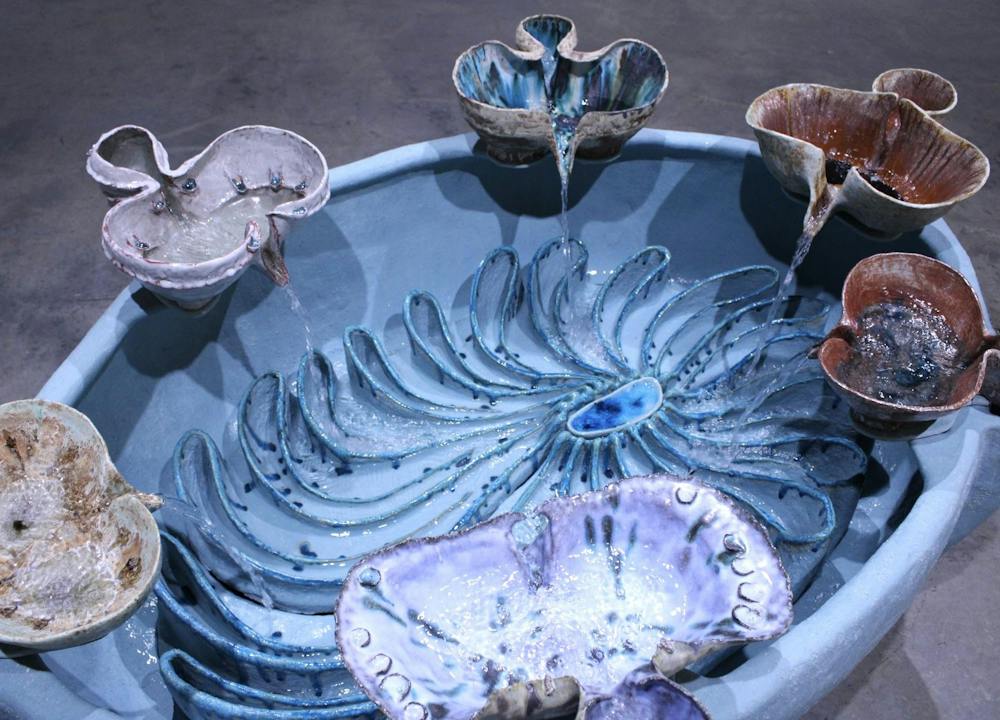
For visitors entering Ruffin Gallery, the first encounter with “Lemniscata” is not necessarily visual, but auditory. The gentle trickle of water emanating from a sculpture at the center of the gallery surrounds the space in soft, continuous rhythm. Titled “My Lungs,” the piece features a large, light-cyan ceramic basin with six petal-like lobed sculptures resting along its edges. Water continuously cycles through the ceramic lobes, cascading into the basin with a resonant sound as the basin’s sculpted ridges and vortices collect and redirect the water back toward the six sculptures, beginning the cycle anew.
Working closely with water’s dynamism in this piece, according to Fishman, has enabled her to slow down and consider the difficulties of containing and directing water within a ceramic sculpture. Fishman said that beyond challenging her understanding of the natural environment, the continuous circulation of water in “My Lungs” reflects her broader interest in how water’s movement in natural environments like streams and rivers can be recreated within human-made structures.
“I live in New York, and I don’t have much control over the water and where it comes from here,” Fishman said. “But it makes me really interested in the waterways and where it comes from and how the city was built and how water is routed … because also water is so difficult to control, I've been really curious about how it's been controlled historically.”
Fishman also drew inspiration from the Austrian naturalist Viktor Schauberger’s theories about the revitalizing effects of vortexing water — specifically how funneling water in a vortex regenerates the energy found in water naturally — which he believed could be diminished as water moves through human-made structures. While Fishman acknowledges that Schauberger’s research leans into pseudoscience and claims about vortices’ cleansing properties are heavily disputed, she embraces the ambiguity offered by the vortices, readily using them as an alternate mechanism to move water.
“I love the tension of how strange it is that these forms [can be seen] working and doing something that I can't explain, but it feels really bodily and innate,” Fishman said. “I love that … there's something there, there's something quantum that we can't quite understand, and we don't maybe have the language in the sciences yet.”
Similarly, Fishman draws deep structural inspiration from British sculptor John Wilkes’ kidney-shaped creations called “Flowforms.” The vessel-like structures were designed to harness water in a way that reflects the momentum found naturally in tides and rivers. Six of these structures line the ridges of Fishman’s “My Lungs” guiding water through cascading movements similar to Wilkes’ original intention.
Eight additional Flowform structures adorn the gallery walls, each with its own hues and textures. Despite following the same general curved, sloping framework, the structures vary in their small details. One, for example, has four lobes, with intricate grooves forming a spiral pattern within each. Another has three brown lobes with slanting prongs pointing toward emerald-green glass at its center.
The variety in color and texture comes from the hand-created glazes that Fishman developed. Fishman explained that she would consult with glaze researchers, develop her own glaze recipes and collaborate with other artists to get a diverse range of hundreds of glaze options. While laborious, Fishman said she reveled in the experience because of the surprise and unpredictability it brought — the colors of the glaze were a mystery until a piece came out of the kiln.
“In the same way that these Flowforms have this kind of quality that goes beyond science, the kilns also have this kind of crazy way of just doing things … [where] something will always just come out in a different [way], something you didn't think would happen,” Fishman said.
Fishman worked on these glazes during a residency at the European Ceramic Work Centre in Oisterwijk, Netherlands. There, the massive size of the kilns compelled her to create a larger sculpture than initially planned. Making the 650-pound “My Lungs” piece by hand, Fishman pounded balls of clay, created her own tools in the center’s metal shop and made special stilts before drying the piece for six weeks. During this process, Fishman said she drew inspiration from previous travel and biological research, anchoring the basin of “My Lungs” around the olfactory rosettes of sturgeons she studied during conservation research in Oregon. The basin’s colors, according to Fishman, were inspired by the blue dye used in Italian-style gardens and fountains.
After three months crafting “My Lungs,” Fishman coordinated its transport from the Netherlands to Ruffin Gallery with Stephanie Germosen Salazar, Ruffin Gallery and visiting artist program manager. Germosen Salazar handled the process of internationally shipping the piece, orchestrating the movement of the weighty sculpture into Fishman’s “Lemniscata.” For Fishman, the process highlighted the often-invisible labor behind public art and its transport.
“A big part of the art world that people don't talk about is also ‘how do you prepare the crate? How do you just really wrap something well so that it survives, especially ceramics?’ It's so much other materials and planning and time that goes into a piece that no one will ever see,” Fishman said.
Despite the intricate mechanisms of “My Lungs” — from its creation and movement to its transport — Fishman's solo exhibition ultimately points back to something much more fundamental at the core of her work. It reflects an appreciation and understanding of the fluidity of water. Anchored by this theme, Fishman described what she hopes audiences take away from “Lemniscata.”
“Gratitude for water, or just to be more mindful of how precious water is,” Fishman said. “I want this to really be something that is different from what people expect and what they know of fountains, and for them to just consider just how precious water is, and how beautiful it is.”
Read More
Michael Longfellow and Isabella Fazio close out Wahoo Welcome with a hilarious night
By Carter Horner | YesterdayThe show brought together the best of the local University comedy scene with national talent, creating a unique experience for the arts at the University.

beabadoobee shines on her electrifying album ‘Pylon’
By Kelsey McIntyre | 2 days agoEven though beabadoobee began writing rock music as a teenager, this is certainly her most adventurous project in terms of genre.

Lizzy McAlpine soars to new heights on ‘Angel’
By Alena Touve | 2 days agoLizzy McAlpine’s “Angel” is a triumph of sonic experimentation and lyrical ability, channeling both folk and musical theater into one harmonious product.