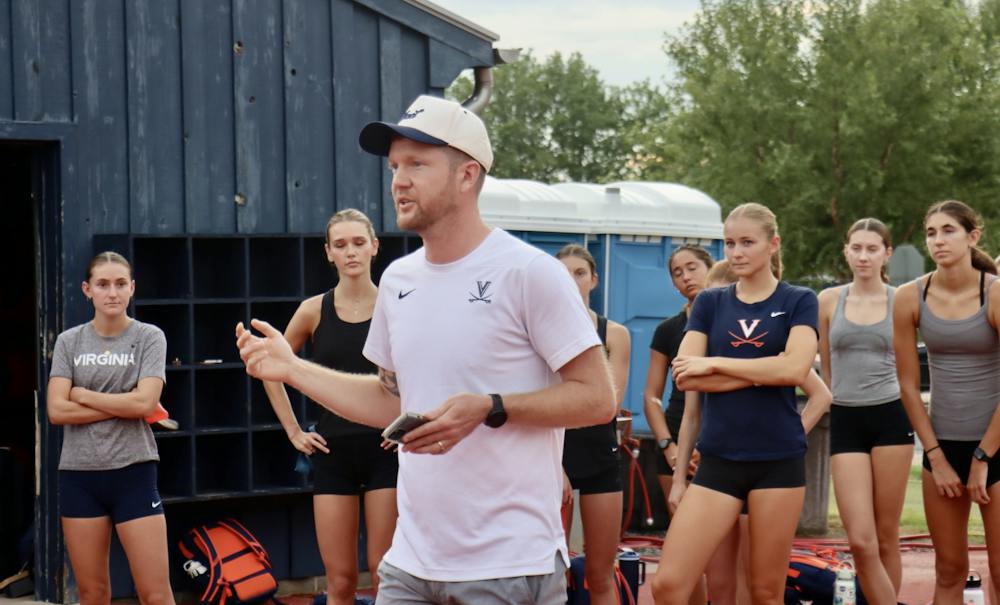
Why exactly should a top track and field athlete come to the University of Virginia? This is the question Interim Coach of Track and Field Trevor Dunbar answers each time he pitches the program.
“Every program that's offered is phenomenal, and we have a top caliber, not just ACC-level athletic department, but [a] nationally competitive athletic department … [Virginia] is a premier destination for prospective student-athletes that want to achieve their fullest academically and athletically,” Dunbar said. “Once you get here, you understand what makes it so special, and not only is it a beautiful place with so much history, a great academic reputation, but the people here make the place.”
Dunbar is a coach focused on his people — developing not only a highly competitive team, but a holistic and connected one.
He has spent the past five years working with Virginia, first as an assistant coach and then was promoted last year to become associate head coach under his old college coach and Virginia’s former Head Coach Vin Lananna.
However, July 29, Dunbar received a call from Lananna, telling him that he had accepted a position as the Chief Executive Officer of USA Track and Field and that Dunbar would be promoted to interim head coach for the year.
“[I] didn't have a lot of time to think [and] process it, but it's been a great transition so far,” Dunbar said. “I feel very confident in my coaching staff and the team that we are going to continue the momentum and provide a great experience for the student-athletes.”
Dunbar himself has lived in the running world for a long time. He is the son of two collegiate distance runners, Marcus and Kathleen, and his high school running career took place in Kodiak, Alaska, overseen by his father. Kodiak, though, was not set up to make his path into collegiate running easy due to the lack of competition and harsh environmental conditions.
“We're dealing with rough climates … and we have the winters [where] it's not a lot of daylight,” Dunbar said. “You [do not have] much competition. It's a sparsely populated state, so we had to travel a lot as I started to get to a different level [of competition].”
When Dunbar eventually joined the University of Oregon’s track and field program as a junior, the traditionally rainy weather in Eugene, Ore., was a remarkably positive change. For one, there was significantly less snow. But also, the competition at the D1 level was much fiercer than in the Last Frontier.
Dunbar went on to become a five-time All-American athlete in events like the 1,500-meter, 3,000-meter, 5,000-meter and 10,000-meter at Oregon while being coached by his future boss, Lananna. He then sought a career as a professional runner, but according to Dunbar, he struggled to achieve results he was happy with and started to miss the team environment. This became the impetus for his interest in coaching.
“I always knew … running wasn't going to last forever,” Dunbar said. “[I missed] the team during my own training and [felt] like it was just running for myself. [It] wasn't as fulfilling to me as running for my teammates, running for my coach, running for our university, and [coaching was] a way to channel that competitive edge, but also you know, help others.”
Dunbar then began taking on coaching roles, first at Boston University and later headed to Florida State for a few seasons before ending up at California. Five months into his work there, Lananna reached out to Dunbar to see if he had any interest in coming to Virginia as an assistant coach.
“I knew a little bit about U.Va. and … the trajectory of the program with Coach Vin,” Dunbar said. “[I] knew that this was a chance to pursue something great and be a part of something special.”
Now with his new role, Dunbar has the chance to shape Virginia’s trajectory more than ever before.
Dunbar’s coaching philosophy is — like most college coaches — crafted with an eye toward results. But, he believes that strong results only come from a well-rounded team, one focused on cultivating each runner and each member of the coaching and support staff.
“[I] want to treat everyone as an individual,” Dunbar said. “[I want to] understand their background, have a great experience during their time and build a positive relationship. On top of that, [I want to be] very competitive … I feel that's only possible with the right team, the right student athletes and the right coaching staff.”
Outside of this philosophical framing, Dunbar also has a strong focus on structure. He has a clear arc planned for the upcoming cross country season to prepare his athletes once championship season rolls around.
According to Dunbar, this past summer was the time to begin to build up mileage and an aerobic base after the conclusion of the outdoor season. Then, the team builds to their maximum volume as school starts and holds that pace for a few weeks as they start to compete at various meets. After mid-October, the workouts become “shorter and sharper,” giving athletes time to rest up to achieve their fastest times for ACC and NCAA Championship meets.
As a coach, Dunbar said he is constantly researching ways to fine tune his training programs to help each individual and the team get better.
“Nowadays … you can learn what the top American athletes are doing, the top world athletes,” Dunbar said. “So I'm constantly researching and talking to other coaches when I get the chance to, and then putting a program together in a way that fits for University of Virginia and for each individual.”
When it comes to cross country, Dunbar acknowledged mental strength is just as important as physical strength. The standard length for a women’s race is the 6K, while the men generally run 8Ks or 10Ks, depending on the meet. Both races entail a considerable period of time to deal with physical pain, demanding a mental ability to fight off exhaustion.
“You build your physical fitness, but you need the confidence to go in with it to maximize performance, and so we are going to be working on competitiveness, connection and that support with each other,” Dunbar said. “[B]eing able to mentally be ready to battle is something that we're constantly working on. We can touch on it in our training … but really, the best practice is our competition.”
Dunbar’s transition to leadership has not come without its challenges and changes. The men’s distance contingent graduated the vast majority of its strongest contributors this spring, such as Gary Martin, Justin Wachtel and Will Anthony, leaving the men’s distance program in need of rebuilding, especially when it comes to cross country.
However, Dunbar is pragmatically optimistic about his younger men’s team.
“I'm extremely excited to see where this group can go,” Dunbar said. “We have to take a little bit of a realistic approach of where we're at, and know that we have a long way to go, a lot of work ahead of us. But overall, I think we're looking at the big picture.”
With Lananna’s exit and Dunbar’s promotion, there was a gap in the distance coaching staff which has now been filled by Sam Bradley, the former head coach of cross country at Radford.
To Dunbar, Bradley exemplified the two key qualities needed in a coach — knowledge and care.
"[Bradley,] has just been someone who deeply cares about the student athlete experience and has a great knowledge of the sport, so those are the two things that attracted me most when I was researching this position [and] interviewing different candidates,” Dunbar said.
Dunbar himself is also dialed into those two principles. His sense of care for his athletes particularly comes across when discussing his goals for the cross country season in his new role.
“[I’m] hoping to give it everything I have and be open and honest with the student-athletes, be able to continue to build positive relationships and serve as a leader amongst the athletic department,” Dunbar said. “We're hunting for ACC titles, but we want to go about it the right way with an emphasis on being well-rounded student athletes.”
Read More
Virginia men’s soccer gets outshot 26-4 and beats No. 6 Stanford 3-2
By Michael Liebermann | 1 hours ago“Get it done by any means possible."

A return to Scott brings a return to form for the Cavaliers on UVA Strong Day
By Ben McNiff | 14 hours agoRecovering from their loss last week, the Cavaliers used a strong passing performance to bulldoze over the Blue Hens 42-3.
Three early goals sink No. 16 Virginia in 3-1 loss to No. 1 North Carolina
By Sofie Keppler | 15 hours agoIn the eighth minute, a sloppy Virginia turnover deep near its own goal turned into a perfectly executed Tar Heel goal from sophomore forward Bella Devey on the left side of the net. 26 seconds later, North Carolina scored again — the same player, same play and same strike — catching Virginia flat-footed twice in a row.