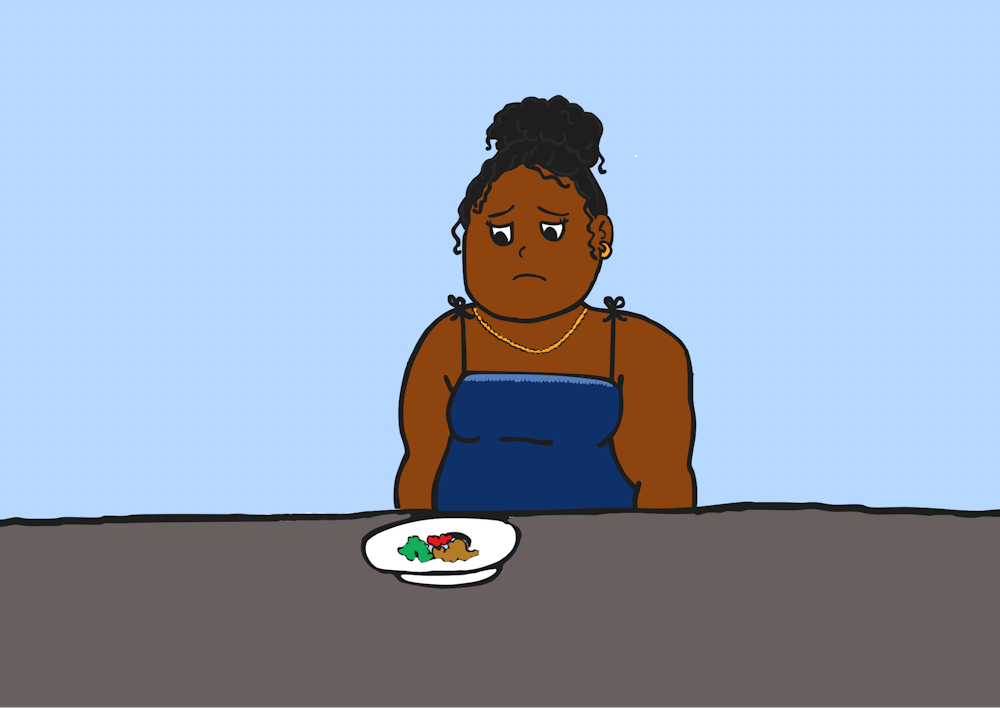
For as long as I can remember, I have always been on the heavier side, with baby fat growing into love handles. My weight and what I was going to do about it have been a topic of conversation my entire life. As I grew up, I was confronted with issues about my weight at every occasion, from the doctor’s office to family gatherings. Questions on what I eat, how I eat and when I eat constantly surround me, hanging over me like a dark cloud.
Through snide comments under someone’s breath or a side-eye look from an older relative, I was constantly reminded of the weight I kept gaining instead of the weight I should be losing.
These comments ultimately led me to try a variety of different diets to slim down, with my earliest attempts starting when I was back in middle school. I went to the dietician with my mother and learned that I needed to count my calories and monitor everything I ate. So I did. I recorded everything I ate and when I ate it — or at least I tried my best to.
This would mark the first time I failed to stick to a diet. The first time I had to go back to a doctor and tell them that I hadn’t done what they wanted me to. The first time I had to sit with that ugly pit in my stomach and know that I had failed them.
It was also the first time I was afraid to look down at the scale to see the number staring back at me — a habit that I am afraid I still have not quit.
This began affecting my moods and how I perceived myself. Beyond overanalyzing everything I ate, I became hyper-aware of my body. Every time I saw myself in the mirror, I picked at my thick thighs and hanging stomach. Even when I was losing pounds with whatever diet I was on, if I was not losing them fast enough, I felt discouraged that nothing seemed to be changing. My image of myself became so closely tied to the unrealistic image of women I saw in weight-loss commercials or “How to get skinny in a week” pop-ups online.
I started wearing longer pants and long-sleeve shirts because I hated how my thighs protruded under shorts and how my arms looked in my tank tops. I spent more nights not eating because I thought being hungry was better than being fat. I tried my best to take up as little space around me as possible, thinking that if nobody noticed me, maybe I could blend in with those around me.
Social media definitely did not help. I used to spend hours scrolling through Instagram, looking at beautiful skinny influencers and wondering what they were doing that I was not. Even when I did find a plus-sized influencer sharing their own health journey, trolls in the comments would make hurtful remarks about their bodies.
That is how the endless cycle of diets began. After each honeymoon phase of trying a new diet came the moment I would ultimately fail. I would slip up on the calories I was supposed to eat each day. I would get a large fry or reach for sweet tea instead of water, feeling like I was undoing all my previous success. The guilt was immense, and I felt like I had failed not only myself, but also those who believed in me so strongly. Instead of the guilt encouraging me to go back on my diet, it pushed me to fall back into unhealthy eating habits.
It took me a while to recognize that I had fallen into the dangerous cycle of diet culture — the societal belief that prioritizes skinniness over health and pushes that losing weight should take priority over building a healthy regimen with regular meals.
Surprisingly, it took hearing other people discuss their failed attempts at dieting for me to realize that starting and failing to complete diets does not make me, myself, a failure. It makes me human. I am not the first person to start a diet and have bad days, and I doubt I will be the last. Diets are not truly the problem — it is the culture that is so closely intertwined with it, encouraging people to go to extreme lengths to become skinny or maintain their weight.
Furthermore, diet culture is so tightly ingrained in our day-to-day lives, from the way many people think to the casual phrases they may say. One example of this is the internet slang "big back," which is used regularly by many young people to describe eating too much of something. While seemingly innocent, phrases like this one perpetuate harmful ideologies, so much so that I think people forget health can be determined by many things outside of what you eat or how often you work out.
I realized some people focus only on others' physical appearance when it comes to assigning them value and determining if they deserve respect. In becoming aware of this surface-level judgment, I began focusing on building my own strength, starting with looking inward. I had to recognize where I fell short in my health and eating habits and analyzed why.
I found that I tend to stress-eat, so when life got difficult, I defaulted to foods that made me feel good. To help correct this, I worked to reduce some of my biggest stressors and find healthier snacking alternatives, prepping them beforehand so that I had healthier options accessible to me.
Changing my eating habits in a sustainable way slowly, but surely, has been incredibly beneficial since being in college, but I’ve also had to unload some of the baggage I was still carrying from when I was younger. I realized that the longer I kept the same narrow mindset about fitness I had in middle school, the harder it would be to be kinder to myself about my diet.
My journey to loving myself and appreciating my body has not been easy — I have had days when I feel like my middle-school self all over again. When that happens, though, I have to remember how far I have come instead of how much I still have to do. I used to think that hating myself would be enough to encourage me to go to the gym more and start numerous diets back-to-back, but that is actually what fueled the burnouts. Instead, appreciating my body for what it does for me was the first step in transforming one of my most complicated issues into a lesson in acceptance.
The body I used to hate so much was the same body that woke me up every day, helped me get to class, let me hang out with my friends and family and gave me the chance to experience each day to the fullest.
Now, I know how to set clear standards for myself for how much weight I am trying to lose and where I want to be health-wise. I am taking it one step at a time, losing weight in reasonable chunks and timeframes. Setting these standards helps me feel accomplished when I lose a certain amount of weight or cut down on my sugar intake for the week.
But most importantly, I am patient with myself. I am not the fastest walker, and sometimes I still end up winded after a trek to class, but at least I walked. Some nights I eat ramen after staying up too late finishing work, but at least some food is better than no food. If I go to the gym and only use one machine, at least I went and got over the anxiety of going. I have come to celebrate small victories and give myself grace when I mess up sometimes.
If I am not doing it for my present self, I am doing it for a younger me who struggled to picture herself as beautiful no matter the weight, for a younger me who forced herself onto new diets even when it was harmful. For once in my life, I'm prioritizing my body for myself, not the standards of others, and I’ve never been more proud of all that I’ve accomplished.

Phoenix Banks is a senior associate on the life desk. She is a second-year College student, majoring in English and Media Studies. Phoenix is from Chesapeake, Va., and she enjoys writing about student perspectives, specifically students of color. Outside of The Cavalier Daily, Phoenix is involved in V Magazine, WXTJ and The Virginia Black Review.
Read More

Hoo’s Watching: Anatomy of a teen TV show
By Caroline Lee | 23 hours ago“Crew Girl” is not reinventing the wheel, nor is it particularly interested in doing so.

Nothin’ But Burgers makes itself at home on the Corner
By Phoenix Banks and Claire McGinn | 2 days agoWhat makes Nothin’ But Burgers unique is its simple and cheap menu — burgers are the sole entree offering.

No-bake date bark brings a taste of joy to all sweet treat lovers
By Lily Notter | 3 days agoWhether you eat these bars with friends, as a solo study snack or after family dinner, they are a delicious and nutritious addition to any day.