New federal Medicaid work requirements set to go into effect Jan.1 under the One Big Beautiful Bill Act could affect University students’ eligibility for Medicaid. The new requirements could require some students to take additional steps, such as verifying their enrollment as a student to maintain their coverage.
Medicaid is a public health insurance program that is jointly funded by the federal government and individual states to provide coverage to eligible low-income individuals and people with disabilities.
Virginia’s Medicaid program — Cardinal Care — is divided into three main categories. The three categories are “Base” Medicaid, which covers eligible low-income children, families, older adults and people with disabilities and Medicaid Expansion, which covers eligible low-income adults ages 19 to 64. The “Base” and Expansion plans cover adults whose income is up to 138 percent of the federal poverty level. There is also the Family Access to Medical Insurance Security program — which provides coverage to children whose families earn up to 200 percent of the federal poverty level.
The new work requirements outlined in the OBBBA — which will go into effect Jan. 1 — only affect those enrolled in the Medicaid Expansion program, which covers Virginia adults aged 19-64 who earn an income that is less than 138 percent of the federal poverty level. According to the Department of Medical Assistance Services, as of July approximately 500,000 Virginians utilize the Medicaid Expansion program for health coverage.
The new work requirements outlined in the OBBBA require Medicaid Expansion beneficiaries to work, volunteer or participate in a work training program for at least 80 hours per month, be enrolled in an education program — such as a college or university degree program — at least half-time and have a household income of at least $580 per month.
The second requirement — which allows individuals to meet the work requirement by being enrolled in an educational program at least half-time — could allow University students under Virginia Medicaid to retain their Medicaid coverage. The Virginia Medicaid website describes being “half-time” as taking “usually 6 credit hours.” As a result, students who enroll part-time but take fewer than six credit hours may be ineligible for coverage.
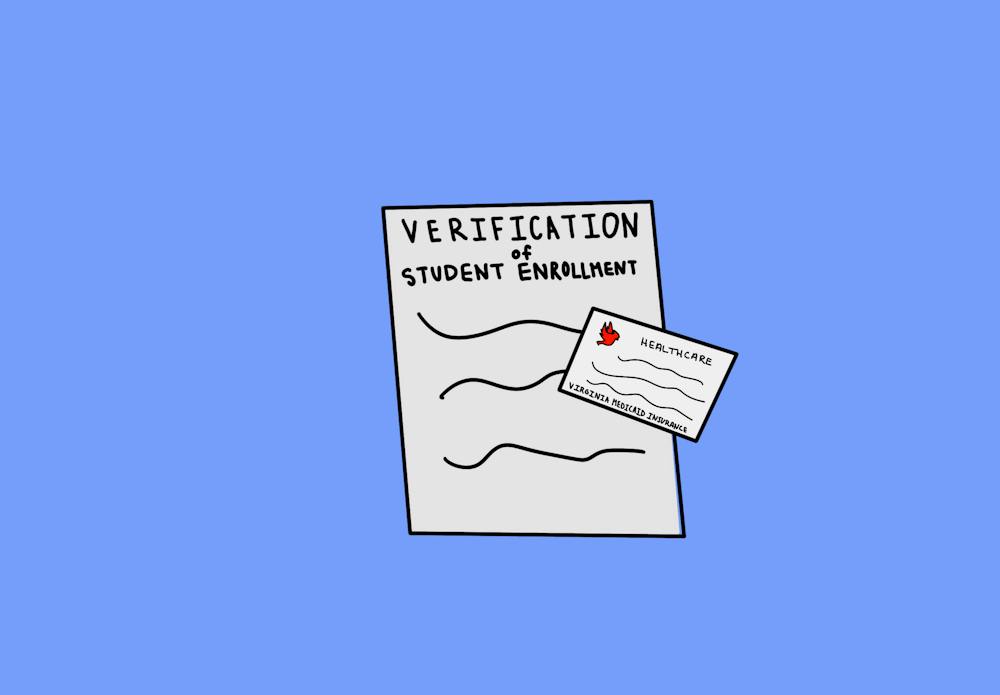
A key change students might face when renewing their Medicaid coverage after the requirements’ implementation is that they may need to prove their University enrollment status. According to the Federal Register, states must attempt to verify a student’s half-time enrollment using reliable information available to the state, such as data from the National Student Clearinghouse — a nonprofit organization that provides education data and enrollment verification services. If the state cannot verify a student’s enrollment using available data, it then must seek additional information from the individual to verify their enrollment status.
Danielle D’Andrea, director of marketing and communications for Student Health and Wellness, wrote in a statement to The Cavalier Daily that SHW is currently in the process of scheduling information sessions to help educate the University community on the upcoming changes.
“Student Health and Wellness is aware of the upcoming changes to Virginia Medicaid requirements and is in the process of scheduling information sessions for students later this fall to provide additional education and resources related to the new requirements,” D’Andrea wrote.
D’Andrea also said SHW is continuing to finalize more resources for students to include in SHW, which it will make available via newsletters, its insurance website and social media platforms as they are completed.
The OBBBA also contains multiple other provisions affecting higher education, including changes to the federal student loan system, Pell Grant eligibility and taxes on private college and university endowments, with changes taking effect Jan. 1.
Michael Racz is a staff writer on the news desk. He is a second-year College student majoring in biology with plans to go to medical school. He enjoys writing about health topics and student self-governance.
Read More

An overview of available resources for victims of sexual assault at U.Va.
By Luca Bailey | 56 minutes agoAccording to research from the American Association of Universities, more than one in 10 college students are victims of sexual assault at some point when attending their university.

Inter-Sorority Council proposes new sorority to join in 2027-28 recruitment cycle
By Isabela Delgado | YesterdayHalligan explained that the ISC and the chapter representatives do not yet know which sorority chapter will be implemented on Grounds.
U.Va. launches asynchronous pathway for bachelor of interdisciplinary studies degree
By Sophie Smith | YesterdayThe BIS degree program offers a flexible way to earn a degree while considering adult life and busy schedules, according to Joshua Katz, senior associate of communications at SCPS.