When somebody typically listens to pop music, they may expect to be met with the strong sound of drums, piano, electric guitars and basses, and — oftentimes in modern music — a techno-synthesizing beat. Pop artists typically aim to tell a story in their pieces, coupling intense instrumentals with heartbreaking, relatable lyrics acting as an effective way to express their emotions. However, as proven by the Radio Music Society at the University, pop does not have to follow this exact format to connect with listeners.
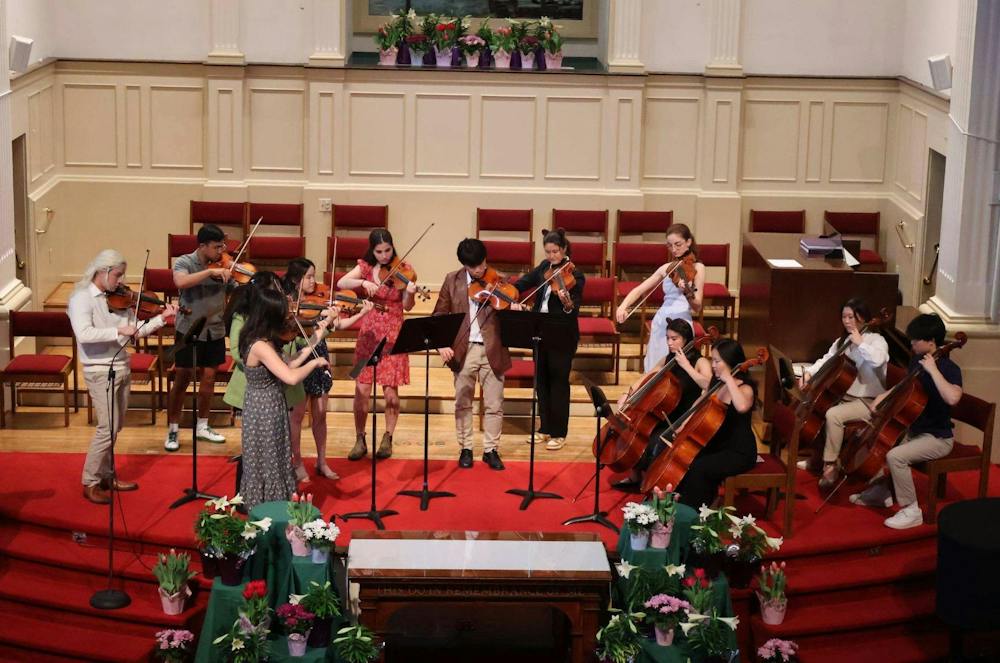
Founded in 2011 by a quartet of students performing in the basement of their first-year dormitory, the Radio Music Society combines a musical practice and genre on opposite sides of the spectrum — string quartets and pop music. A quartet consists of two violins, a viola and a cello, string instruments commonly used for playing classical pieces akin to those of composers like Beethoven or Mozart. RMS puts a unique spin on those musical traditions, using their instruments to play songs such as “Mr. Blue Sky” by Electric Light Orchestra, “Fearless” by Taylor Swift, “Still Into You” by Paramore and “That’s So True” by Gracie Abrams.
Manmayi Ghaisas, RMS social chair and fourth-year College student, described the reaction among audience members surprised by their style of performance.
“I love seeing people's faces when they recognize the song that we're playing, and when they sing along and when it clicks for them,” Ghaisas said. “I think that is such a fun moment. It's very joyful to play pop music on strings.”
Elise Ha, president of RMS and fourth-year College student, arranges performances and supports each quartet during rehearsals for the group’s gigs. RMS has performed at weddings, spontaneously on the Downtown Mall and at University events such as Lighting of the Lawn. Near the end of each semester, quartets join for a larger, self-led concert at the University Baptist Church, with previous themes ranging from a “Battle of the Bands” — where quartets represented differing famous bands — to fairytales, with performers focusing on different famous stories.
Despite a shared, specialized passion for classic instruments, Ha explained the notable diversity of members found throughout RMS who form a tight-knit community.
“The type of people that you meet through RMS is amazing. You get people from different schools, but they all love music and it's such a niche part of music,” Ha said. “We all have that classical background, but we all also wanted to branch out into some kind of unknown, contemporary type of music.”
Given the group’s high-skill musical pursuits, aspiring RMS performers must audition to enter the organization. Ghaisas said auditions consist of sight reading — playing a piece of music one has never seen before — along with performances of prepared pieces. She added that performances require a certain caliber of musicianship, and many members have been playing their instruments from a young age.
This semester, the club has 22 players, meaning that two quintets formed to accommodate additional players. These groups are composed of two cellos, two violins and one viola. Within their individual teams, members arrange and choose songs to perform, each ensemble working on different compilations of songs for their upcoming performances.
“[Executive members] will come together … and we try to do traditional quartets and try to get as many as we can,” Ghaisas said. “Sometimes we have really good people audition that we want in the club, so we'll do some non-traditional quartets.”
Ha said that rehearsals occur once a week for one to two hours depending on concert scheduling. According to Ghaisas, this flexible, low-commitment schedule allows students of all years to get involved, frequently staying in the club throughout their time at the University.
“I think we're a pretty low commitment club,” Ghaisas said. “I think it's not difficult for people to balance.”
After a member’s first semester in RMS, each musician begins arranging their own music for their quartet to perform, getting to implement their own song interests and ideas. This semester, Claire Youn, vice president of RMS and third-year College student, is arranging Olivia Rodrigo’s “the cure.” Youn explained the natural obstacles in adapting modern sounds onto classical instruments.
“[Arranging] involves a lot of repetition of playing the song over and over again, trying to hear what different parts there are … because it's usually going to be just a bunch that you can't fit into a quartet reasonably,” Youn said. “I spend a lot of my time just figuring out what of those parts are most important, or at least the most attractive, and then I turn those into parts for us to play.”
Looking forward, Ha said that the group hopes to do a jukebox event on the Lawn, where community members can choose songs for the quartets to play from their repertoire. She also said the club is looking into recording covers to release online. Sharing their unique style, RMS will be holding their end-of-semester concert in November. Admission is free, and audience members should look forward to being able to hear fan-favorite modern hits in an unprecedented format.
Read More

Season four of ‘Ted Lasso’ lands on a positive note, but still falls flat
By Catherine Ziegler | YesterdayAlthough season four has elements of progressive character growth and touching themes, its execution comes off as superficial.

Troye Sivan’s ‘She’s the Best’ takes Sivan far from his best artistic self
By Alena Touve | 2 days agoWhile the album does contain powerful tracks which combine fresh sounds with Sivan’s familiar templates, certain songs get lost within their own musical experimentation.

‘The Social Reckoning’ is many things, but a sequel is not one of them
By Caroline Lee | 2 days agoSorkin’s script still soars, but its execution often falls flat.