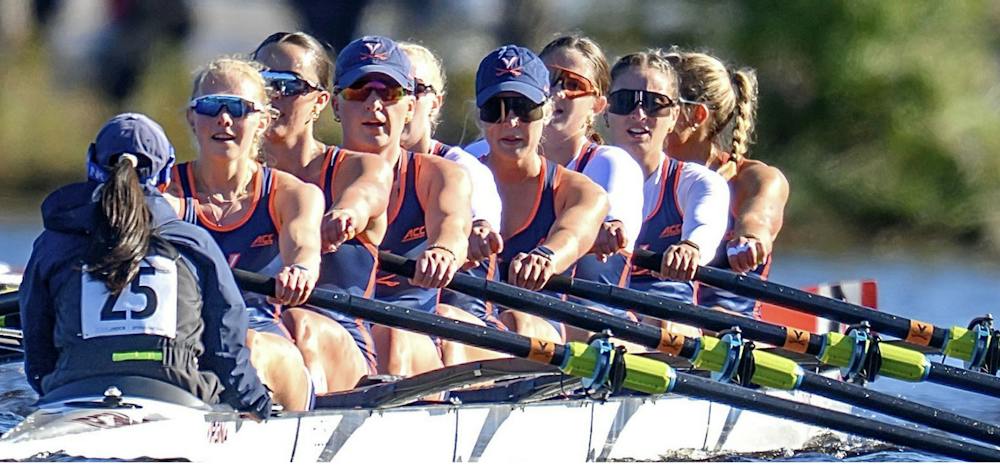
Bow 25 is not a number a crew wants. In a head race, boats leave the start one by one, and a late bow number means the early starters are already out on the water, slower and in the way. Virginia drew 25, then rowed the Charles River as if it were number one.
On Sunday, the Cavaliers stopped the clock at 15:02.791 in the Women's Championship 8+ event. Despite the unfavorable bow number, this time earned the Virginia crew third place overall in an international field and made Virginia the fastest collegiate crew at the 61st Head of the Charles Regatta in Boston, Ma.
Only two boats were quicker, and neither was a collegiate program. USTC Princeton (14:44.037) and USTC Boston (14:52.962) — both USRowing Training Center crews — crossed the line ahead of the Cavaliers. These crews are built with post-collegiate national team rowers, many of whom are ramping up for a run at the 2028 Olympics.
The result marked an encouraging start to the Cavaliers’ fall campaign, their third under Coach Wesley Ng and a long way from where he started. In his first fall at Virginia, the Women's Championship 8+ placed eighth overall and sixth among collegiate boats. This spring, Virginia finished fourth at the NCAA Championships, its highest national placement in a decade. Now it has gone from eighth to third on the sport's biggest stage.
Over roughly 4,800 meters and seven bridges, the Head of the Charles tests how well a crew navigates as much as how fast it rows. Crews race the clock rather than each other as head-racing eliminates the clean side-by-side fairness of the 2,000-meter buoyed racing typically seen in the spring. Instead, that uniformity is replaced with a staggered, 15-second interval time trial that magnifies steering geometry and split consistency — a clean line through a turn can be worth as much as a few strong strokes.
Third-year coxswain Brie Joe had to find that line while passing traffic from the back of the order, and with her razor-thin lines, the Cavaliers held third at every timing point. However, the college title was not secured early. Virginia held a 3.6-second advantage over Princeton at the Riverside split before the Tigers narrowed the margin to under two seconds near the Cambridge Boat Club. The Cavaliers widened the gap over the final stretch, outrowing Princeton by about 2.2 seconds over that final piece. Princeton's varsity shell (15:06.987) finished fourth overall, just over four seconds behind.
Four seconds sounds like a lot until the total race time is considered — that margin is less than half a percent of Virginia's final time. Over a course this long, the Cavaliers’ win over Princeton was narrow and hard-earned.
Virginia well out-paced every other university rival on the course, including other perennial powerhouses from the Ivy League. Yale's top crew finished in 15:25.511, more than 17 seconds back, with Brown crossing the finish line almost three seconds after the Bulldogs.
The distance up the leaderboard tells just as much as what happened below Virginia. USTC Boston was about 10 seconds ahead of the Cavaliers, and USTC Princeton approximately 19. These USRowing Training Center programs are built for and around world championship medalists — closing a gap between them is the kind of problem a program with national title ambitions wants to have.
For the fall opener, this crew was stacked with returning veteran leadership and elite international pedigree. The crew was stroked by third-year Paula Lutz, an All-ACC selection and U23 World Championship medalist for Germany, who maintained an unyielding cadence that insulated the boat through heavy course turbulence. Meanwhile, the boat's engine room was anchored by 5-seat fifth-year Elsa Hartman and 4-seat fourth-year Lila Henn — two athletes who entered the fall season fresh off gold-medal performances for Team USA at the 2026 World Rowing U23 Championships.
The boat that finished third consisted of Joe, stroke third-year Paula Lutz, 7-seat fourth-year Skylar Morrison, 6-seat third-year Flynn Greene, 5-seat Hartman, 4-seat Henn, 3-seat third-year PJ Balazy, 2-seat fourth-year Emma Alimbau-Borrás and bow fifth-year Maddie Agudelo.
Virginia's presence along the Charles extended far beyond the active collegiate roster. In the Women's Alumnae 8+ event, a crew of former Cavaliers and All-Americans placed ninth overall in a dense 42-boat field, demonstrating the program's enduring legacy of speed.
The Cavaliers will look to carry this early-season momentum further south as they continue their fall racing block at the Princeton Chase Nov. 1 before hosting a slew of crews in Charlottesville for the Rivanna Romp the following week.
Read More

No. 19 Virginia fends off late comeback, downs No. 20 Monmouth 4-3
By Adair Reid | 3 hours agoComing off of a single corner in their overtime win against Wake Forest, Virginia flipped the script with three of six total corners coming in the first quarter.
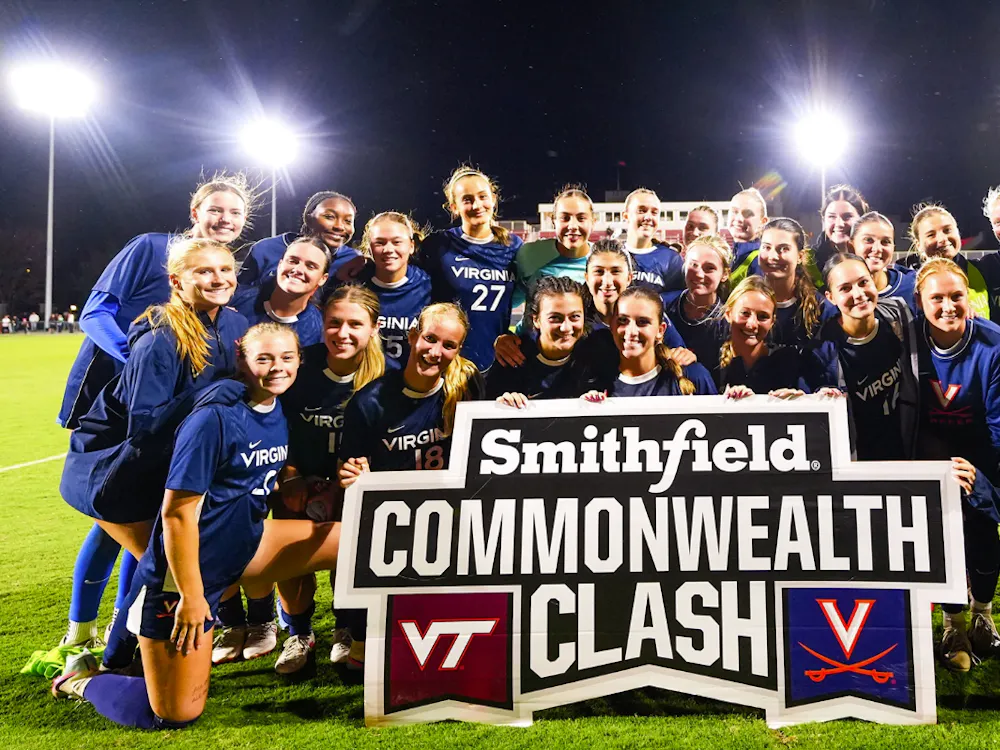
No. 18 Virginia edges Virginia Tech 1-0 in Commonwealth Clash thriller
By Alain Buensuceso | 3 hours agoVirginia entered Friday night’s contest looking to sustain their momentum following their first road-win victory and explosive 5-1 blowout against SMU earlier this week, seeking to prove that their attack schemes can continue to succeed on the road.

With miscues rampant, Virginia falls 23-13 in Dallas
By Drew Dillman | 10 hours agoA trip down to the Lone Star State provided Virginia an opportunity to get a ranked win. Instead, the Cavaliers squandered it with poorly-timed penalties and bad playcalling.