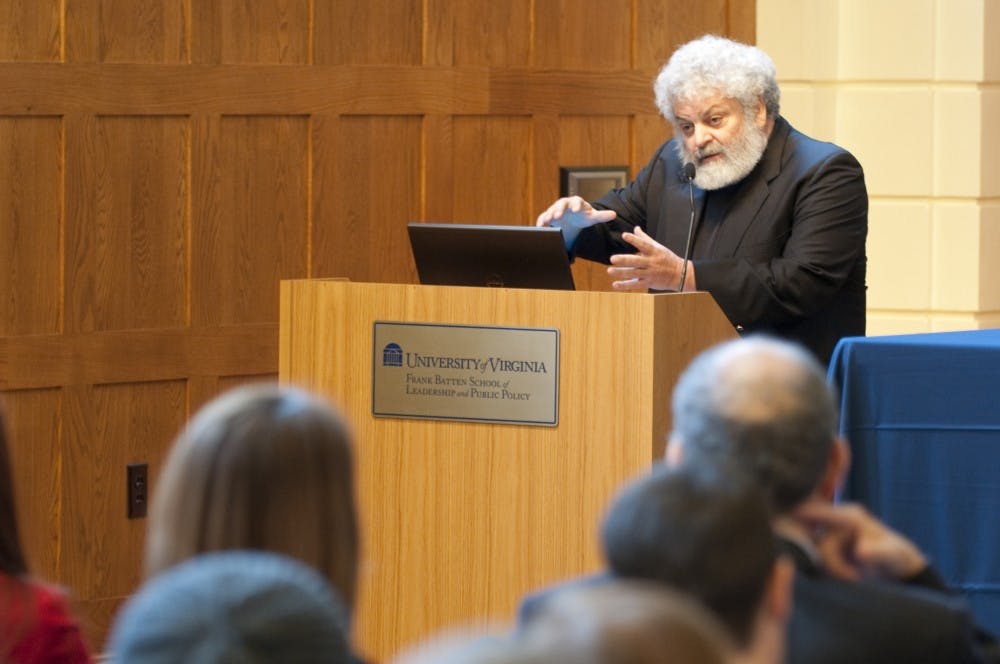
Unethical leadership can stem from many causes, according to a talk given at the Batten School Tuesday, but fixing this problem can be as easy as holding leaders more accountable for their actions.
Darden Prof. Ed Freeman emphasized the necessity of “connecting values with leadership.” He advocated responsible leadership — a combination of both socially accepted ethics and individual principles.
But both Freeman and Harvard University Business Administration Prof. Max Bazerman recognized that being an ethically responsible leader is easier said than done. Freeman outlined several possible causes of unethical behavior — ranging from the individual’s narrow conception of leadership to a fundamental character trait. “The most important reason is that leaders don’t see the need for them to inspire other people,” Freeman said.
Bazerman’s lecture highlighted the “blind spots” of leaders, blaming their unethical behavior on their own ignorance. “We aren’t as ethical as we think,” he said. “There’s a gap between our intended and actual behavior.”
It’s not just leaders who have a responsibility to foster an ethical community. Bazerman also suggested followers had an unhealthy tendency toward the status quo and were insufficiently critical of leaders.
“We don’t notice things until the bad outcome occurs,” he said. “We tend to not notice when people’s behavior erodes over time.”
The talk was co-sponsored by the Darden School’s Initiative for Business in Society, which promotes interaction between business programs and the public.
Read More

From the Archives: Fraternity life
By Maisy Callahan and Emily Conway | YesterdayMore fraternities decide to partner with the Historic Renovation Corporation, a University-affiliated agency that provides tax credits for the restoration of historic buildings.

Center for Politics hosts Tom Perriello to discuss AI, congressional responsibilities
By Melody Yuan | 2 days agoAt the event, titled “The Deep Divide Between How the People and the Powerful Are Thinking About AI,” Perriello also referenced his Sept. 22 article “To Wary Working People, AI Preemption Is the New Nafta” in The New Republic during his discussion.

U.Va. Health’s telehealth program approaches 1 million visits
By Vrinda Vashisht | 2 days agoThe program arose from the challenge of U.Va. Health physicians traveling to communities across Virginia to treat patients who could not easily reach Charlottesville.