
Out of 257 schools, the University dropped from last year’s first place ranking to 21st in The Foundation for Individual Rights and Expression 2026 College Free Speech Rankings, released in September. In comparison to last year’s first-place ranking score of 73.41, this year the University earned a score of 70.33 out of 100 points. Amidst this decline in the rankings, the University offers a wide range of resources and events with the goal of promoting a positive free speech climate on Grounds.
The College Free Speech Rankings are an annual report produced by FIRE — a non-profit organization that aims to defend free expression rights across the country — and CollegePulse, a survey research and analytics company. They surveyed 68,510 undergraduate students at 257 American universities for its 2026 rankings. Data collected spans from Jan. 3 to June 5, according to the 2026 report.
FIRE included the University within a group of schools the organization said have consistently fostered an environment conducive to protecting free expression. However, the report noted that most institutions within this category — such as the University with its C- grade — had only received scores between 70 and 80 points.
Although the University dropped by 20 ranks, its individual score only dropped by about 3 percentage points between the 2025 and 2026 rankings. Connor Murnane, FIRE’s campus advocacy chief of staff, said that by better educating and communicating with the student body about free speech initiatives and expectations, the University has the potential to reach the top once again.
“If I'm anyone at U.Va., I'm looking at the severe drop in some of these student categories,” Murnane said. “I'm saying, ‘Okay, how can we better communicate? How can we better educate the student body to make sure that [the students] get it, but they also get that [the administration] gets it?’”
The University prides itself on its offering of a wide range of resources with the goal of promoting a positive free speech climate on Grounds. An official statement from the University on free expression and inquiry is available on the University’s free speech website, and was formally adopted by the Board of Visitors in June 2021. The free speech website also contains resources related to other free expression policies and programs on Grounds.
“The University of Virginia unequivocally affirms its commitment to free expression and free inquiry,” the statement reads. “All views, beliefs and perspectives deserve to be articulated and heard free from interference. This commitment underpins every part of the University’s mission.”
A specific initiative on Grounds is Think Again, which aims to promote civil conversations among the University community from all parts of the political spectrum. Marsh Pattie, associate vice president for student affairs, specifically mentioned Think Again’s “Free Speech Fridays” as part of the initiative.
“[At Free Speech Fridays] students gather with faculty over free lunch in the historic Rotunda for events such as ‘Disagree with a Professor,’ in which faculty bring controversial statements of their own creation — some serious, some funny — and engage in constructive disagreement with students,” Pattie wrote in a statement to The Cavalier Daily.
Mary Kate Cary, Think Again director and deputy chief of staff for communications and strategic initiatives for Interim University President Paul Mahoney, emphasized Think Again’s mission to encourage discussion across differences beyond social media.
“Our goal is to get students to take off the headphones, put down the cell phone, look each other in the eye and have civil discourse, interesting conversations, arguments, disagreements, and learn how to use those muscles,” Cary said.
In addition to Think Again’s initiatives, Cary also said that the president’s office is hosting events promoting free speech as a part of the 250th anniversary celebration of the Declaration of Independence next year. Specifically, the office hopes to host a speaker series, with two events in the spring and two events in the fall. In the spring, it plans to have two speakers — Robert George and Cornel West, authors of the book “Truth Matters: A Dialogue on Fruitful Disagreement in an Age of Division” — come to the University.
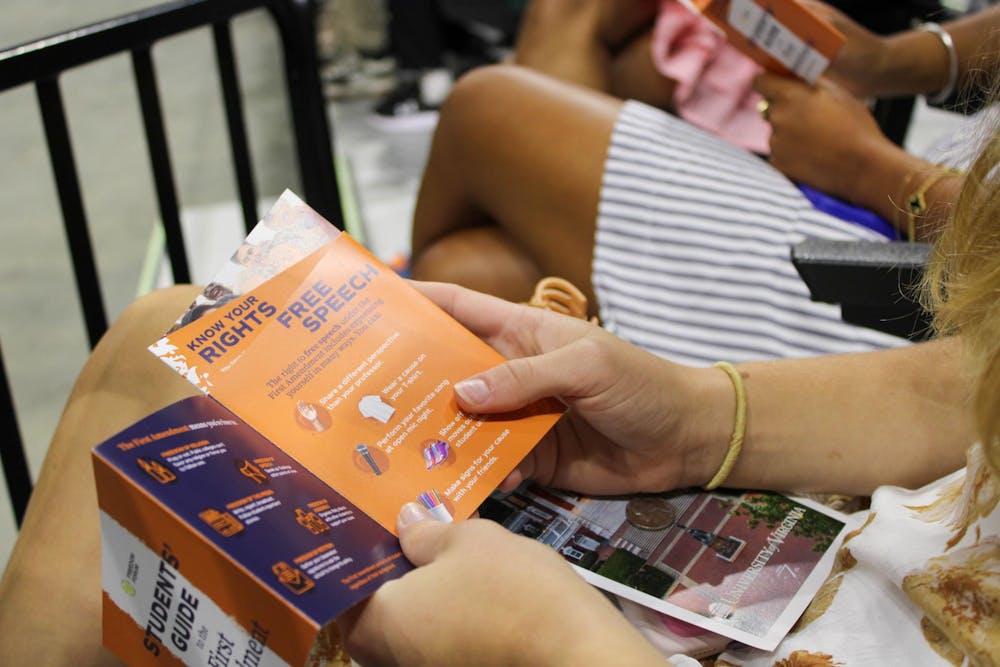
Pattie also mentioned a recent partnership between Student Affairs and Freedom Forum — a national foundation which aims to “foster First Amendment freedoms for all” — to produce a free speech brochure distributed to all students at opening convocation in August. Pattie said that the hope of the Office of Student Affairs is that resources like these will further educate students on their First Amendment rights on a college campus.
“Our goal is to promote more awareness around students’ rights under the First Amendment while also helping them understand certain limits,” Pattie wrote. “Engaging in behaviors not protected by the First Amendment and that violate University policy … would potentially result in referral to the University Judiciary Committee.”
The double sided and multi-fold brochure gives an explanation of the First Amendment, students’ free expression rights on a university campus, an explanation of hate speech and how students can know if it is protected speech and an infographic outlining when and where students have the right to protest.
Further, Pattie noted the free expression efforts of the Karsh Institute of Democracy, specifically its Civic Cornerstone Fellowship. According to the program's website, the fellowship was designed to combat the challenge of engaging in meaningful conversation in a “hyper-partisan political climate.”
Stefanie Georgakis Abbott, director of programming at the Karsh Institute, said in an email statement to The Cavalier Daily that the program welcomed 400 students this fall semester from all 12 of the University’s schools.
“Over the course of a semester, students engage in sustained peer conversations across lines of ideology and identity, with a consistency that supports the development of civic and intellectual virtues such as curiosity, intellectual humility, open-mindedness and empathy,” Georgakis Abbott said.
Georgakis Abbott said that she hopes the program’s lessons transfer to the real world, whether the students are conversing with peers, their professors or family members.
In FIRE’s rankings, the most significant category of each school’s overall score is the student survey — 315 U.Va. students were surveyed for the 2026 ranking. According to Murnane, this category makes up 60 to 65 percent of the overall ranking.
Murnane said that even though policy foundation and administrative action data is helpful, student surveys tell a deeper truth about the free speech climate on college campuses.
“We do really like to see that institutional neutrality statement … but so much of it is cultural,” Murnane said. “That's why the student survey component we do every year is what really has the biggest influence.”
In August 2024, the University issued a “statement on institutional statements,” declaring that the University would adopt a policy of institutional neutrality, meaning it would not make any official statements on social or political issues unless they pertain to university operations.
Murnane noted that the student survey category was where the University lost several points in its overall score from the 2025 to the 2026 ranking. This year, the University ranks 211 on “Comfort Expressing Ideas” compared to 107 last year. The University also ranks 210 on "Administrative Support” compared to 97 last year.
Looking forward, Cary said that she sees the University headed in the direction of a more positive free speech climate — she hopes that by continuing and further expanding the free speech efforts on Grounds, the University can increase its free speech climate score.
“The things that [the University] is doing, both inside and outside the classroom, I think could really help with the scores,” Cary said. “Students are learning how to be more and more comfortable with speaking up for what they believe and making their case with evidence.”
Cary said that she hopes the efforts by the president’s office for the Declaration of Independence’s 250th anniversary will further promote a positive free speech climate in the coming calendar year.
In a University-specific report from FIRE, it is recommended that the University incorporate “robust First Amendment education into first-year orientation,” to further educate students on their freedom of expression rights. Cary said that she is hoping the University will be able to integrate this into new student orientation this summer.
Additionally, Murnane noted that rankings only tell so much about the school's free speech environment. When the University was ranked first, its overall score was 73.41. Claremont McKenna College, ranked first in the most recent report, has an overall score of 79.86. Murnane emphasized that universities have room for improvement every year in their overall scores, despite their position compared to other schools.
Also according to the report, seven in 10 University students are uncomfortable publicly disagreeing with a professor and self-censor during classroom discussions. Additionally, only 24 percent of students found the administration either “very” or “extremely” clear in protecting freedom of speech. 46 percent considered the administration “somewhat” clear.
Murnane noted that the University’s next president could play a significant role in the reshaping of free speech on Grounds and therefore could impact the University’s 2027 ranking. The University’s presidential search is ongoing, following former University President Jim Ryan’s resignation in June after pressure from the Department of Justice.
“Whoever the new president [will be], new presidents have an awesome opportunity, more often than not, to redefine the campus culture,” Murnane said. “I would love to see U.Va. climb back up to the top.”
Nina Broderick is Managing Editor for the 137th term. She previously served as senior associate editor on the news desk. Nina is a third-year student from Richmond, Va. and is majoring in Public Policy & Leadership in the Batten School with a double minor in Government and Spanish.
Read More
With midterm elections approaching, Miller Center experts share foresight
By Reilly Auld and Luca Bailey | 5 hours agoThese midterm Congressional elections are generally viewed as an opportunity for voters to evaluate the incumbent President’s performance in their first two years in office.
Honor Committee continues to debate changing appeals process
By Michael Racz and Bryan Dean | 5 hours agoThe proposed change, if voted into effect, would alter the way students are able to appeal either their hearing or sanctioning panel decisions, should they feel there has been a violation of a granted right or there is new evidence to introduce to the case.

University Medical Center nears top safety grade, looks to improve in November
By Michael Racz | YesterdayIn the spring 2026 Leapfrog Hospital Safety Grades, the University Medical Center received a “B” grade — the second-highest grade awarded by The Leapfrog Group — with a numerical score of 3.18, just 0.02 points below the threshold for an “A.”


