
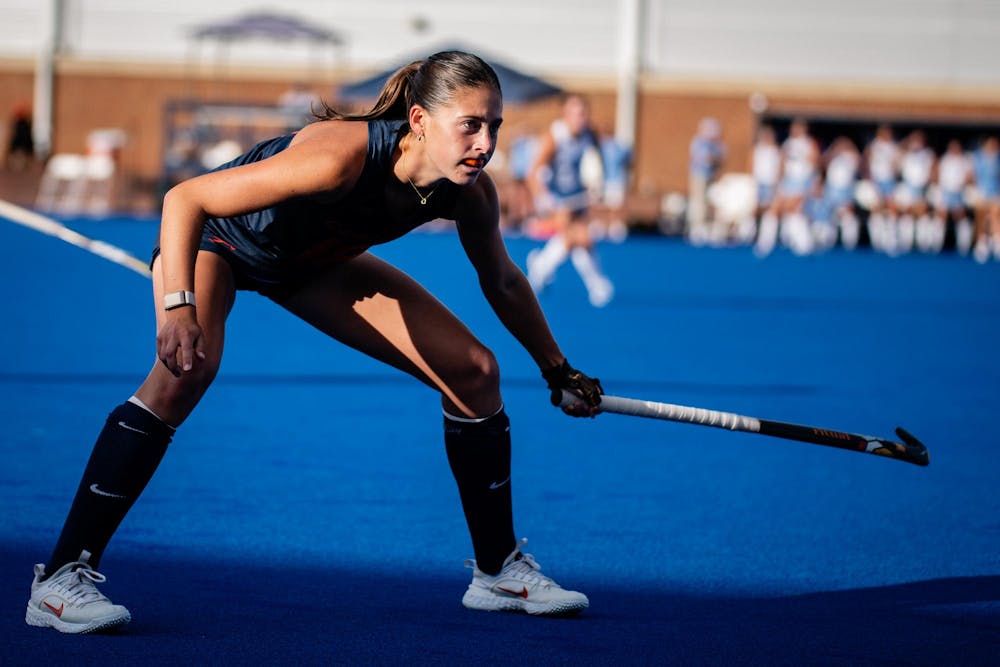
Since the addition of field hockey to NCAA sports in 1981, the circle of championship-winning programs has remained small. For all its pedigree and despite six semifinal appearances, Virginia field hockey has yet to reach a Final Four match, let alone join that circle of championship programs. And this year was no different.
On paper, the Cavaliers’ tournament performance looks to have worsened in recent years — since its Final Four run in 2023, Virginia has not made it past the Elite Eight — but while their tournament hopes were dashed early this year, the Cavaliers delivered a historic campaign that very well could mark the beginning of the next field hockey dynasty.
The success that Coach Ole Keusgen and his squad found in his second year at the helm is notable in its own right. The fact that Keusgen achieved it despite the surplus of youth and lack of collegiate experience on the roster makes it all the more impressive. For another team, managing 11 newcomers — nine of which were true freshmen — might have sunk any postseason hopes before they had the chance to blossom. The Cavaliers flipped this on its head, turning their young talent into a strength.
“With the right leadership from our captains and good teammates it can always fuse into this,” Keusgen said. “That we were able to create this is obviously fantastic. The young players, they carry a lot of load as I’ve said throughout the entire year, but we put things like into place that would help them to be confident from day one.”
By the end of the season, the Virginia freshmen established themselves not only as some of the best freshmen in the country, but as some of the best players. Of the Cavaliers’ 45 goals, 14 came from freshmen, as did 11 of the squad’s 30 assists. Their impact on the team was crucial considering Virginia was still reeling from the loss of Dani Mendez, who led the team in points her junior season. By the end of the season, her absence was a distant memory thanks to the various freshmen who stepped into leadership roles across the field.
While all nine rookies shone at various points in the season, freshman back Lauren Sloan and freshman midfielder Mary Adams stood out as crucial additions to a Virginia squad that lost several cornerstone players. Sloan’s contributions on the back line helped the Cavaliers lead the ACC in goals against average, save percentage, saves per game and shutouts per game, earning her ACC Defensive Player of the Week honors in early September.
Adams, meanwhile, ranked fourth on the team in total points, tallying two game-winning goals against perennial top-25 teams James Madison and Louisville. Combined, the pair registered five goals and eight assists — more than 10 percent of the team’s overall points.
Further distinguishing this year’s team was its significant improvement in the attacking third. Virginia’s defense has historically been much more consistent than its offense, and this year was no different — the Cavalier attacking unit generated almost identical numbers to last season’s subpar offense in goals and shots per game. After a heartbreaking midseason loss to then-No. 3 North Carolina, however, something changed in Keusgen’s team.
Rather than allow the defeat to kill their momentum, the Cavaliers made a concerted effort to improve upon the issue that cost them the match against North Carolina — their offensive production. The results were staggering — the Cavaliers nearly doubled their average shots on goal in the second half of the season, jumping from 5.4 shots on goal per game in the first 10 matches to 8.11 in the following nine.
What’s more, Virginia’s goal average rose from 2.1 goals per game to 2.66. For reference, Saint Francis ranked 20th nationally in goals per game with an average of 2.68, putting the Cavaliers just outside the top 20 in goals per game — significantly higher than their season average of 2.30 goals per game, which only ranked 36th.
Virginia’s newfound focus on offense was not without drawbacks — sustaining such an aggressive style of play was bound to take its toll. As the Cavalier midfield and offense began to tire at the end of each half, it became more and more difficult to backtrack and help protect the circle. That left the defense vulnerable to counterattacks that more often than not resulted in a penalty corner for its opponents.
In the first half of the season, the Cavaliers held opposing teams to an average of just four corners a game, but once their focus shifted from defense to offense, that number spiked to 5.25. In a sport where penalty corners are considered prime looks on goal, a 1.25 increase could mean the difference between victory and defeat.
Luckily, Virginia boasts one of the best defensive units in the country. Spearheading the backline quartet was junior goalkeeper Nilou Lempers, the ACC Goalkeeper of the Year honoree who racked up three ACC Defensive Player of the Week honors as well as one for NFHCA Division I Defensive Player of the Week. Lempers led all ACC players in total weekly honors, offensive or defensive. Her stalwart presence in the cage yielded nine shutouts, six of which came against ranked opponents.
“Nilou has been a backbone,” Keusgen said. “We defend well, but our opponent gets two, three, four good looks every game. She makes the easy saves that you have to have, but then she also makes at least one save that you don’t [always] make, the outstanding save.”
Joining Lempers on defense were senior back Madison Orsi and junior back Mia Abello, who commanded the field from the back third. Orsi had a strong case for the title of ACC Defender of the Year, but lost out to Wake Forest sophomore back Mia Montag, who led the conference in assists. Abello also flew under the radar when it came to ACC recognition, but was deservedly awarded South Region Second Team honors Wednesday. Two of her nine goals were game winners and she led the team in total points with 20. To call Abello a powerhouse would be putting it lightly.
While Virginia often came out on top thanks to the contributions of the defense, the collegiate field hockey season is too short for the offense to take over a month to hit its stride. The good news is that this young squad has the time and tenacity required to learn from this season’s mistakes. A national title might be the ultimate prize, but the experience the freshmen gained from such a successful regular season will set both them and the program up for success down the line.
Luckily for Cavalier field hockey followers, Virginia has already set the bar high — all that’s left to do now is sit back and enjoy the ride.
Read More

No. 9 field hockey strikes early, lands intense bounce-back win against No. 11 North Carolina
By Adair Reid | 7 hours agoWith defensive finesse and an electric offense that came out swinging and kept up the pressure, Virginia put North Carolina and the conference on notice, defeating the Tar Heels at Chapel Hill for the first time in 20 years.

Virginia fights to five sets, but Buckeyes complete the sweep
By Joby Jung | 7 hours agoOhio State (7-3, 0-0 Big Ten) waltzed into the Aquatic and Fitness Center and took two back-to-back wins against an injury-riddled Virginia (4-5, 0-0 ACC).

Late drama denies Virginia men’s soccer’s ferocious comeback against Wake Forest
By Mofeoluwa Akande | 17 hours agoAll four of Virginia’s losses have been the result of 80th minute or later breakthroughs by their opponents.


