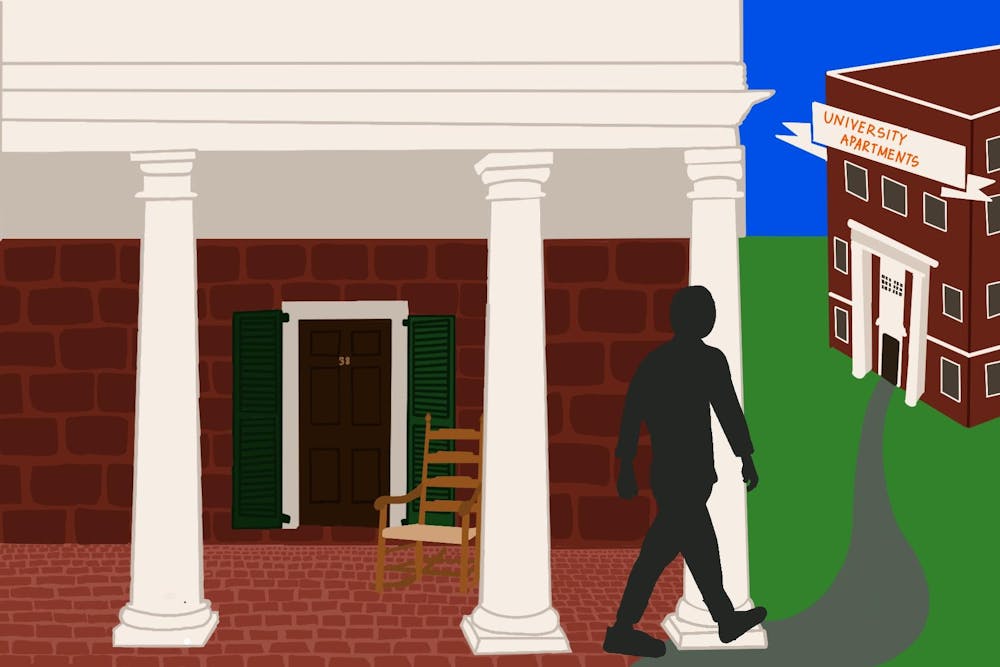
Every February, a group of 54 students entering their final year of undergraduate studies are accepted to live on the Lawn. Living in one of these rooms is supposed to be a privilege due to the Lawn’s history and prominence in University life. Due to this prestige, the experience is offered to students who have demonstrated service to the University or Charlottesville, as well as academic achievement. However, the incompatibility between getting a Lawn room and undergoing the University housing process creates harm for students trying to determine their fourth-year accommodations — especially when considering the off-Grounds housing market.
The current timeline of the Lawn room application process is at the center of the inconvenience for prospective applicants. Lawn residents are not selected until mid-February of a student’s third year, months past the University and off-Grounds housing processes. This timeline risks disincentivizing future potential interested applicants that would otherwise apply if the timeline aligned with off-Grounds housing cycles. The results are a tradeoff between a practical choice to sign an off-Grounds lease and the iconic experience of living in a Lawn room.
There are two reasons that the University claims that this application timeline must be maintained. First, they argue that the student-run Lawn Selection Process Organizing Committee needs time built in to consider changes to the application each year, such as different application questions. Amending the timeline would temporarily truncate the time for this review process. Second, pushing the process earlier would supposedly disturb the ability of potential applicants to optimize their community involvement and academic performance. These reasons are not convincing barriers to keep the application process specific to the current timeline.
The suggestion of waiting until after Lawn decisions are released to sign an off-Grounds lease is simply not realistic — not only does the limited housing supply pressure students into having to sign off-Grounds in the fall of the prior year, but waiting that long likely eliminates the option of signing a lease with friends. Most students looking to live off Grounds sign leases by the end of the first semester in the prior year. Many potential Lawn applicants who forgo off-Grounds housing and instead apply, wait and are rejected for a Lawn offer risk sacrificing important characteristics of housing including proximity to Grounds.
The University even acknowledges this challenge and recognizes the difficulty students may have in resolving their off-Grounds leases, saying that it “might be difficult for you to remove yourself from that obligation if you receive an offer.” Thus, students vying for a Lawn room are left with the options of not signing an off-Grounds lease on the gamble of being accepted, or putting their name on a lease and risking financial or legal repercussions for removing their name. By contrast, if the Lawn application timeline was aligned with these off-Grounds options, students would not be faced with a choice between two far from ideal options.
The University emphasizes on-Grounds housing as a solution for students that do not get Lawn rooms. However, this option is far from ideal. Many students prefer to live off Grounds due to feeling secure signing with people that they know, whereas the on-Grounds lottery risks students having to live with random people. Additionally, the on-Grounds application process gives priority to earlier years, with rising fourth years the last to receive housing. This puts students at risk of being placed in a location that is suboptimal in relation to where the majority of their classes and activities are. To add to this, on-Grounds housing is not even guaranteed.
The competitiveness of the Lawn room process, with an acceptance rate of around 23 percent, further highlights the sheer number of students this can become a problem for — such a low acceptance rate risks leaving the vast majority of applicants without adequate housing opportunities. Students who do not get accepted can be left without a group to sign with and likely without on-Grounds options, leaving these students with no clear place to live for their final year at the University.
Further, the very reasons the Organizing Committee uses to defend maintaining their current application process could be maintained with a new application timeline that allows students to apply before the beginning of their third year. The Organizing Committee looks to select a “diverse community of peers” with “high standards of scholastic and extracurricular achievement.” None of the qualifications involved within this are contingent on a student having completed part of their third year to achieve. An expedited timeline may even encourage students to start making an impact earlier than they would have previously. These earlier impacts would foreground future aspirations, placing an emphasis on the applicant’s vision and goals for their future actions at the University in a way that would maintain the quality and consequence of Lawn room residents.
Living on the Lawn is meant to be an honor, but this desire is at risk of dwindling if students overlook the opportunity for practicality. The University should update the Lawn application process so that offers are released at the beginning of third-year fall. This allows for ample time to get involved in the University and Charlottesville community while not imposing a barrier to entry. This adjustment would encourage new forms of student involvement beyond the norms and ensure that students are not gambling when choosing to apply for a Lawn room.
Emma Nero is an opinion columnist who writes about economics, business and housing for The Cavalier Daily. She can be reached at opinion@cavalierdaily.com.
The opinions expressed in this column are not necessarily those of The Cavalier Daily. Columns represent the views of the authors alone.
Read More

EDITORIAL: College sports need fixing
By Editorial Board | 21 hours agoCollege sports, in their current state, are fundamentally broken, and they desperately need legislative stabilization and reform.
EDITORIAL: Student self-governance deserves our confidence
By Editorial Board | 5 days agoNow, just a month into the semester, new officeholders appear to be delivering results.

YOUNIS: SJP’s criticism is not hysteria — it is a challenge to U.Va.’s standards
By Ayat Younis | September 16, 2026Any leader deserves scrutiny for their professional past, regardless of their background and especially if they have ties to brutal military-industrial complexes through the IDF.