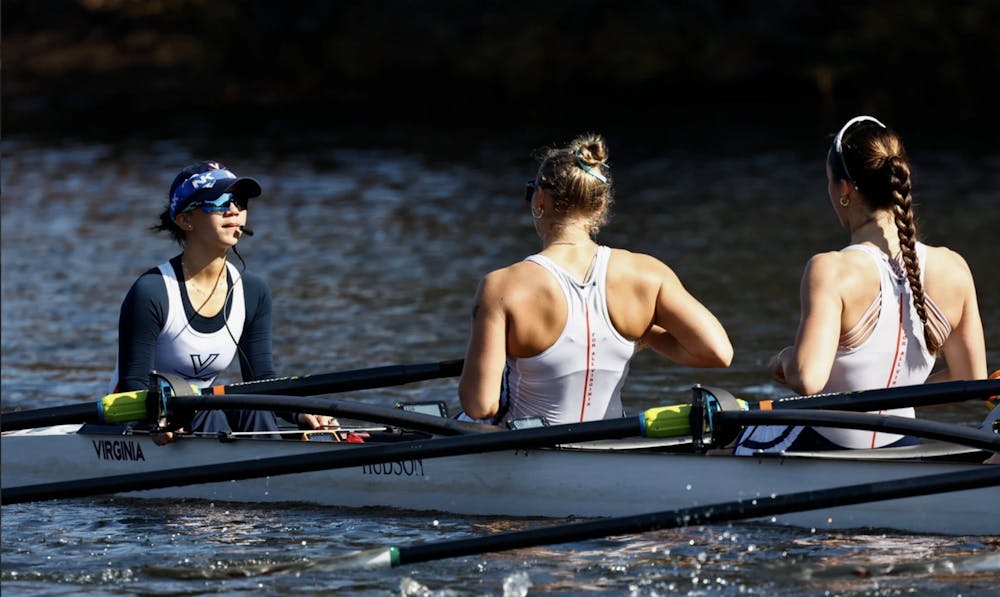
On a grey morning at the Rivanna Reservoir, mist sitting low on the water and the shoreline still quiet, the Virginia women's rowing team slips out of the dock with only the rhythmic sound of oars disturbing the stillness. In one stern of one shell sits sophomore coxswain Brie Joe, tucked neatly behind her crew and speaking into a small microphone. Her tone is controlled, her calls precise in a way that feels almost out of place for someone only 19 years old.
Composure, however, has become Joe's trademark. In just a year and a half with the program, she has grown into a calm and commanding presence, emerging as a pivotal leader whose maturity and tactical precision belie her age.
However, the coxswain's path to that seat was anything but expected. A Chicago native, Joe stumbled into coxing almost by accident on the eve of the coronavirus pandemic as she approached the end of seventh grade. After hearing about a local rowing club, she initially envisioned herself as a rower, but after a few sessions on the erg during winter training, she was handed a mic and a cox box when the team got back on the water. While Joe was not sure what to expect, the second she took charge of the boat, something clicked. It was a decision that, in hindsight, would alter the trajectory of her athletic career.
That path became complicated by an unexpected challenge once she arrived at Virginia. Joe's recruiting class was the final one selected under longtime Coach Kevin Sauer. By the time she reached Grounds, a new era had begun under Coach Wesley Ng — a sudden change that brought both nerves and uncertainty to her recruiting class.
“I was really nervous about coming into Virginia,” Joe said. “I think ... everybody else in my class was. [We had a] ‘These coaches didn't recruit us. What are they going to do with us?’ kind of mindset.”
But rather than becoming a hindrance, the coaching transition became an unexpected advantage. The new staff had no real expectations of the current or incoming student-athletes, allowing everyone on the roster to be seen equally in the eyes of the coaches.
“I think it really ended up blossoming in my favor,” Joe said. “Because Wes and all the coaches came in with no preconceived notions about all of the athletes here.”
Alongside the brand new coaches and first-years, Joe stepped into a level playing field where it did not take long for her to prove herself. By the end of her first fall, she had risen to the top of the coxswain group and taken control of the first varsity boat.
Despite her rapid ascent, Joe openly admitted to grappling with imposter syndrome. She struggled with the “oxymoron” of her situation — being the youngest in the training group while simultaneously holding “arguably the highest leadership position you could have.”
The dynamic only intensified when she learned that six of the eight rowers in her boat were in their final collegiate season. These rowers had all been national contenders with Virginia for multiple years, including Sky Dahl who earned a silver medal at the 2024 Paralympic Games in the PR3 mixed four.
“I [didn't] want to let down all these older and accomplished rowers who have years on me,” Joe said.
Yet, she credits that veteran crew with accelerating her development because she was able to gain experience rowing alongside an extremely seasoned crew earlier than most collegiate coxswains do. Her older rowers became more than just teammates — they acted as her mentors as Joe built up not only her technical expertise, but also mental fortitude.
”I really value how much I learned from them,” Joe said. “[My] rate of improvement would not have been so steep if I hadn't had such an old boat.”
Her teammates were not the only ones accelerating Joe’s technical growth. Ng's emphasis on quantitative performance has introduced Joe to new resources like the Peach system, which forces her to adapt her coxing style. The Peach system is a telemetry device that attaches to each oarlock and feeds the coxswain and coach with detailed metrics — like watts, catch angles and velocity — from each rower in real time. This detailed feedback allows coxswains to better diagnose areas of improvement for their boat in real time.
As Joe settled into her role, she used such technology to innovate her approach around a simple, powerful philosophy — “information is motivation.” She does not just call the race, she manages the metrics. Joe uses the hard numbers she is receiving from the Peach system to issue commands that drive the boat faster. Now, instead of giving her rowers vague commands such as “you're rowing short,” she is able to offer precise solutions like “give me two more degrees of compression at the catch.”
For Joe, the art of coxing is not about guesswork but instantaneous calculus. She processes the stroke rate, split times and rhythm to deliver razor-sharp calls that instantly turn raw feedback into blistering speed. That blend of precision and decisiveness was on full display in October at the Head of the Charles Regatta, where she guided the Cavaliers to the Collegiate Four title.
Joe's preparation for the notoriously winding Head of the Charles course was exhaustive. A self-described repetition-based learner, she spent hours watching videos, memorizing landmarks and studying a detailed map provided by her Boston-native teammate. By race day, she was ready to execute.
The most dramatic moment of the race, captured in widely circulated photos, was her bold decision to steer the Virginia 4+ directly behind the stern deck of the Penn AC 4+ for nearly 1000 meters — a maneuver that provided her rowers with the cleanest water possible.
According to Joe, the move was no impulsive gamble — it was a rehearsed tactic from training, calculated based on her real-time assessment that both boats were traveling at the same exact speed. She also knew the Penn AC crew well — it included three Cavalier rowing alumni — and trusted the coxswain ahead of her to hold a reliable course.
This victory in Boston also served as a marker of personal transformation for Joe. Last season, the enormity of competing at the Head of the Charles for the first time left her overwhelmed by pressure and expectations. This year, the experience was transformed.
“I was able to cross the line and feel so confident in the decisions I made during that race and so at peace with it,” Joe said. “I wasn't seeing anybody else's approval in that moment.”
That internal confidence now fuels an even bigger ambition, one that Joe is unequivocal about when she states, “I really want to win a national championship.”
With Virginia's early momentum — punctuated by their victory at Head of the Charles — Joe believes Virginia has built the foundation it needs, giving the team a crucial sense of belief as they continue their push forward toward collegiate rowing's highest stage, the NCAA Championships in May.
As this sophomore leader continues to grow into her voice, the Cavaliers will rely on Joe's steady hand and analytical mind — qualities she has rapidly refined from her experience as a young, emerging star — to guide them through the races still ahead.
“We're not a fall sport,” Joe said. “So to have a huge accomplishment in our first race of the entire year is huge. And that's our goal — win a national championship in the Varsity Eight.”
Read More

Chris Feifs named associate head coach, defensive coordinator in first hire for Cassese
By Drew Dillman | 17 hours agoMonday, Chris Feifs was named the associate head coach and defensive coordinator for Virginia men’s lacrosse. The arrival of Feifs marks the first choice at the assistant coach level under Coach Kevin Cassese’s leadership of the Cavaliers.

Kevin Cassese is getting busy working on his program’s resources
By Michael Liebermann | 6 days agoCassese fielded multiple questions about fundraising and athletic department support and alumni relationships — those are the things that zipped to the top of his checklist almost the moment he accepted the coaching post.

Cavaliers struggle to find rhythm, fail to make match play at NCAA Championships
By Stephen O'Dea | 6 days agoThe weekend did provide one silver lining. The Cavalier faithful will not have to wait long to see James — the Connecticut wunderkind who signed on with Virginia four years ago and thus changed the trajectory of the Cavalier program — play again.