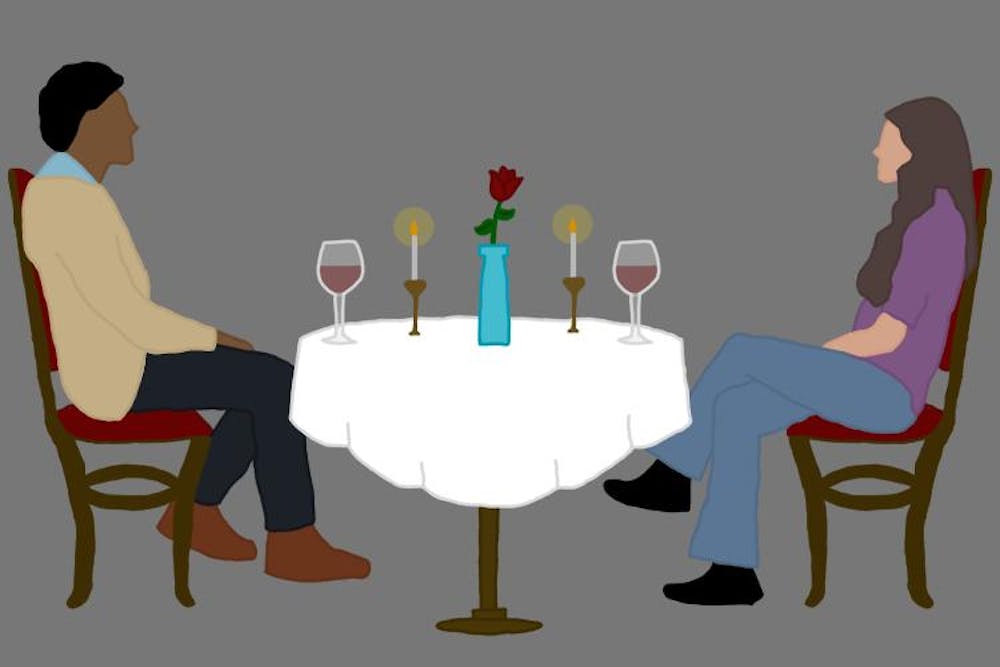
If you were to ask my partner to describe me, he would do so in a variety of ways. In my mind, he would say that I am beautiful, intelligent, creative, a go-getter and for all intents and purposes, the human incarnate of superwoman. More realistically however, my boyfriend would emphasize one trait above all — I am a control freak.
Though I may reword it to be “terminally type A,” there resides a lot of truth in my identity as a control freak. Symptoms of this condition creep into my relationship in a variety of ways, from politely suggesting outfits for my boyfriend to wear — it’s necessary, I promise — to always manipulating a “compromise” on movie choice to somehow be my pick. Where I see my left-brained nature most, however, is my consistent role as the date-planner.
In a perfect world, the date-planning role would not have to fall solely on me. If we want to call our relationships “partnerships,” shouldn’t each person be putting in equal effort to plan a romantic rendezvous or even just an evening of cozy couch cuddles?
Nowadays, there is an expectation for the modern relationship to be “equal,” which my boyfriend and I do adhere to, to an extent. For example, my boyfriend and I take turns paying for meals, gas and the like. At the end of the day, we find that system to work best for our constricted student budgets. Plus, it acts as a way for both of us to express appreciation for the other.
To me, this “net zero” system screams equality — but really, it mostly guarantees financial equality. Though this agreement works great, my boyfriend has never made a reservation in his life. He sincerely thinks “I’ll pick you up at 8” constitutes a plan. So, if we want to claim a holistically equal partnership, why is it the expectation of me as the girlfriend to be coordinating these dates?
The basic fact of the matter is that the effort that planning dates takes signals that your partner truly values your company and time. Underneath it all, that is the real reason so many of us type A people in relationships are looking to relinquish some control. Though I know logically that my boyfriend values me, gestures like date-planning go beyond just the implicit feeling and actually serve as a tangible representation of that appreciation.
Now, I must pause for a moment of self-reflection. Admittedly, while I have such strong feelings about the weight of my date-planning role, my communication about such feelings is subpar. There is often this mistake we make in our relationships that we just assume the other one is telepathically understanding our frustrations. When I think about it — in a way that avoids invalidating my feelings — I am leading myself down the primrose path at times by assuming my boyfriend knows my every little thought.
Talking to my boyfriend about this conundrum allowed me to realize he was struggling to manage the logistics of date-planning, from remembering to call the restaurant for a reservation to sending out an itinerary text. This understanding has made me want to work harder together to fix the problem rather than just expecting him to completely assume the role of planner extraordinaire.
There also must be a reckoning with the programmed mindset that we as partners are asking for “too much.” To me, there is no such thing as “too much” when the goal is fostering an equal and flourishing relationship for the long run.
Date-planning also doesn’t have to be organizing frequent grand gestures. Planning a date could be as simple as suggesting seeing a new movie on a specific day and time or offering up monthly sit-down dinners. The value is often in the thought, not just the execution. I’m living proof that proposing these suggestions to your partner works, as I now see my boyfriend making small gestures like sending me TikTok date ideas and narrowing down our plan to see “Wicked: For Good” over winter break.
In the end, planning dates is not just about who calls the restaurant or researches movie times, but rather a conversation about defining our standards of reciprocity. Just as we beg to have reciprocal relationships when in bed and when signing checks, the same expectation should apply for the effort that both partners are putting in to grow and sustain a relationship. So for us “control freaks,” channel that energy towards setting more reciprocity standards for your relationships.
Correction: A previous version of this article stated the idiom “for all intents and purposes” incorrectly as “for all intensive purposes.” The article has since been updated to include the correct idiom.

Madigan Wirkus is a staff writer for the life desk. She is a fourth-year College student from Franklin, Mass., majoring in Media Studies and minoring in Public Policy and Leadership in the Frank Batten School of Leadership and Public Policy. She frequently covers topics such as relationships and sexual health resources, as well as the occasional feature for the life desk.
Read More

Play the organ
By Elizabeth Adams | 9 hours agoThe college side quest does not need to be the multi-semester jaunt that my organ adventure has become, and it certainly doesn’t have to make sense.

Girls Who Lift brings gender inclusivity to the gym
By Sadie Adams | YesterdayBy providing this safe space in the gym, Girls Who Lift encourages more women to take up weightlifting as a hobby.

Cville Sabroso Festival brings a taste of Latin American cultures to the Ting Pavilion
By Summer Hoffman | 3 days agoInside the Ting Pavilion, a sea of Latin American artisans, food vendors and performers greeted festivalgoers.