
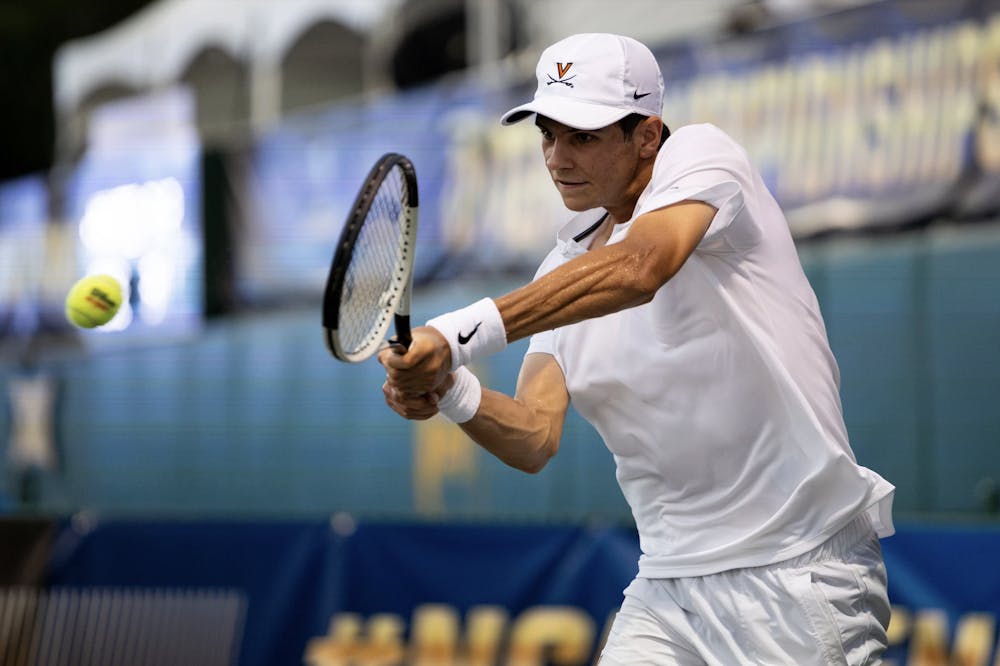
By the time the lights shone on the King Abdullah Sports City tennis courts in Jeddah, Saudi Arabia, Rafael Jódar was approaching the final days of his collegiate chapter. The week that followed would end with his announcement that he was turning professional.
Just last year, Jódar was at the tournament as a hitting partner, brought in to help prepare qualified players for matches and experience the tournament without competing in the main draw. This year, he returned as a qualifier, now a 19-year-old Spaniard carrying momentum and belief to beat the tournament’s top seed on the biggest stage of his youth career.
“When I was here hitting with these players last year, I was thinking to myself that maybe one day I was going to make it,” Jódar said. “At the end of [this] season, I had very good results and that gave me the opportunity to play here in Jeddah.”
The Next Gen ATP Finals is the ATP’s annual showcase for the world’s best players aged 20 and under. The event has long been a proving ground for future stars, with past champions including Jannik Sinner and Carlos Alcarez. The event’s innovative format, featuring short 4 game sets, no-ad scoring, live electronic line calling and coach headsets, has turned it into a laboratory for the future of tennis. In December, with the tournament set in Jeddah for the third consecutive year, Jódar became part of that future.
Jódar earned his place in the eight-man draw Nov. 29 by finishing inside the top eight of the PIF ATP Live Race to Jeddah, the season-long points race used to determine entry into the event. His qualification was secured through an accumulation of ATP ranking points earned on the Challenger Tour, where he captured three Challenger titles — in Hersonissos, Greece in August, Lincoln, Neb. in October and Charlottesville in November. Those victories generated enough points to move him from outside of the world’s top 900 in March to inside the top 200 by the season’s end.
While the Next Gen ATP itself does not award ATP ranking points, matches count toward a player’s official win-loss record, and qualification reflects high-level performance even at the professional level. For Jódar, reaching Jeddah means direct entry into Challenger main draws, reducing his reliance on wildcards as he transitions from collegiate matches into more tour-level matches in 2026.
That trajectory was tested immediately once play began in Jeddah. Drawn into a demanding round-robin group featuring top seed and World No. 28 Learner Tien and fellow European prospects Nicolai Budkov Kjær and Martin Landaluce, Jódar entered the week with little margin for error. Over these five days, each player would compete in three best-of-five set matches under the event’s shortened scoring format, where games are finished quicker and tiebreaks often decide advancement.
Jódar announced his arrival at Next Gen’s opening night with the most dramatic win of his career edging Tien in a five-set battle. The result reflected what the Next Gen Finals is really about — going head-to-head with the world’s most accomplished under-20 players in a format designed to expose resilience and competitive nerve. After dropping the opening set, Jódar repeatedly steadied himself in the face of elimination, ultimately saving four match points in a 1-4, 4-3(3), 1-4, 4-2, 4-3(4) victory. The win marked the first meeting between the two and immediately reshaped the dynamics of the group, reframing Tien’s expectation to be the overall tournament winner.
“It was a battle,” Jódar said afterward. “I had to keep believing and I knew that I was going to have a chance.”
Jódar split his next two matches, falling to tournament fifth seed Nicolai Budkov Kjær 1-4, 2-4, 4-1, 2-4, before defeating close friend and fellow Spaniard, Martin Landaluce, in straight sets 4-3(7), 4-1, 4-3(2). Against Landaluce, Jódar blasted 31 winners and won 92 percent of his second-serve points, holding firm through repeated pressure moments.
“We’re good friends,” Jódar said. “I’ve known [Landaluce] since we were really young. I don’t remember the exact age. Maybe 10, 11 years old. We used to play a lot when we were young. We played team [events] in juniors together.”
The unforgiving math of round-robin tennis had the final say. Despite the 2-1 record, Jódar missed the semifinals on tiebreakers as Tien and Budkov Kjær managed to advance. This was a reminder that success in tennis at such an elite level hinges on only a handful of games.
Yet, there was still magic in Jeddah. Rafael Nadal, Jódar’s lifelong idol, was watching from the stands. Nadal later posted a message on X praising both young Spaniards.
“Really enjoyed spending some time with Martin Landaluce and Rafa Jódar in Jeddah and watching them play,” Nadal wrote. “Great to see two [Spanish] players competing in a tournament that brings together the best young talents on the ATP Tour.”
For Jódar, the message held significance well beyond the post itself. Growing up in Madrid, idolizing Nadal was almost inevitable. Jódar spent his childhood watching Nadal set the standard for Spanish tennis, a legacy that now framed his own moment on the Next Gen ATP Finals stage.
“Rafa has been my idol for a long time, since I was very young,” said Jódar. “I used to watch all of his matches. He was my role model in tennis. I’m super happy that he was here. It means a lot that he came to Saudi Arabia to watch this tournament.”
More than anything, the week made clear that his game belongs at the professional level. Just days after competing in Jeddah, Jódar, in an Instagram post, announced his decision to forgo his remaining college eligibility and pursue a full-time professional career.
“My time in college has played a huge role in my growth, both as a player and as a person, and I now feel prepared to take this next step and embrace a new challenge in my life,” Jódar wrote.
Though Virginia tennis will lose one of its most accomplished young players, Jódar’s impact on the program is lasting. In turn, the structure and support found in Charlottesville helped position him for the professional stage.
That transition was quickly validated on court. In his first major event after announcing his decision to turn professional, Jódar earned a place in the Australian Open main draw by navigating three qualifying round matches, defeating Li Tu 6-2, 6-1, former Cavalier Chris Rodesch 7-6 (10), 6-3 and Luca Van Assche 6-3, 0-6, 6-1. This run only reinforced the significance of what had taken place days earlier in Jeddah. Now, Jódar is set to face Rei Sakamoto in the first round of the main draw Sunday.
From a hitting partner to centre court, Jódar’s journey at the Next Gen ATP Finals was not defined by how it ended, but rather by what it confirmed. With his decision to turn professional announced days later — one already paying dividends Down Under — the performance he delivered in Jeddah now stands as the closing chapter of his collegiate career and the clearest indicator of what’s to come for the teen prodigy.
Read More

Late drama denies Virginia men’s soccer’s ferocious comeback against Wake Forest
By Mofeoluwa Akande | 8 hours agoAll four of Virginia’s losses have been the result of 80th minute or later breakthroughs by their opponents.

Country roads lead to Charlotte blues as Mountaineers reclaim long dormant rivalry
By Joe Schwiesow | 9 hours agoThe Queen City claims another Virginia football victim, as the Cavaliers fail to overome a powerful West Virginia offense in a 38-27 loss.

Taking stock as Virginia men’s soccer finally leaves Charlottesville
By Michael Liebermann , Mofeoluwa Akande and Noah Cinel | YesterdayAfter a lengthy homestand to kick off the season, Virginia men's soccer finds itself in a shaky position with a 3-3-1 record. Three writers assess where the team is now and what is of note in the future.


