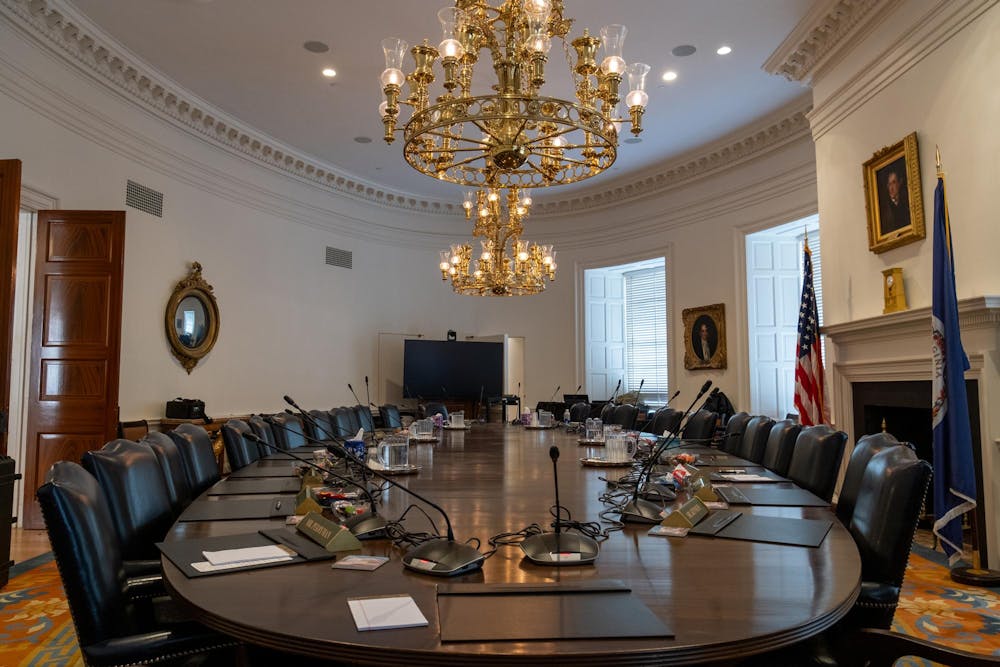
Since the Board of Visitors’ appointment of Scott Beardsley Dec. 19 as the University’s 10th president, debate among University community members about the legal legitimacy of the Board has persisted. Various groups, such as the University’s chapter of the American Association of University Professors, have claimed that the Board is out of compliance with the statutory membership requirement outlined in the Code of Virginia. The University, however, remained confident in the Board’s consistency with the Code of Virginia through a statement to The Cavalier Daily in September.
Under the Code of Virginia — Title 23.1, Chapter 13, Article 1 — the University’s Board is required to consist of 17 members, 12 of which are required to be Virginia residents and 12 of which are required to be alumni of the University. As it currently stands, the Board has nine residents of the Commonwealth and nine alumni of the University.
Currently, of the 12 members, Porter Wilkinson, John Nau and David Okonkwo are not listed on the Board’s official website as Virginia residents. Additionally, according to the Board’s website, Paul Harris, Stephen Long and Paul Manning are not alumni of the University.
University Spokesperson Bethanie Glover declined to comment on whether the Board can lawfully act with its current composition that does not meet state statute requirements. However, Glover noted in September that Board leadership, University leadership and University Counsel all remained “confident” that the Board would continue to act in manners consistent with the Code of Virginia and relevant case law.
Initial questions of the Board's legitimacy occurred following the resignation of former University President Jim Ryan and the subsequent appointment of former Interim President Paul Mahoney. Debate has persisted since Mahoney’s appointment, and has been intensified following the search committee’s continuation of the presidential search and the Board’s appointment of Beardsley despite requests from several University stakeholders to pause.
The University’s chapter of the AAUP released a statement citing no confidence in the Board in August and recently released a statement Jan. 6 rejecting Beardsley's appointment as president — asserting it as an illegitimate action.
“The presidential search, problematic from the start and resulting in this appointment, represents the Board’s continued failure to engage in authentic shared governance with the faculty,” the statement read.
Walt Heinecke, immediate past president of the U.Va. chapter of the AAUP and associate professor of Education and Human Development, said that he believes the Board is in violation of state statute and therefore lacks the legal authority to make significant decisions for the University.
“[The Board has] no business doing things like firing Jim Ryan, hiring an interim president, engaging in an agreement with the Federal Department of Justice and then initiating a search for the permanent president,” Heinecke said. “Our stance has been that they are out of compliance with state statute, and therefore they shouldn't be doing these things until they're in full compliance.”
Further, Heinecke noted that concerns about the Board’s legitimacy could have negative consequences for the University community, including undermining the legitimacy of the University’s 10th president.
“It's clear that this is going to have a continuing effect on the legitimacy of the president … It’s going to create chaos [and] issues [for the University],” Heinecke said. “It's clear that most organizations around Grounds are clear that there is a crisis of legitimacy, and that nobody should have been appointed in December.”
The Faculty Senate has also repeatedly voiced concerns about the legitimacy of the Board’s actions through resolutions calling for the suspension of the presidential search.
Jeri Seidman, Faculty Senate chair and associate Commerce professor, said she believes the Board has not properly received the input of the Faculty Senate as required by the Faculty Senate bylaws and the Code of Virginia. The Board is required by law to solicit the input from representatives of the University Faculty Senate twice per academic year and before the election of a new president.
Historically, this advisory position has been held by the chair of the Faculty Senate, but this year, the Board received faculty input from the faculty representative to the Board, James Lambert. The faculty representative is a member of the Board who serves to advise the Board and share insight on academic matters but does not have voting power.
According to Seidman, soliciting input from a faculty representative who is a member of the Board themselves does not satisfy the statutory requirement to solicit input from an institution’s faculty senate. Seidman said that the separate clause in the Code of Virginia that requires the Board to solicit input from representatives of the institution's faculty senate implies that these representatives are intended to be individuals who are not sitting Board members.
“The faculty [representative] to the Board is a Board member, so that changes that person's relationship [to the Board],” Seidman said. “[The Faculty Senate has] not considered [the Code of Virginia] to be satisfied by asking the faculty representative to the Board, who is a Board member, to provide input.”
Clay Dickerson, Student Council president and fourth-year College student, also expressed concern about the legitimacy of the Board. According to Dickerson, this concern has led to little “faith” among University community members in the decisions the Board makes.
“The Board of Visitors' obscure decision-making during this transition period has left much of the community in the dark, betraying decades of shared governance … The presidential search’s results have not healed this University and have endangered our community by politicizing the process,” Dickerson said.
Gov.-elect Abigail Spanberger visited the University in September prior to winning the election in November, and in response to a student question said that the Board’s member appointment process should be revisited. Spanberger and her administration will take office Saturday. She will have the opportunity to appoint members to the Board to fill vacant positions, although it is unclear when and if she will do so.
Michael Racz is a staff writer on the news desk. He is a second-year College student majoring in biology with plans to go to medical school. He enjoys writing about health topics and student self-governance.
Read More
Parking on Grounds — what has changed this semester?
By Charlotte Gabriel | 13 hours agoAccording to University students interviewed by The Cavalier Daily, several expressed frustration with high parking prices on Grounds, as well as the difficulty in finding available parking in general.

Student Council connects with University’s Strategic Planning Committee
By Lucia Gambacini and Reilly Auld | 13 hours agoThe Council also heard updates from Executive Board members regarding the upcoming Fall 2026 elections and new investments in free Sexually Transmitted Infection testing kits for students.

Virginia colleges workshop three-year bachelor’s degrees
By Luca Bailey | 13 hours agoIf the effort is successful, participating schools in Virginia and Ohio will join at least 70 higher education institutions across more than 26 states that have already adopted three-year programs in some capacity.