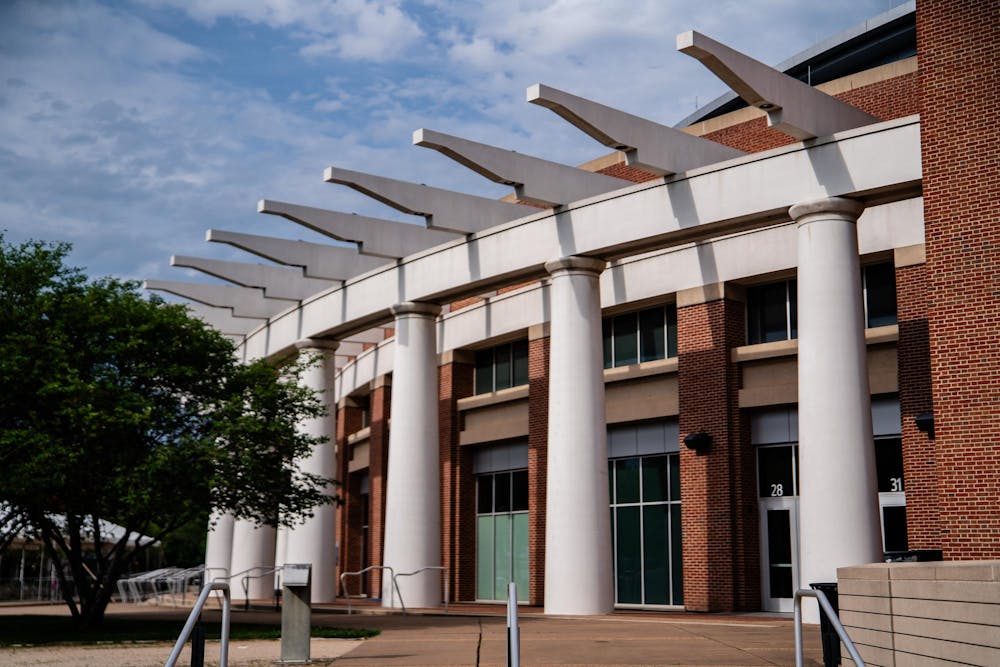
The University’s John Paul Jones Arena housed a dedicated dining facility for student-athletes on the second floor of the arena, which shut down at the end of the Fall 2025 semester. Virginia Athletics attributed the shutdown of the JPJ dining hall to cost-saving efforts, though student-athletes have said this loss leaves a lack of food options and deprives the athletes of a community-building space.
The 7,900 square-foot dining hall opened in 2006 as part of JPJ to provide all student-athletes with a nutritious and convenient dining experience in proximity to their practice facilities. It was located one floor above the academic-athletic center, which has since relocated to the new Olympic Sports Center and Hardie Football Operations Center. During the academic year, JPJ dining hall served dinner five nights a week — Sunday through Thursday.
Although JPJ dining only offered a dinner service, for many student-athletes, the weeknight dinners also provided time to unwind as a team, build friendships and create a community across sports. Large narrow tables spanning the width of the room allowed teams to sit together in big groups and also mingle with members of other teams. Student-athletes often described the dining hall as a social hub each weeknight.
Many teams made it a routine to eat dinner together at JPJ after practice, which helped build camaraderie across class years. Ella Bathurst, former women’s swimmer and Class of 2025 alumna, underscored the importance of these shared meals.
“One of my favorite things about JPJ was that regardless of what day of the week it was, if we had had practice or not, you could show up to JPJ and find someone to sit with, whether they were on your team or another team,” Bathurst said. “It just really made you feel closer as an athletic department as a whole, which was really so special.”
Kate Kelly, former rower and Class of 2024 and McIntire Class of 2025 alumna, said the JPJ dining hall provided the rowing team, one of the largest athletic teams, with a space to bond.
“I think that the social component will be harder to find for larger teams [without the JPJ dining hall],” Kelly said. “Especially, [with] rowing being such a large team, I think it was hard to actually have the chance to get to speak with everybody and really get to know everybody on the team [except at the dining hall].”
The closure also impacts day-to-day convenience for student-athletes. JPJ is located nearby many training facilities, such as Disharoon Park, making it easy for student-athletes to migrate from practice to dinner seamlessly. Now, student-athletes may have to trek to dining halls that are farther away from practice facilities and have more limited hours. According to Bathurst, the nature of the food offered also made a difference.
“Compared to other dining halls, the food was much better at JPJ,” Bathurst said. “You always knew that you were going to be able to get the nutrition that you needed to perform well the next day.”
Virginia Athletics administrators cited financial and operational factors as the official reason for closing the JPJ dining hall. In a statement to The Cavalier Daily, associate athletic director for communications Erich Bacher explained that the decision was driven by unsustainable costs of operating the additional dining facility.
“In conjunction with the University, Athletics has made the decision to close the JPJ Dining Hall due to ongoing cost savings efforts,” Bacher said. “Athletics administration has worked collaboratively with our head coaches, members of the Student-Athlete Advisory [Committee] (SAAC) and the sports nutrition department to provide alternative solutions to ensure our student-athletes receive the nutritional support needed to compete at a championship level.”
Kyle Montaperto, president of the SAAC and fourth-year Education student, echoed Bacher’s reasoning during the Jan. 20 Student Council general body meeting. Montaperto said that because the ACC opted in to the House v. National Collegiate Athletic Association settlement, schools are now able to provide up to $20.5 million in direct payments to athletes in the form of revenue sharing starting in the 2025-26 academic year. Virginia committed to distributing the maximum amount.
During the Student Council meeting, Montaperto said that the culmination of these settlement costs imposed on the University was largely the reason the school could not afford to keep the JPJ dining hall open, which he said was approximately a $1.2 million operation annually.
While athletes like Bathurst and Kelly appreciated the dining hall at JPJ, for others, the facility simply was not necessary. Since football and both men's and women's basketball programs have their own separate dining areas and facilities, JPJ dining was primarily serving Olympic sports athletes.
In the Student Council meeting Jan. 20, Noah Dyer, a student-athlete representative and third-year Commerce student, said that the athletic department has introduced a temporary solution — providing student-athletes with one catered meal per week. However, Dyer added that this measure fails to replace the consistency and convenience offered by the JPJ dining hall.
A resolution proposed to the Council by both Dyer and Montaperto called for the University to establish a permanent athletic dining option within an existing dining hall, such as Newcomb Dining Hall, to accommodate a dedicated student-athlete dining station. The proposal was unanimously passed, and next, Dyer and Montaperto plan to meet with Nicole Hall, senior associate vice president for student affairs and dean of students, to discuss potential permanent solutions regarding athletic dining Jan. 28.
The University’s decision to close its athletic dining hall may impact recruiting efforts — particularly in Olympic sports — in the era of the transfer portal as well as NIL and revenue-sharing. When Carla Williams arrived as Athletic Director in 2017, one of her focuses was upgrading Virginia Athletics facilities, because recruits notice when a school lacks amenities that others boast. Student-athletes such as Kelly mentioned this as a potential future concern.
“I do think that a big pull for some student-athletes is having that access to dining that's going to be consistent … every time,” Kelly said. “I can see a lot of the Olympic sports having a little bit of a harder time, just because I know that gave Virginia just a bit of a leg up in terms of what they're recruiting or what they could offer to recruits.”
Former student-athletes expect that the dining hall will be missed. Kate Morris, former women’s swimmer and Class of 2025 alumna, said that she feels “really, really disappointed” that upcoming student-athletes will not experience the dining hall.
“One of my other favorite memories was being a first-year, and all of us would go to JPJ on Sundays,” Morris said. “I have vivid memories of the entire first-year class being at JPJ for probably almost three hours, like the entire time it was open … we had nothing better to do besides hang out, and that was such a great atmosphere and environment to bring us together and bring us closer.”
Lauren Seeliger is a news editor of the 137th term and enjoys covering U.Va. Health and University governance. Lauren is a fourth-year Behavioral Neuroscience student from Fairfield, Connecticut.
Read More

A chance meeting led field hockey assistant coach Brendan Creed to Charlottesville
By Adair Reid | 22 minutes ago“Ultimately we haven't won this thing here, so that kind of is a big attraction for me in terms of let's do something for the first time,” Creed said. “There's something to chase, which I think is also really exciting.”

On the recruiting trail, Virginia baseball finds future Cavaliers
By Drew Dillman | 25 minutes agoWhether it be in Virginia or across state lines, incoming first-years or experienced veterans, Coach Chris Pollard has found a way to recruit talent for the 2027 season and beyond.

U.Va. reports increases in rape, aggravated assault and liquor law violations in 2025
By Jaylynn Perez | 27 minutes agoThe report has been published annually since 1991 under the federal Jeanne Clery Campus Safety Act.