
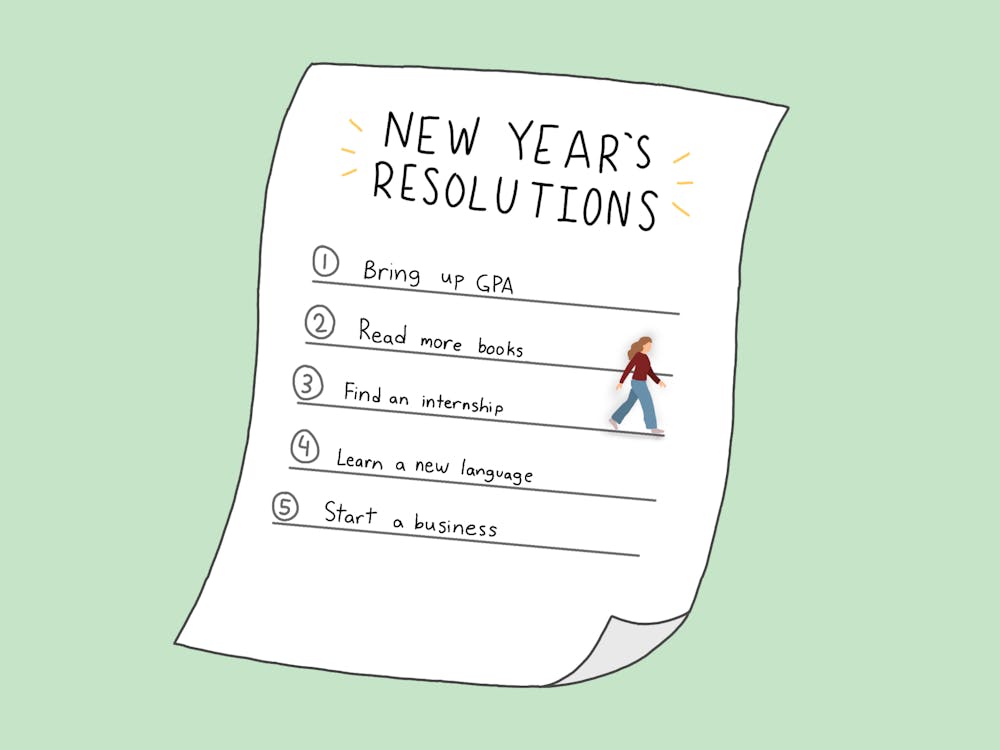
According to Forbes, 80 percent of New Year's resolutions fail by the beginning of February. The common and widespread failure of these lofty resolutions has prompted University students to reflect on why these goals so often fall apart.
The traditional ambitious start-of-the-year goal — such as running four miles a day five days a week, for example — leaves little room for flexibility and lots of room for incompletion. In turn, several University students detail their preference for setting more incremental, mindset-based goals that are more realistic and attainable.
Some students say that rigid resolutions can feel like an extension of the already demanding culture on Grounds. With rigorous coursework, extracurricular activities and personal aspirations, many students, such as third-year McIntire student Tegh Khuman, feel that pursuing an additional new goal is a lot for an already hectic schedule.
“I feel like I can’t just add something to my life because I have no time as is,” Khuman said. “If I was going to add something, I feel like I might have to remove something or change something else around.”
Besides scheduling obstacles, third-year College student Camden Young believes the reason many people’s New Year’s resolutions remain unaccomplished is due to the pressure these ambitious goals often create.
“I think there’s a lot of pressure with creating these goals and having pressure to hit them,” Young said. “For me, I find it more valuable to use [the new year] as a period of reflection … instead of [setting] certain goals, it’s more so ideas … of how I want to see myself in the new year.”
Rather than tacking another daunting task onto their to-do lists, students like Young are opting to embrace mindset shifts, creating a more sustainable approach to self-improvement that is proving far more effective than all-or-nothing resolutions.
Third-year College student Seton Gerrity takes a unique, more tangible approach to the re-envisioned resolution. Aside from not participating in traditional resolution-setting practices, Gerrity and her friends from high school have created a New Year’s vision board over winter break for the past three years. She notes how this creative practice has given her and her friends both a fun bonding activity and a chance to grow alongside each other into the new year.
“New Year’s is a time to get together, and the [vision boards] are a nice way to do something creative. Because we don't get to spend as much time together as we did before, I feel like it's a nice way to gather and …. [envision] what we want our lives to look like,” Gerrity said.
One of the centerpieces of Gerrity’s vision board is a runner, materializing her goals of movement without the rigidity of a hard and fast resolution. As a matter of fact, Gerrity ran the 2025 Allianz Richmond Marathon Nov. 15, an achievement she attributes to the flexible and strategic approach to goals she brought into this past year.
“I knew I wanted to run more in the new year, but not having a marathon as the explicit end goal almost alleviated the daunting element of it. This is something that I am doing because I want to and that can be relatively casual without it hinging on being a big lofty goal,” Gerrity said.
Also averse to grandiose resolutions, Young decided to prioritize his commitment to his mental and physical health in 2026. He chose a single word that he wanted to use to define his new year — balance.
“I take the time right before the end of the year to write down my highlights of the year, like what went really well and what went really poorly,” Young said. “I really don't know if I believe in the idea of a resolution. I think it's a great time to think about growth, but I don't know if I really believe in hard set goals.”
Khuman, too, reflected on his experience rethinking the New Year’s resolution after several attempts that failed to stick in previous years. Ultimately, he attributes his shortcomings to hollow preparation and neglecting to instill accountability systems.
“[My resolutions] I wanted to do, but I didn’t have enough discipline or motivation to do it,” Khuman said. “Because it was the new year, it was like, okay, let’s make this a thing. But I don’t think there were enough systems in place to keep me accountable.”
Like Young, Khuman acknowledges that consistency can be difficult to maintain in a college environment where class schedules change daily and social distractions are constant, and decided to focus on building habits over seeking drastic lifestyle changes. With a year-end goal of going to the gym more routinely and eating cleaner, he emphasized the importance of building systems of accountability rather than solely relying on the novel motivation of the new year.
“You have to have the willpower to [do it] … but I think it helps if you have someone or some type of system to keep you accountable,” Khuman said.
Though their approaches differ, Gerrity, Khuman and Young all reject rigidity, and instead emphasize the importance of building lasting systems of support. In doing so, they illustrate how meaningful change does not need to depend on Jan. 1. As a matter of fact, Khuman questions the widespread belief that people must wait until the New Year to make beneficial changes to their lives.
“It’s intrinsic [to] want to make a change,” Khuman said. “I guess a better question is — why weren't you already doing it? Why does it have to be a New Year’s thing?”
Read More

From soccer to startup, Emiliano Mercenari is doing it all
By Malone Morchower and Abby Snowdon | 3 days agoMercenari is a first-year College student, an attacker and midfielder for the Virginia men’s soccer team and the founder and current operator of four startups.

Conmole cooks up the perfect evening out
By Ingrid Gay | 3 days agoAs much as I loved many of the dishes we had that night, the best part of Conmole was not the flavors, it was the service.

The Ozempidemic — is social media telling the full story?
By Dana Douglas | September 9, 2026To strain the surplus of information about GLP-1 medication circulating on social media, The Cavalier Daily spoke to those on the frontlines of the phenomenon — University medical professionals and a student prescribed GLP-1 — to uncover what this development actually looks like for the future of weight management, diabetes treatment and American healthcare as a whole.


