
The Frank Batten School of Leadership and Public Policy’s grade normalization policy — commonly referred to by students as the “Batten Curve” — has remained a recurring point of discussion among Batten students. While some students say the curve has not significantly impacted their grades, many students said it is occasionally unclear when and how the curve will be applied, and some worry it might deter underclassmen from applying to the school.
Under the policy, Batten courses are guided by a grade normalization standard that aims for a class-wide mean GPA of approximately 3.5, rather than grading solely on raw scores or percentages.
A policy statement listed on all Batten course syllabi states, “The Frank Batten School has a grade distribution practice, with an emphasis on a well-distributed range of grades. Batten courses aim to have a mean grade that does not exceed a 3.5 grade point average.”
In a statement to The Cavalier Daily, Eileen Chou, associate dean for academic affairs and Public Policy professor at Batten, said the Batten School’s grading practice has remained consistent in its intent since it was introduced on syllabi in 2019, though the school has refined its language over time to improve clarity.
Chou shared with The Cavalier Daily a message that was sent to Batten faculty at the end of the Fall 2025 semester outlining the intent of the school’s grading practice.
“The Batten School has a grade distribution practice to support consistency and ensure that courses are designed as rigorous for the intended student population,” the message stated.
The message further stated that the school’s grade distribution practice is intended as guidance for professors rather than a mandatory curve.
“For all Batten courses, faculty are encouraged to aim for an average course GPA of 3.5 in the design of their courses,” the message stated. “Please note that this is a suggested grade distribution and is not a required curve. Please do not curve grades down simply to meet a grade distribution.”
The message also said that if grades at the end of the semester trend outside of the distribution, then faculty should contact the director of academic operations to discuss.
Chou also noted that administrators have met regularly with Batten student representatives in recent years to better understand student experiences and answer questions about the grading policy. She added that a faculty committee has convened to examine the grading practice and its implications on student experience.
An analysis conducted by The Cavalier Daily of publicly available GPA data from Batten courses sourced from CourseForum and VA Grades between 2018 and 2024 found that the average GPA during that period was roughly 3.6. While the data does not capture how individual professors applied grade normalization in specific courses, the overall average roughly aligns with the school’s stated target under the policy.
The Cavalier Daily reached out to five faculty members for comment on the policy’s rationale and implementation, but did not receive any responses. The Cavalier Daily also interviewed multiple Batten students about their experiences with the curve, many of which cited confusion about how it operates and skepticism about its purpose and impact.
Faith Windbigler, president of the Batten Undergraduate Council and fourth-year Batten student, said that while many enrolled students ultimately find the curve less damaging than expected, it often looms large for students considering whether to apply to Batten with fears of their GPA dropping.
“As I was thinking about applying to Batten, I talked to a lot of people about my intentions to apply [and] I was immediately met with, ‘Oh, that’s really not a good pre-law major — have you heard about the Batten Curve?’” Windbigler said. “It was really disheartening, because [Batten] was why I came to U.Va.”
Windbigler said those concerns are reflected in student survey data collected last year. According to a 2024 survey of 122 Batten undergraduates conducted by the then-student body president, 74 percent of respondents said they would support removing the “Batten Curve.”
Third-year Batten student Jessica Drennan said she knows of several students who opted against Batten because of worries about maintaining a competitive GPA for postgraduate applications.
Despite this common fear, third-year Batten student Anila Noushin said the curve’s impact on grading is often overstated, especially among underclassmen considering applying to the school.
“I don’t think the ‘Batten Curve’ is something that should sway people or deter people from being in Batten, because I don’t think it really hurts many people’s grades from my experience,” Noushin said.
Noushin said she first learned about the “Batten Curve” informally, often through peers rather than through official channels or introductory programming and had to seek information independently.
“I remember having to do research myself, and I feel like a lot of people also had this experience,” Noushin said. “A lot of us didn’t really know what it meant.”
Other students echoed that initial confusion. Drennan said the curve was often described in vague terms — such as being “a 3.5 curve” — without much explanation of how it actually functions in practice. She said that while she understood it generally involved grade adjustment, the mechanics were unclear early on.
Windbigler said much of that confusion stems from how the policy is communicated in classes. While the “Batten Curve” appears in syllabi, she said many professors do not explain how — or whether — they intend to apply it.
“What happens in many courses is it’s in the syllabus. It’s not addressed, and you either have to directly talk to the professor about what their specific curving policy is, or find out throughout the semester,” Windbigler said.
Drennan also said that while the curve is referenced as a schoolwide policy, its implementation can vary significantly by course and professor, sometimes making it difficult to track academic standing throughout the semester.
“It’s pretty confusing. You don’t really have a clear picture of what your grade is in the class most of the time, until the very end,” Drennan said.
Despite confusion around grading mechanics, Drennan said she did not feel professors were intentionally trying to penalize students through the policy, and said that so far she has not been upset with how the curve is applied in her courses.
Drennan also said that she recognizes the potential academic value in grading systems that emphasize feedback over uniformly high grades, arguing that constructive criticism can be more beneficial than consistently receiving top marks without reflection.
“It does encourage you to work maybe a little bit harder,” Drennan said. “I think it's better to get a lower grade on an assignment but have feedback and know how to improve … than to just always be getting an A and never really question what you're doing. So I can see definitely the value in it in that way.”
Beyond GPA concerns, Windbigler shared a quote from a student who participated in the 2024 survey regarding the “Batten Curve” who said the curve affects how students approach collaboration in Batten classes.
“In my opinion, the curve strongly disincentivizes true collaboration between classmates, because helping someone else makes it harder to outperform them,” the quote stated. “This reality feels weird since Batten is full of group projects.”
Windbigler also said the curve can affect how faculty are recognized for their work with students.
“A lot of the best professors at Batten don’t use the curve, and that’s because they really invest so much in their students,” Windbigler said. “They’re meeting with students constantly, having really productive office hours and going out of their way to make sure students are supported.”
Additionally, Noushin noted the curve's impact on course selection, particularly for electives and special topics courses. She said students often rely on informal guidance from upper-class students for course selection, who may recommend courses where professors do not apply the curve.
Looking forward, Windbigler said she believes Batten is beginning to seriously reconsider how the grading practice affects students.
“I do think there’s new momentum to really thoughtfully think about what this curve is doing to students,” Windbigler said. “[But] at the end of the day, the biggest harm is on student stress.”
Read More

Students, professors weigh in on the importance of letter grades
By Ruby Budetti | 13 hours agoWhen thinking about letter grades for themselves, many University students and faculty said they prefer letter grading throughout all four years of college.
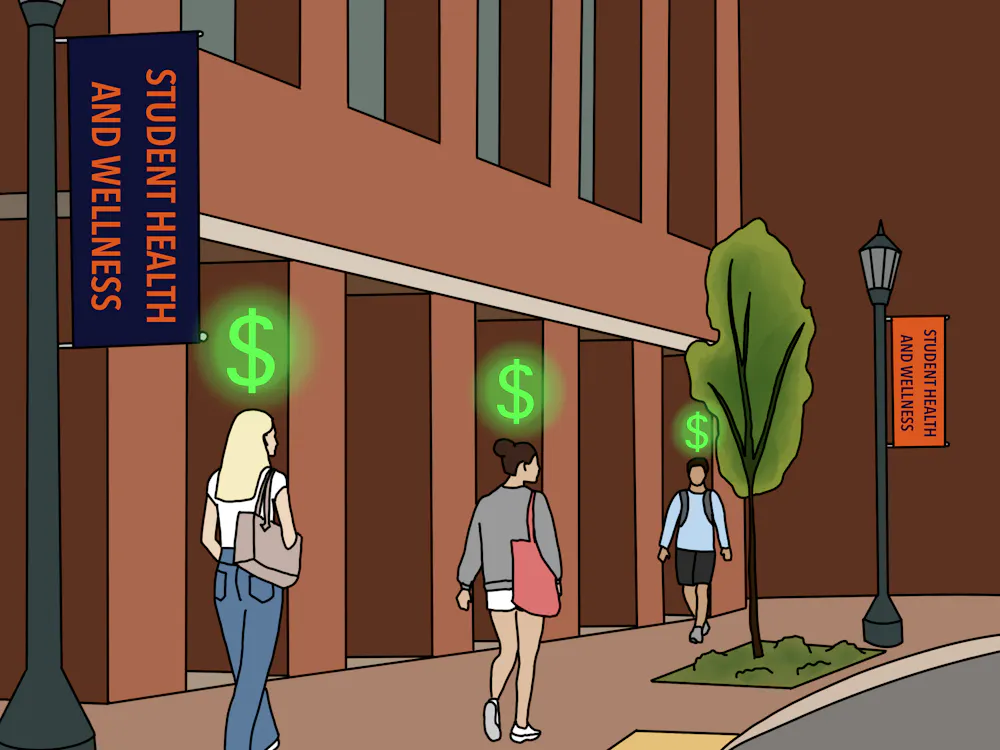
What services does the Student Health Fee provide for students?
By Melody Yuan | 13 hours agoThe University Board of Visitors approved tuition and fees for the 2026-27 academic year in April, and the Student Health fee rose from $1,147 to $1,184 per student.

The ‘AI and Future of Work’ Series — How the University is preparing students for what is next
By Lidia Zur Muhlen | 15 hours agoIn a recent Gallup Inc poll, 79 percent of Americans believe that artificial intelligence will reduce the number of jobs over the next 10 years.