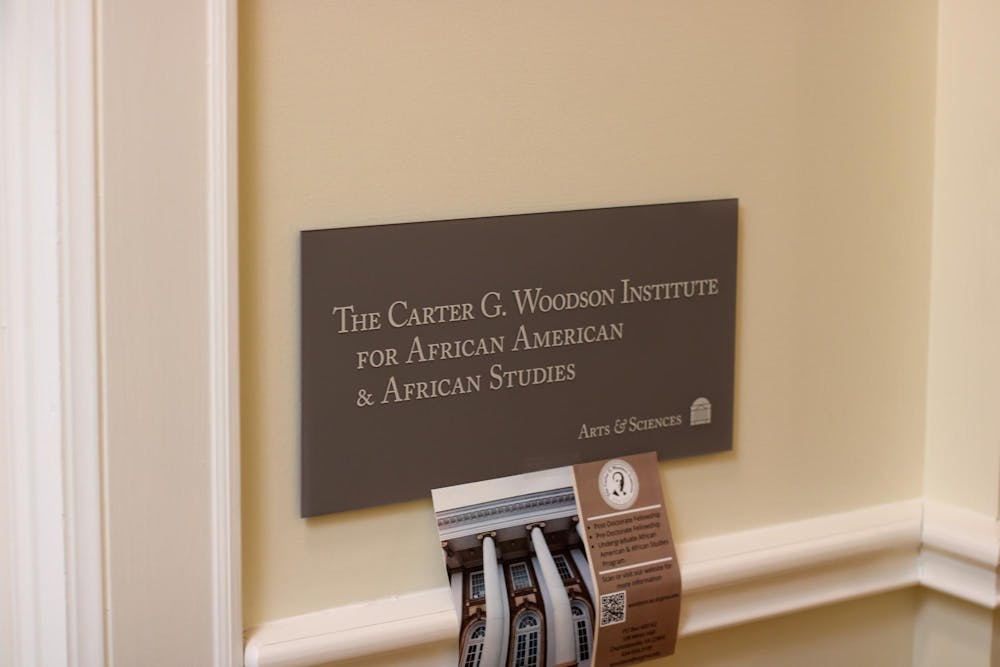
The Carter G. Woodson Institute, which administers a fellowship program for students and organizes conferences and a lecture series, was founded in 1981 after the rise of expressed student interest in an African American studies program. The African American and African Studies department offers one major, two minors, Swahili and 25 course options.
Kevin Gaines, interim chair of the Department of African American and African Studies and Julian Bond Professor of Civil Rights and Social Justice, said that the subject of African American studies has increasingly adopted a global and interdisciplinary perspective across peer universities in the U.S. The University has followed suit — courses like AAS 2710, “Introduction to Afro-Latin America” and AAS 3157, “Caribbean Perspectives” offer students historical lessons from across the globe. In addition to increasingly global perspectives, course offerings focus on race and its broad intersections — the University offers AAS 3500, “Race, Ethnicity & Health in U.S.” and AAS 3500, “Race, Class, Politics, & Environment” as interdisciplinary courses.
“Africana studies departments [have always studied] … the continuing relevance of race in American society … but we don't just do that,” Gaines said. “We're taking an intersectional approach that looks at race, gender, sexuality and class within the same framework.”
Retracing the Department’s history, in 1969, students expressed interest in forming an African American Studies program, and the University created this program the following year. In 1981, the University created the Carter G. Woodson Institute to house the African American and African Studies Program and offers a fellowship for pre- and post-doctoral scholars. The Woodson Institute officially became an academic department in 2017, removing its dependence on other departments to hire faculty. In 2024, the Institute and Department became independent, leaving the major and minor programs to be overseen by the Department and the fellowship to be overseen by the Institute.
The Carter G. Woodson Institute offers a two-year program for fellows. Fellows who have finished their doctorate are required to teach an upper-level seminar to undergraduate students, and some fellow-taught courses include AAS 3500, “Black Women, Slavery & Freedom” and AAS 3500, “Black Power & Environ Movement.”
Professor Robert Trent Vinson, director of the Carter G. Woodson Institute, said the Woodson Institute is unique, as other similarly-focused fellowships typically last one year. In contrast, the Woodson Institute offers a two-year fellowship. There are six doctoral fellows and eight pre-doctoral fellows in residence, and since its founding, the Woodson Institute has had 250 fellows.
The pre-doctoral program allows fellows completing dissertation projects to learn from scholars across the nation to guide their research. The post-doctoral participants hold the positions of research associates and lecturers.
Vinson said he aims for the Department and Woodson Institute to be a place where students feel welcomed and represented. He recalled that when he was an undergraduate, he did not have any African American courses to take or professors to connect with.
“Representation, I think, is important for students who feel we're a numerical minority here,” Vinson said. “There's a lot of talk at U.Va. about belonging, that you belong here. This is your university. …That's important as a slogan, but for it to be more than just rhetoric, all of our students, have to feel, ‘I belong here, and I see myself represented in everyday life, in my classes.’”
Unlike similar African American and African Studies programs at other universities, the Department is home to Swahili language courses, which were housed in the Department of Anthropology prior to 2015. To globalize perspectives brought to the teaching, the Department hired faculty from Africa, the Caribbean and South America.
“All that cutting-edge research that [fellows are] doing while they're here for two years, our students benefit from that research,” Vinson said. “I've had students talk about [taking] this course on Brazil, [and finding] out it's one of our fellows who taught the course. [Without the fellows], there would not have been that course. So the fellows help with the curriculum mission.”
Alexandria Smith, assistant professor of Gender and Sexuality within the Department, said she sees interdisciplinary thinking as one of the unique offerings of the Department that makes it stand out from peer institutions. She has a doctorate in Women’s, Gender and Sexuality Studies with a focus on Black feminist and queer literature and theory, and she said interdisciplinary training is something that not only gives students knowledge, but also critical thinking skills and perspectives on how to ask questions.
“Relational learning, where you can learn the things that are presented to you within the framework of a traditional discipline, is important, but interdisciplinarity [thinking] can train you to ask questions that are best answered through drawing on methods and the kind of knowledge base of multiple fields,” Smith said.
Smith joined the faculty following her fellowship in the Woodson Institute from 2021-23. Vinson said that many fellows go to other universities to teach or to complete post-doctoral fellowships. Smith, however, chose to stay at the University.
Fourth-year College student Mikayla Williams said that the African American and African Studies major offers an additional perspective to her Global Public Health major. As someone interested in studying health inequities and pursuing the pre-medical track, Williams said the African American and African Studies major helps her understand a new perspective on health equity and its connection to race.
“I realized that [African American Studies is] perfect to couple [with Global Public Health], especially … courses [in] public health but still [with an] African American background,” Williams said. “There are so many different disciplines that you can enter with [this] major.”
Third-year College student Joseph Jones said he was introduced to the Department through events held by the Woodson Institute, and he said he found community in the Department. Jones said the Department’s professors express support and interest in helping students succeed.
“U.Va. was built on this idea of an [Academical] Village in which students were interacting constantly with the professors and [in] the African American [and African] Studies Department, it feels like those professors sometimes are your family,” Jones said. “They actually care about you. They care about your goals and where you want to go. They want to help you succeed.”
Over this past month, the Woodson Institute has held a series of events celebrating Black History Month. One of the events, which took place Feb. 18, hosted a panel on the Julian Bond Papers. Bond was a professor at the University and a civil rights leader, and after he passed in 2015, his widow donated all of his letters, books, speeches and newspaper articles to the University, where they are now being catalogued and digitized for the public.
“The students actually get the experience of looking at real history, cataloging it, digitizing it, being able to talk about it,” Vinson said. “The Julian Bond Papers are a wonderful way of archiving and preserving, but it's also helping our students get that real hands-on experience, literally working with these documents.”
Speaking to the relevance of the program in the current political climate, Vinson said the federal government’s recent attempts to remove Black history from educational curricula across the country reflects historical trends of attacking Black history. Vinson emphasized the importance of teaching Black history to everyone, despite efforts throughout the country’s history to prioritize the importance of white people and their history. He expressed his commitment to upholding the value of African American and African studies at the University, especially in the current political climate.
“We've always had enemies. We've always had threats to our funding, to our existence,” Vinson said. “It's a moment of deep concern, but we have to keep going. Because if we just give up, then these other forces have won, and everyone loses … It's not just Black people losing, it's everyone losing.”
Read More

A look at the University’s post-resolution DEI changes
By Brendon Bordwine | YesterdayIn the first week of his presidency, President Donald Trump signed two executive orders directing the elimination of race- and sex-based preferences across federally funded institutions.
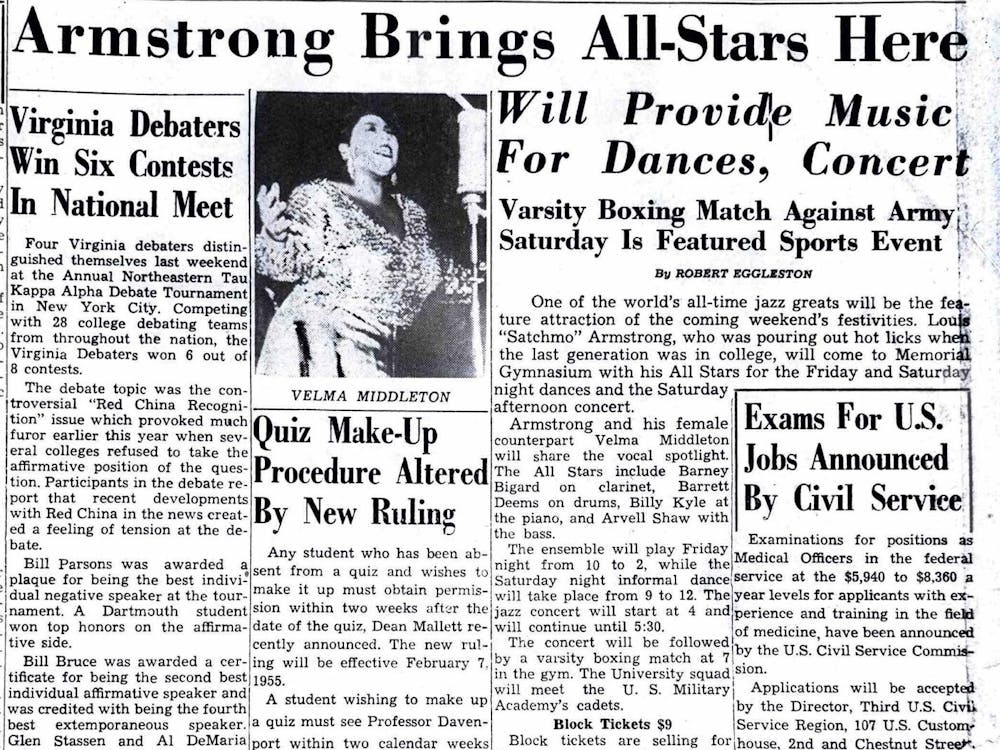
From the Archives: Continuing Black History Month
By CD Archive Staff | YesterdayOn Monday, March 25, 1963, Martin Luther King Jr. spoke at Old Cabell Hall, after a press conference earlier that day in the South Meeting Room of Newcomb Hall.

Student Health and Wellness reports 25 snow-related injuries during January’s storm
By Michael Racz | 2 days agoThe snowstorm also resulted in at least 25 student injuries — including sprains, abrasions and bruising — according to Student Health and Wellness.