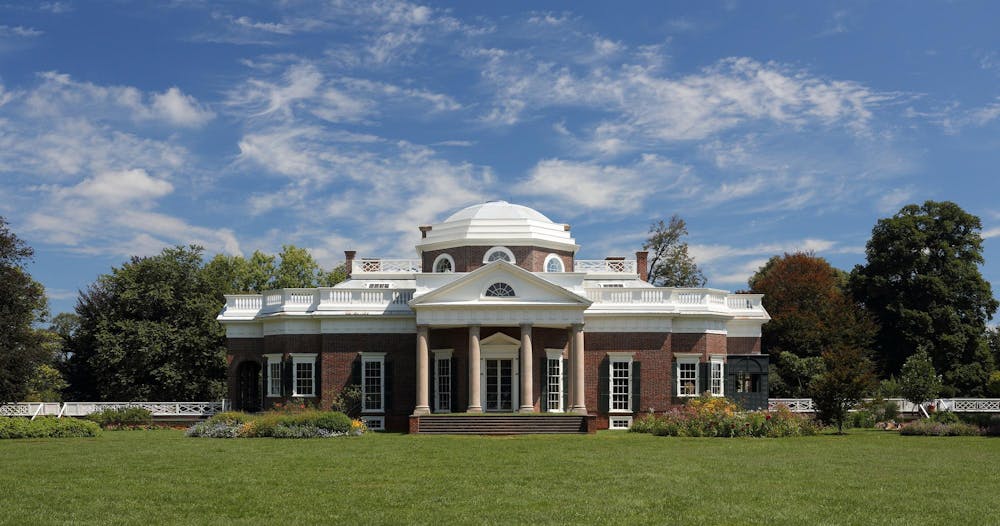
Thomas Jefferson’s Monticello commemorated Black History Month with a series of events centered around sharing the history of Monticello's enslaved community this February. Programming began with the Black Family History Symposium, followed by a conversation Feb. 10 with Christopher Brown, professor in the Department of History at Columbia University, and concluded with an Archaeology open house Saturday.
Monticello served as the primary residence and plantation of Thomas Jefferson, who enslaved more than 610 individuals throughout his lifetime — 400 lived at Monticello. Now, it is a National Historic Landmark and a UNESCO World Heritage Site, owned and operated by the Thomas Jefferson Foundation. Historically, the organization has highlighted Monticello’s troubling past through the lens of preservation and education.
In a statement to The Cavalier Daily, Andrew Davenport, vice president for research and Saunders director of the Robert H. Smith International Center for Jefferson studies at Monticello, described that the institution’s mission is multifaceted by nature. Especially during Black History Month, Monticello is committed to exploring local history in its entirety, according to Davenport.
“Jefferson’s life and legacies cannot be fully understood without understanding American chattel slavery, nor can it be understood without understanding the lives of the hundreds of enslaved individuals that lived and labored at Monticello,” Davenport wrote. “This means asking visitors to hold contradictory ideas in mind … that Jefferson was an important philosopher of liberty, a forceful, lifelong critic of the institution of slavery, and a lifelong slaveholder.”
The first event of the month was the third annual Black Family History Symposium, held Feb. 7 at the Jefferson School African American Heritage Center. The free, day-long gathering explored the theme "Refounding Legacies" as the nation approaches the 250th anniversary of its founding.
“This milestone [of the 250th anniversary] invites us to confront the gap between the nation's written history and lived reality,” Monticello’s website explains. “Black families have always … preserv[ed] accounts of kinship resilience, creativity and generational memory that challenge and enrich our national understanding.”
The symposium was led by the Getting Word African American History Department within Monticello. Several panelists highlighted the stories of African American families and communities through oral histories and personal archives. Attendees were also invited to participate in genealogy workshops, which explored the fundamentals of family history research.
In a statement to The Cavalier Daily, Auriana Woods, director of the Getting Word African American History Department at Monticello, explained that this approach to historical storytelling is a crucial part of understanding Black history at Monticello and in the United States.
“We cannot tell the stories of individuals without understanding them in the context of their families and communities, white and black, free and unfree,” Woods wrote. “[The stories tell] us something about how the institution relied upon the exploitation of families across generations, a central insight that could be missed if interpretation focused solely on individuals and not their family origins and units.”
Monticello hosted Dr. Brown Feb. 10. Brown is a historian of the British Empire, and he focuses specifically on the comparative history of slavery and abolition. His talk explored how revolutionary ideals coexisted with the institution of slavery in the American Revolution. Dr. Jane Kamensky, President and CEO of the Thomas Jefferson Foundation, moderated the conversation at the Howard and Abby Milstein Theater at Monticello.
The Black History Month Archaeology Open House rounded Monticello’s official programming for Black History Month. Featured displays, exhibits, activities and walking tours allowed visitors to explore the archaeological history of Monticello’s mountain. Archaeologists shared recent discoveries about the lives of enslaved people at Monticello and led walking tours to Site 30 — an archaeological site with rich insights into enslaved agriculture labor and precolonial Indigenous communities.
“What archaeologists now call Site 30 is a site on the mountaintop where enslaved people once lived,” Davenport wrote. “It is yet another reminder that the story of the past cannot be told by relying upon handwritten or printed documents alone.”
Throughout the year, Monticello offers tours focused on sharing the perspective of enslaved laborers at the plantation, including the "From Slavery to Freedom Tour" and the "Slavery at Monticello Guided Tour." The former is a two-and-a-half hour long, small-group tour focused on Monticello’s enslaved community and their enduring legacy. The latter is a walking tour focused on the experiences of enslaved laborers on the Monticello plantation, and it is included with admission.
Several exhibits are dedicated to preserving and retelling the stories of Monticello’s Black history. These include several sites along Mulberry Row, the Contemplative Site, a Burial Ground of Enslaved People and a model of the plantation. By guiding visitors through these spaces, Monticello aims to develop widespread understanding about the nation’s past.
“We hope that through learning about Monticello’s enslaved community and the central role of enslaved people at Monticello and across the new nation, visitors might begin to understand the American story as the story of the many, not the few,” Woods wrote. “We hope to impart the knowledge that we cannot tell the American story without telling the stories of people from backgrounds that are as varied as those of the American people today.”
Monticello offers year-round free admission to University students. For those unable to attend in-person events, Monticello's website offers a variety of online resources and exhibits focused on Black history at the plantation. More information about Monticello's Black History Month events and year-round programming can be found on their newly renovated website.
Read More

2-1 UBE decision upholds Student Council presidential election results
By Grace Little | 1 hours agoThe University Board of Elections voted in a 2-1 decision to uphold the Spring 2026 Student Council Presidential election results Wednesday, affirming third-year Commerce student Michael Mitchell as the winner of the presidential race.

Genny Freed elected new Honor Committee chair for the 185th term
By Michael Racz | YesterdayInternal elections to select the new chair and vice chairs took place during the Honor Committee’s annual Graves Mountain Lodge retreat March 27-29.
Class of 2026 announces Jim Ryan as keynote speaker for Valedictory Exercises
By Jaylynn Perez and Nina Broderick | 2 days agoRyan will deliver the commencement address at John Paul Jones Arena May 15 as part of Valedictory Exercises.